Training Your Dog to Follow a Scent Trail Through Water Sprinklers
Your dog can follow scent trails through sprinklers because water carries odor molecules without breaking them. Use oscillating or rotary sprinklers with 4–8 ft spray height and 15–20 psi to simulate light rain. Start training on dry ground with straight, short trails using aged scent articles. Gradually acclimate your dog to water using 90°–180° adjustable arcs and 5-minute spray intervals. Reward within 1.5–3 meters of the spray zone with high-value treats like freeze-dried liver. You’ll soon discover advanced techniques that build precision in wet conditions.
Notable Insights
- Begin training on dry ground to establish reliable scent detection before introducing water elements.
- Use oscillating or rotary sprinklers with adjustable arcs and 4–8 ft spray height for controlled exposure.
- Gradually acclimate your dog to sprinklers starting at low pressure and increasing proximity over time.
- Lay aged scent trails every 15 minutes, keeping them straight and free from contamination by nearby scents.
- Reinforce success with high-value treats delivered within seconds and within the spray zone.
How Dogs Smell Through Sprinklers
Scent is your dog’s primary tool for traversing the world, and it works even in challenging conditions like running water and mist. Canine olfaction relies on over 220 million scent receptors, enabling detection of odor molecules despite interference. Water from sprinklers affects scent diffusion, but does not eliminate it. Odors adhere to water droplets and ground moisture, creating a discontinuous yet traceable path. Your dog interprets these fragmented signals using airflow dynamics and residual chemical traces. Though mist disperses volatile compounds, scent particles bind to organic matter, preserving trail integrity. Canine noses detect concentrations as low as parts per trillion, making minor scent pockets sufficient for tracking. The vomeronasal organ enhances odor discrimination, even in wet environments. Scent diffusion patterns shift with water pressure and droplet size, but trained dogs adapt quickly. Understanding this guarantees effective training setups. You don’t need perfect conditions-just enough olfactory information for your dog to process and follow the trail accurately.
Pick the Right Sprinkler for Training
Start with a sprinkler that delivers consistent, adjustable coverage to control scent disruption during training. Choose oscillating or rotary sprinkler types for predictable water patterns, which help simulate real-world conditions without scattering scent trails excessively. Oscillating models offer rectangular coverage up to 30 feet wide by 50 feet long, with adjustable flow rates from 2 to 5 gallons per minute. Rotary sprinklers rotate 360 degrees and distribute water in a circular pattern, ideal for larger areas. Match the spray height-typically 4 to 8 feet-to avoid overspray that degrades scent particles. Use models with brass nozzles for durability and precise arc control. Consistent water patterns let you replicate training scenarios accurately. Avoid impact sprinklers; their irregular pulse disrupts odor continuity. Select a sprinkler with variable settings so you can gradually increase difficulty. This control guarantees your dog learns without confusion.
Start Scent Trails on Dry Ground First
Before introducing water elements, establish a reliable foundation by working your dog on dry, stable terrain where scent dispersion remains predictable. This dry foundation guarantees your dog masters scent introduction without environmental distractions. Begin with short trails, gradually increasing complexity. Use consistent markers and rewards to reinforce focus. Only after reliable performance should you integrate dynamic variables like moisture.
| Surface Type | Scent Retention (hrs) | Wind Drift Risk |
|---|---|---|
| Grass | 2.5 | Moderate |
| Dirt | 3.0 | Low |
| Gravel | 1.0 | High |
| Sand | 1.8 | Moderate |
| Pavement | 0.5 | High |
A controlled scent introduction on a dry foundation improves odor discrimination. Accurate tracking begins with predictable conditions, letting your dog learn the target scent profile efficiently. Maintain trail straightness within 10-degree variances for maximum learning. Use aged scent articles (24–48 hours) to simulate real-world scenarios.
Get Your Dog Comfortable With Spraying Water
Your dog now reliably follows scent trails on dry ground, demonstrating accurate odor discrimination under controlled conditions. Now, shift focus to water acclimation to prepare for trails crossing wet zones. Begin with low-pressure sprinklers emitting 15–20 psi, positioned at least six feet away. Gradually decrease distance over sessions, allowing incremental exposure. Use oscillating sprinklers with adjustable arcs (90° to 180°) to control spray spread. Fear reduction is critical; monitor body language for signs of stress-avoid pushing too fast. Let your dog approach the spray at their pace. Pair initial exposure with neutral activities like sniffing or sitting. Run the sprinkler for five-minute intervals, increasing duration as comfort grows. Consistency across ten to fifteen sessions guarantees reliable acclimation. Water should fall softly, mimicking light rain, not a forceful stream. This simulates real-world tracking conditions without overwhelming the dog.
Use High-Value Rewards Near Sprinklers
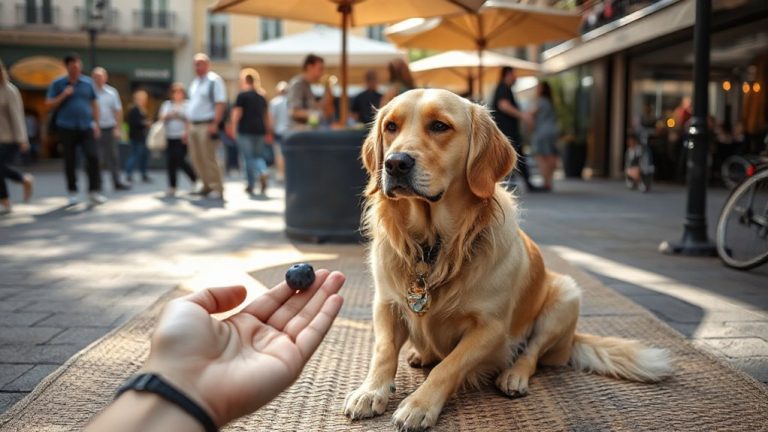
You’ll need to reinforce positive associations with the sprinkler zone using rewards the dog finds irresistible. High-value treats, such as freeze-dried liver or cheese cubes (≈1–2 cm³), markedly increase treat motivation. Deliver rewards within 1–2 seconds of desired behavior to guarantee precise reward timing, strengthening the dog-sprinkler-reward connection. Use a clicker or verbal marker (“yes”) to bridge the moment of correct behavior and treat delivery. Administer treats only near active sprinklers (water spray radius: 1.5–3 meters) to condition proximity. Rotate treats every 5–10 trials to prevent satiation and maintain engagement. Caloric intake should remain below 10% of daily needs to avoid weight gain. Consistent, high-value reinforcement during early training builds reliable performance. Treat size and delivery speed directly influence response accuracy-small, soft treats are ingested quickly, minimizing distraction. Best training treats for pets are especially effective for sustaining motivation during challenging exercises like scent work near distractions. This method establishes strong operant conditioning through precise stimulus-reward pairings.
Train Focus Despite Sprinkler Spray
How do you maintain your dog’s attention when water sprays unpredictably from all directions? You condition focus through gradual water exposure and structured reinforcement. Start with sprinklers set to low output (0.5 gallons per minute) and a fixed spray pattern. Work at a 10-foot distance, decreasing incrementally as your dog remains attentive. Use a verbal cue like “focus” paired with a high-value reward when eye contact is maintained. The goal is to reduce reaction to sensory distraction by predictable reinforcement. Increase spray intensity only when your dog consistently performs under current conditions. Monitor body language-tension or avoidance indicates overload. Proper acclimation builds mental resilience. Each session should last no more than 8 minutes to prevent fatigue. Repeat training 3–4 times weekly. Consistent repetition under controlled variables conditions reliable focus, even amid dynamic water exposure.
Level Up: Harder Scent Trails With Water
Once the dog consistently maintains focus amid active sprinklers, it’s time to integrate scent discrimination into the dynamic environment. Increase trail complexity by weaving bends, false starts, and longer distances-up to 50 feet-across wet terrain. This tests water resistance in scent particles and challenges olfactory precision. Use essential oils like anise or birch to lay distinct trails, spacing them three feet apart to prevent cross-contamination.
| Trail Length | Recommended Turns |
|---|---|
| 20 ft | 1 |
| 30 ft | 2 |
| 40 ft | 3 |
| 50 ft | 4 |
| 60 ft | 5 |
Each turn increases cognitive load and enhances problem-solving. Scent dilution rises with water exposure; hence, re-lay trails every 15 minutes for consistency. You’re building resilience and focus under realistic field conditions. Maintain clear markers and consistent wind direction for accurate training replication.
On a final note
You now understand the fundamentals of scent training through sprinklers. A properly calibrated sprinkler emits a 20–30 psi spray over a 5–8 foot arc, dispersing water without overwhelming canine olfactory detection. Dogs detect scent particles even in light mist by using laminar airflow tracking. Consistent reinforcement with high-value rewards increases focus. Proper conditioning guarantees performance in real-world tracking scenarios involving environmental interference.