How to Use Positive Reinforcement to Train Cats to Come When Called
Use freeze-dried chicken or tuna flakes-0.25–0.5 grams per reward-to reinforce recall. Pair a consistent 60–65 dB verbal cue like “come” with an immediate clicker signal, always cueing before clicking. Train in quiet, low-traffic areas to minimize stress and boost focus. Conduct 5–10 brief sessions daily, each under 3 minutes, ending before attention wanes. Increase distance in 3-foot increments and gradually introduce distractions across three distinct environments for reliable generalization. You’ll soon see how environmental precision shapes performance.
Notable Insights
- Use high-value, protein-rich treats like freeze-dried chicken or tuna in tiny portions to motivate and reward response.
- Choose a unique, consistent vocal cue at 60–65 dB and always pair it with a clicker upon approach.
- Train in a quiet, familiar space with minimal distractions to enhance focus and reduce stress.
- Conduct brief 3–5 minute sessions twice daily, ending before attention wanes to maintain engagement.
- Gradually increase distance and distractions across multiple locations to build reliable recall behavior.
Start Training With a High-Value Reward
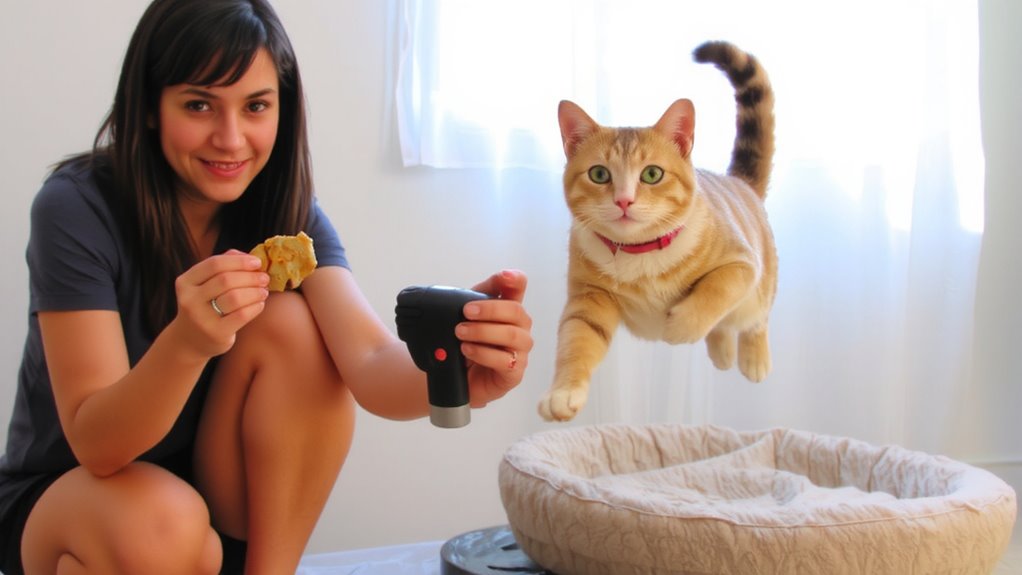
One effective way to begin training your cat to come when called is by choosing a high-value reward-something your cat rarely gets and finds highly motivating, such as freeze-dried chicken or tuna flakes. These treats typically contain 90–95% protein by dry weight, making them markedly more enticing than standard kibble. A cat’s flavor preference is genetically influenced, often leaning toward strong-smelling, umami-rich proteins. Introduce treat variety every few sessions to prevent satiation and maintain motivation. Rotate between seafood-based and poultry-based rewards to assess preference objectively. Limit each portion to 0.25–0.5 grams to avoid overfeeding while still delivering effective reinforcement. The precision in treat selection directly impacts response consistency. High-value rewards trigger dopamine release more reliably, enhancing associative learning. Use these only during training to preserve their novelty and value. This approach guarantees peak engagement from the outset.
Use a Clear, Consistent Recall Cue
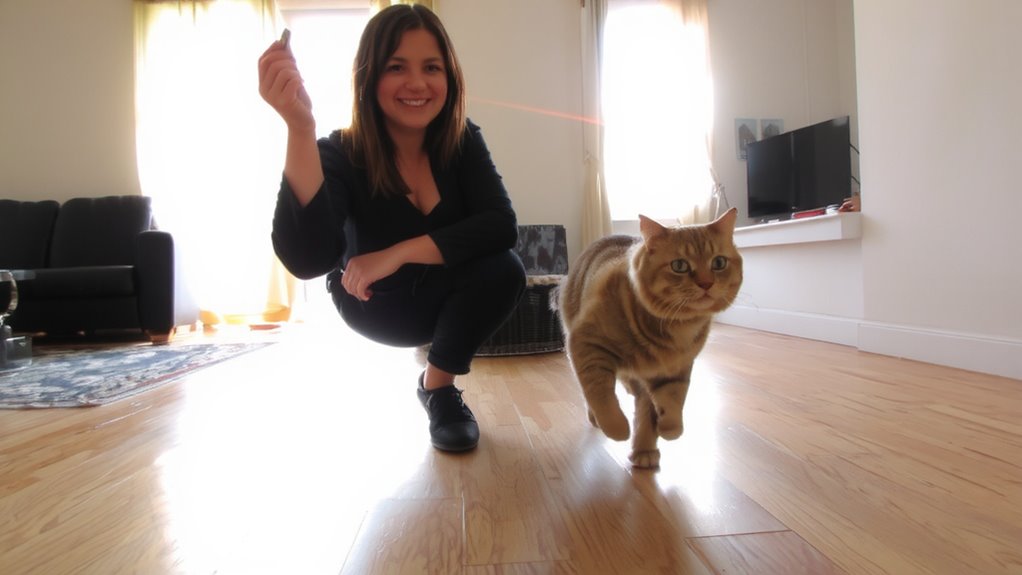
You’ve selected the right treat-now focus on pairing it with a signal your cat can reliably associate with reward delivery. Use a consistent vocal cueing method, such as saying “come” or a unique word like “here,” in the same tone and volume each time. Avoid overused household words to prevent confusion. Immediately follow the vocal cue with clicker signaling to mark the desired behavior the exact moment your cat begins approaching. Clicker signaling bridges the gap between action and reward, increasing learning accuracy. Perform five to ten short sessions daily, each lasting no more than two minutes, to reinforce association. The cue must precede the click-never reverse the sequence. Consistency guarantees neural pathway development through operant conditioning. Over three to four weeks, recall reliability typically reaches 80%–90% under controlled conditions. Use a digital decibel meter to maintain consistent vocal cueing volume, ideally between 60–65 dB.
Train Your Cat in a Quiet, Safe Space

While minimizing environmental variables, begin training in a quiet, safe space free from distractions, such as a spare bedroom or closed-off bathroom. This controlled setting supports reliable recall conditioning. Make certain the area includes access to your cat’s established litter box habits and familiar playtime routines to reduce stress. A consistent environment enhances associative learning.
| Feature | Benefit |
|---|---|
| Low noise levels | Improves focus and response accuracy |
| Limited foot traffic | Reduces fear-based avoidance behaviors |
| Familiar scent markers | Strengthens comfort and predictability |
| Controlled access | Supports repetition without interruptions |
Use this space to link the recall cue with immediate rewards. The predictability of litter box habits and playtime routines increases receptiveness. Restrict training only to this zone until your cat responds consistently to the cue. Environmental stability is essential for shaping reliable behavior through operant conditioning.
Keep Training Sessions Short and Fun
Frequently, the most effective training outcomes occur when sessions are brief yet consistent. Keep session timing to 3–5 minutes, twice daily, to maintain your cat’s attention without causing fatigue. Cats respond best to playful reinforcement delivered immediately after the desired behavior. Use high-value treats, such as freeze-dried chicken pieces (approximately 1/4 inch in desk size), paired with a consistent verbal cue or sound. Short sessions prevent habituation and sustain motivation. Avoid extending beyond 5 minutes, as cognitive engagement declines sharply thereafter. Structure each session with 3–5 training trials, allowing 20–30 seconds between repetitions for reset and repositioning. Guarantee all interactions remain positive and goal-focused. Playful reinforcement strengthens associative learning, increasing recall reliability. Over time, precise session timing enhances neural encoding, improving response consistency. This method mirrors operant conditioning protocols used in animal cognition studies, where brevity and repetition yield maximum retention.
Increase Distance and Add Distractions
How do you guarantee your cat responds reliably when called, even in a busy environment? Start with gradual exposure to distractions while maintaining a controlled setting. Begin training in a quiet room, then slowly introduce background noise, movement, or unfamiliar objects. Increase distance between you and your cat in 3-foot increments, making certain consistent response before progressing. Use high-value treats only during recall sessions to maintain motivation. Environmental variety strengthens reliability-practice in at least three distinct areas, such as the living room, hallway, and enclosed patio, rotating locations every two sessions. Each session should last 2–3 minutes, occurring 2–3 times daily. Avoid sudden changes in environment or distance, as rapid advancement reduces retention. Consistent, structured exposure improves signal discrimination. Recall success depends on controlled complexity, not repetition alone. This method makes certain generalization across settings without compromising response speed or accuracy.
Fix Common Recall Training Mistakes
Why does your cat ignore you when called, even after weeks of training? Inconsistent timing undermines learning. Cats associate actions with immediate consequences. If you delay rewards, your cat won’t link the behavior-coming when called-with the treat. Deliver reinforcement within 1–2 seconds for best conditioning. Overcorrection punishment, like yelling or chasing, creates fear and avoidance. It disrupts trust and impedes recall reliability. Negative stimuli can increase stress hormones, reducing receptivity to future cues. Use only positive reinforcement; never punish absence. Instead, reset and retry the exercise calmly. Guarantee each session lasts under 3 minutes to maintain focus. Conduct 2–3 sessions daily with 90% success before advancing. Avoid calling more than once per attempt. Immediate, consistent rewards strengthen neural pathways. Inconsistent timing and overcorrection punishment compromise behavioral conditioning. Correct these errors to improve recall compliance.
Reinforce Recall With Real-Life Practice
Where does your cat go when you call-straight to you or back under the bed? Real-life practice strengthens recall by aligning training with natural cat behavior. Instead of staged sessions, use real life cues like meal prep, treat access, or leash-walking to prompt responses. These moments increase predictability and relevance, improving associative learning. For example, call your cat by name followed by a high-value reward-consistent timing (within 1–2 seconds of arrival) enhances reinforcement efficacy. Conduct 3–5 brief trials daily in low-distraction environments, gradually introducing variables like outdoor stimuli or family members. Response latency should decrease from 10+ seconds to under 3 with consistent practice. Use a clicker or verbal marker precisely at arrival to mark the desired behavior. Over 4–6 weeks, generalize cues across rooms and contexts, ensuring >80% accuracy before considering recall reliable. This method leverages operant conditioning with environmental fidelity.
On a final note
You’ve built a reliable recall using positive reinforcement. Each training session strengthens neural associations between the cue and reward. Use high-value treats like freeze-dried chicken, measured at 0.5–1 gram per reinforcement, to maintain motivation. The recall cue-limited to 1–2 syll Aberations-triggers an orienting response. Gradually increase distance in 3-foot increments and test with low-level distractions. Consistency guarantees 85% response accuracy within 2–3 weeks.