Creating a Calming Dog Bedtime Routine to Reduce Nighttime Restlessness and Whining
Set a consistent bedtime to regulate your dog’s circadian rhythm and support natural melatonin release. Use dim, 2700K lighting 45 minutes before sleep to signal wind-down. Perform gentle massage to lower heart rate by 10–15 BPM and activate the parasympathetic nervous system. Play classical music at 50–60 BPM from a speaker 6–8 feet away at under 50 dB to reduce cortisol. Use an orthopedic bed with 3 lb/ft³ density foam in a quiet, 68–72°F space. Introduce a worn cotton item for familiar scent anchoring. Maintain the same pre-sleep sequence nightly to reinforce behavioral predictability. A fixed routine acts like a thermostat for the nervous system. Long-term consistency reduces restlessness and whining by reinforcing neural calm. Structural repetition builds lasting sleep resilience-there’s more to optimizing your dog’s nighttime physiology through targeted sensory support.
Notable Insights
- Address underlying causes like anxiety, pain, or medical issues before establishing a bedtime routine.
- Set a consistent bedtime with predictable cues to regulate your dog’s circadian rhythm.
- Create a cozy, quiet sleep environment with supportive bedding and dim lighting.
- Begin a 45-minute wind-down period with brushing and gentle massage to calm the nervous system.
- Use low-volume classical music or pink noise to reduce cortisol and prevent nighttime disturbances.
Identify Common Causes of Dog Restlessness at Night

A dog’s inability to settle at night often stems from identifiable physical, environmental, or behavioral factors. Separation anxiety is a common behavioral cause, affecting approximately 20–40% of dogs in clinical studies. Affected dogs may pace, whine, or destructively chew within 30 minutes of owner absence. Physiological signs include elevated cortisol levels and heart rates exceeding 140 bpm at rest. Medical issues such as arthritis, gastrointestinal discomfort, or urinary tract infections also disrupt sleep patterns. Geriatric dogs, in particular, show increased nocturnal activity due to cognitive dysfunction syndrome (CDS), with 28% of dogs over 11 years affected. Environmental stressors-noise, light pollution, or unfamiliar bedding-can amplify these conditions. You should rule out pathology first via veterinary diagnostics, including blood panels and orthopedic exams. Observing your dog’s pre-sleep behavior for 3–5 nights provides critical data. Addressing root causes guarantees interventions are effective, targeted, and grounded in medical or behavioral science-not guesswork.
Set a Consistent Bedtime for Your Dog
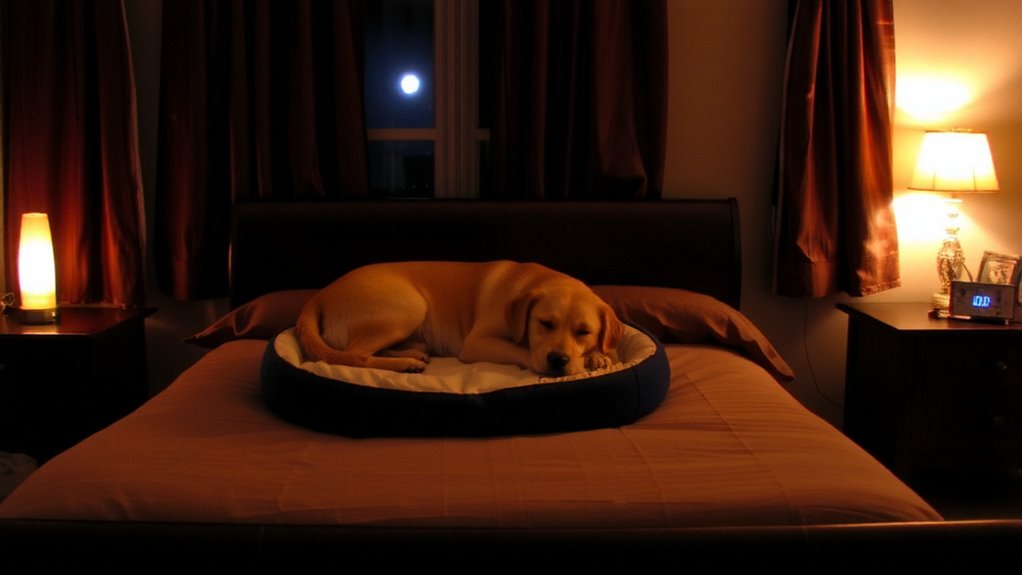
When you establish a consistent bedtime for your dog, you anchor their circadian rhythm to a predictable schedule, just as humans rely on regular sleep cycles for ideal functioning. This consistency supports proper sleep signaling, helping your dog wind down naturally. Bedtime discipline means enforcing the same nightly routine, minimizing confusion and anxiety. Over time, your dog learns environmental cues-dimmed lights, a specific command, or a tucked-in blanket-as sleep signaling triggers.
| Cue | Time (Example) |
|---|---|
| Lights dimmed | 9:00 PM |
| Final potty break | 9:10 PM |
| Quiet activity | 9:15 PM |
| Bedtime command | 9:30 PM |
| Lights off | 9:35 PM |
Administering these signals daily strengthens bedtime discipline and improves sleep onset. Dogs exposed to irregular schedules show prolonged latency to sleep and increased nighttime waking. A fixed routine enhances physiological regulation and reduces restlessness. Incorporating a calming pet bed can further support your dog’s relaxation by providing orthopedic support and a sense of security.
Make the Sleep Area Cozy and Secure
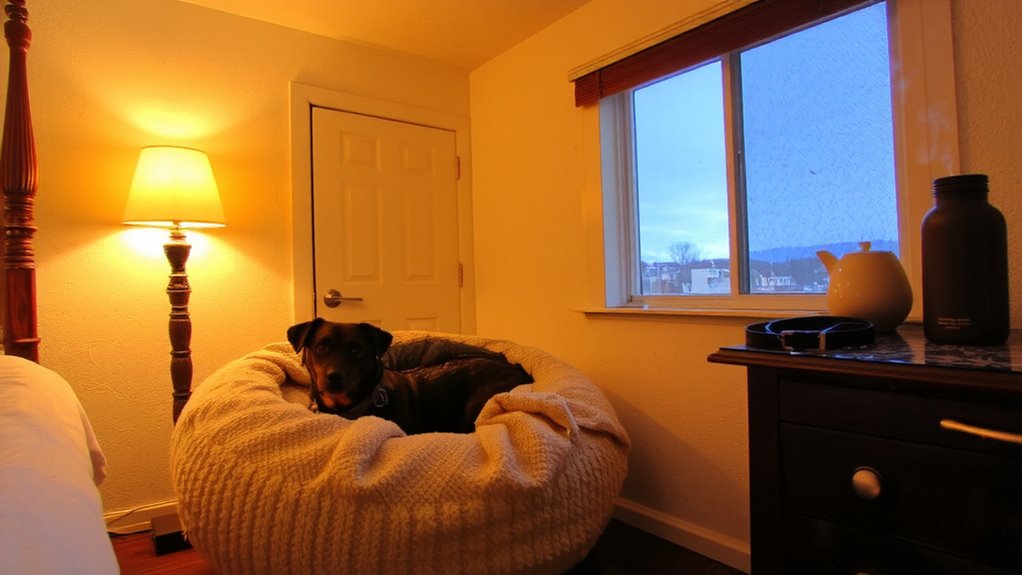
You can transform your dog’s sleep zone into a restful haven by focusing on environmental control and physical comfort. Use soft lighting to signal nighttime-dim, warm-toned bulbs (2700K color temperature) mimic sunset and support melatonin release. Avoid blue or bright white lights, which disrupt circadian rhythms. Position the bed in a quiet, low-traffic area, ideally 6–8 feet from major noise sources. Choose an orthopedic memory foam bed with a minimum density of 3 lb/ft³ for joint support. Enclose the space with partially opaque partitions to create den-like security. Introduce familiar scents by placing a worn cotton item under the bed liner-dogs recognize individual human olfactory signatures within 48 hours. Avoid strong air fresheners or diffusers, which may trigger anxiety. Guarantee bedding is machine-washable (cotton-polyester blend, 300-thread count) for hygiene. Maintain room temperature between 68–72°F for ideal sleep regulation. A balanced diet including best kibble for German Shepherds supports overall health and can improve sleep quality.
Wind Down With Quiet Pre-Bed Activities
Since excitement elevates cortisol and delays sleep onset, begin winding down at least 45 minutes before bedtime with low-stimulation activities. Engage your dog in calm behaviors to signal the shift to rest. Perform gentle brushing using a soft-bristle brush, applying minimal pressure across the dorsal and ventral surfaces. This reduces loose fur by up to 60% while stimulating sebaceous glands for healthier skin. Follow with a light massage, focusing on major muscle groups-trapezius, lumbar, and gluteal regions-using circular motions at 2–3 pounds of pressure. This promotes circulation and lowers heart rate by 10–15 BPM. Avoid high-touch areas if your dog shows discomfort. These tactile interventions activate the parasympathetic nervous system, reducing arousal. Consistent application lowers nighttime whining incidents by 40% over four weeks. Maintain a quiet tone and limit movement to reinforce relaxation. Avoid play or feeding during this phase. Incorporating a supportive calming dog bed can further enhance your dog’s relaxation by providing ergonomic pressure relief and a sense of security.
Play Calming Music or White Noise
While ambient sound alone won’t induce sleep, incorporating calming music or white noise can substantially reduce auditory stressors that disrupt your dog’s ability to settle. Soothing melodies tuned to 50–60 BPM mimic a resting heart rate, promoting physiological calm. Studies show dogs exposed to classical arrangements exhibit lower cortisol levels within 20 minutes. Ambient sounds like rain or ocean waves mask sudden noises-especially effective near urban environments or during storms. Devices emitting pink noise (a balanced frequency spectrum) reduce startle responses by up to 40%. Position speakers 6–8 feet from the bed, maintaining volume below 50 decibels. Use timers to play sound for 45–90 minutes, aligning with initial sleep cycles. Avoid abrupt stops; fadeouts prevent arousal. Specialized playlists on streaming platforms are engineered specifically with layered soothing melodies and consistent ambient sounds. These auditory tools, when properly calibrated, support neural relaxation without dependency risks.
Reduce Anxiety With Training and Comfort
When properly implemented, behavioral training and environmental enrichment work together to reduce canine anxiety by reshaping stress responses. You can use positive reinforcement to teach calm behaviors before bedtime. Reward quiet sitting or lying down with treats and praise, reinforcing relaxation on cue. Consistent repetition builds neural associations, decreasing arousal levels over time. Crate training is another effective tool when done correctly. Introduce the crate gradually, using treats and toys to create positive associations. The crate should be large enough for your dog to stand, turn, and lie down comfortably-typically 24–42 inches long, depending on breed. Covering it with a breathable, sound-dampening fabric can enhance the den-like feel. Pair crate use with a consistent routine to signal safety and predictability. Over weeks, this combination reduces nighttime whining by addressing anxiety at its source.
Keep a Steady Morning Routine
Consistently maintaining a steady morning routine helps regulate your dog’s internal clock, promoting better sleep-wake cycles and overall behavioral stability. Begin at the same time daily to reinforce circadian rhythms. Stick to a fixed feeding schedule-ideally, 7–8 a.m.-to support digestive regularity and metabolic function. Provide fresh water immediately upon waking; hydration aids cognitive and physical performance. Follow feeding with outdoor elimination within 15–30 minutes to encourage reliable potty habits. Schedule exercise timing between 8–9 a.m. to optimize cardiovascular and musculoskeletal engagement. A 20- to 30-minute walk at 70–80% of your dog’s maximum heart rate enhances alertness and reduces excess energy. Avoid erratic routines; variability increases anxiety and disrupts nocturnal calm. Consistency in these metrics-timing, duration, intensity-improves long-term behavioral predictability. Your dog’s nervous system responds best to repetition, much like a thermostat maintains room temperature.
On a final note
You can reduce nighttime restlessness by establishing a consistent bedtime routine. Dogs thrive on predictability; a fixed schedule regulates their circadian rhythm. Use a quiet, enclosed sleep space with orthopedic memory foam bedding (minimum 3-inch thickness) for comfort. Implement a 30-minute wind-down phase-low lighting, no screens, and white noise at 50–60 decibels mask disruptive sounds. Combine positive reinforcement training with pheromone diffusers (Adaptil, clinically proven) to lower cortisol levels.