Building a Weekly Novelty Introduction Plan for Indoor-Only Cats
You should rotate novel stimuli weekly to maintain engagement in your indoor cat. Offer 1–2 grams of FIFE-certified catnip every Tuesday and Friday in a 3-inch refillable plush toy; 70–80% of cats respond olfactorily for 5–15 minutes. Use puzzle feeders like the Kong Active Treat Ball (6.5 cm) or Outward Hound Nina Ottosson (levels 1–3) on Mondays and Thursdays for 10–20-minute sessions. Introduce new scents-cedar blocks, diluted lavender on cotton balls-every Wednesday, placed 30–50 cm from rest zones. Play ambient sounds at 45–55 dB daily to mimic prey. Rotate 3–5 toys weekly, selecting non-toxic, chew-resistant items like food-grade silicone or sisal; store unused ones in airtight containers to preserve sensory properties. Adjust the plan using observed behavioral responses to optimize long-term enrichment effectiveness-there’s a precise system that guarantees sustained mental stimulation.
Notable Insights
- Schedule catnip sessions on Tuesdays and Fridays using 1–2 grams of FIFE-certified catnip in refillable toys for 5–15 minutes.
- Rotate puzzle feeders weekly on Mondays and Thursdays, selecting models with adjustable difficulty to maintain engagement.
- Introduce new scented items weekly, such as cedar blocks or diluted lavender, placed 30–50 cm from resting areas.
- Use timed auditory and visual stimuli on Wednesdays, playing prey-like movements and ambient sounds at 45–55 dB.
- Implement treat trails and food puzzles 2–3 times weekly to extend foraging behavior and reduce begging.
Create a Weekly Novelty Schedule for Your Cat
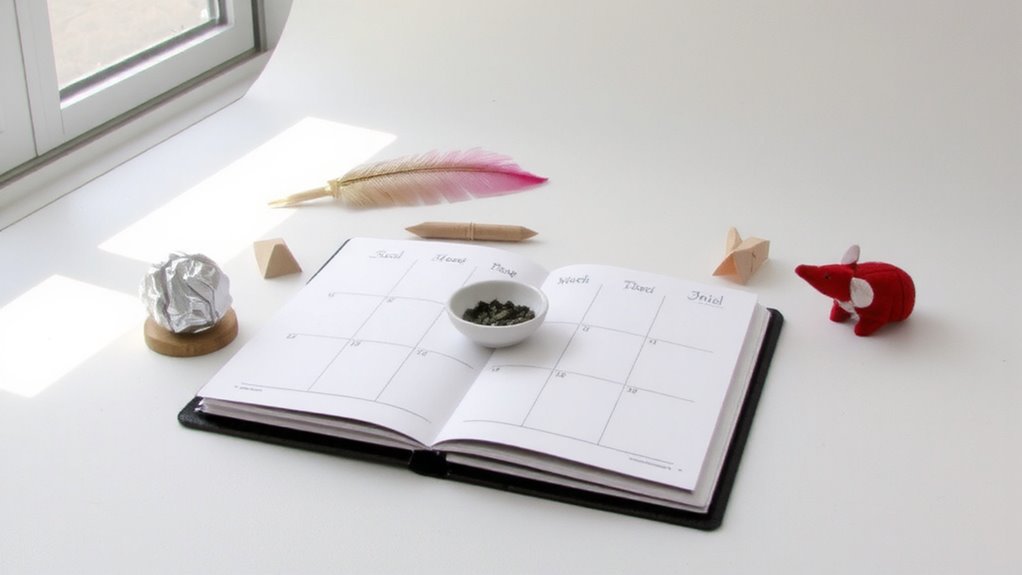
While maintaining consistency is essential for your cat’s sense of security, introducing structured novelty prevents habituation and supports cognitive engagement. Establish a weekly novelty schedule to balance predictability with enrichment. Schedule catnip exploration every Tuesday and Friday, using 1–2 grams of dried Nepeta cataria in a refillable toy (e.g., 3-inch plush insert). This triggers olfactory stimulation in 70–80% of cats for 5–15 minutes. Rotate puzzle feeders every Monday and Thursday to sustain interest. Use models like the Kong Active Treat Ball (diameter: 6.5 cm) or Outward Hound Nina Ottosson series (difficulty levels 1–3). These require 5–20 minutes of manipulation, dispense 10–15 kibble portions, and improve motor-cognitive coordination. Each activity should last 10–20 minutes. Log responses to track engagement. Consistent timing and measurable interaction duration guarantee ideal mental stimulation without overwhelming your cat’s routine. For added variety, consider incorporating a best pet entertainment systems unit on Wednesdays to provide auditory and visual stimuli that mimic prey movement.
Pick Safe and Fun Items to Introduce Weekly
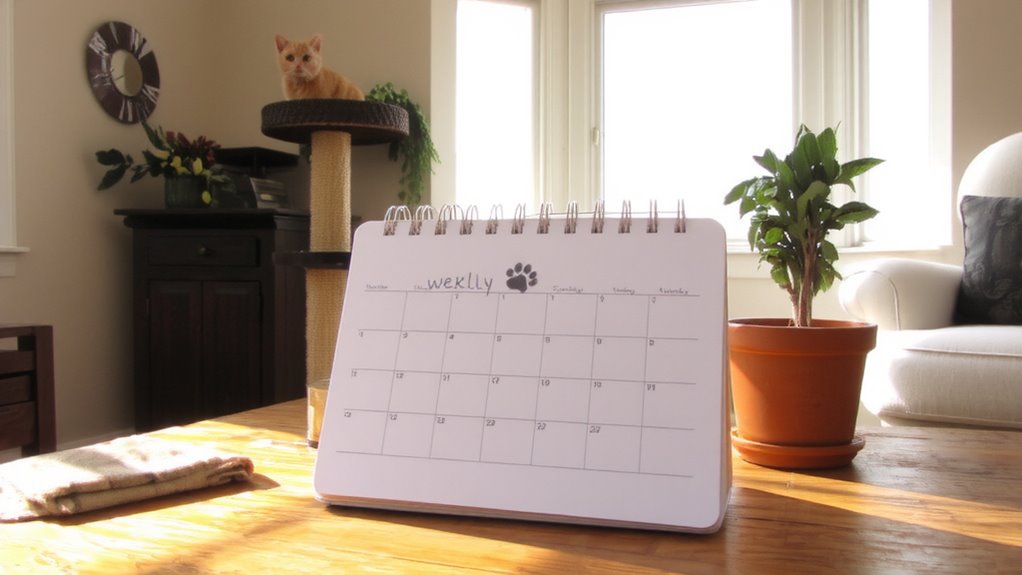
Enrich!=’ begins with selecting safe, stimulating objects that align with your cat’s natural behaviors. Choose non-toxic, chew-resistant materials like food-grade silicone or untreated sisal. Introduce puzzle feeders with adjustable difficulty-models with sliding panels or rotating compartments extend engagement time by 40%. Use only FIFE-certified catnip in controlled doses; fresh batches trigger response rates of 70% in genetically receptive cats. Conduct catnip experiments biweekly using pouches sealed in breathable cotton to prevent overexposure. Avoid small, detachable parts; items should exceed 2 inches in diameter to reduce ingestion risk. Rotate items every seven days to maintain novelty. Opt for feeders weighing 6–8 oz for stability during use. Guarantee textures provide tactile feedback without abrasiveness. Monitor interaction duration: sessions exceeding 15 minutes indicate high efficacy. Replace worn items monthly to maintain safety and function.
Add New Smells, Sounds, and Textures Every Week
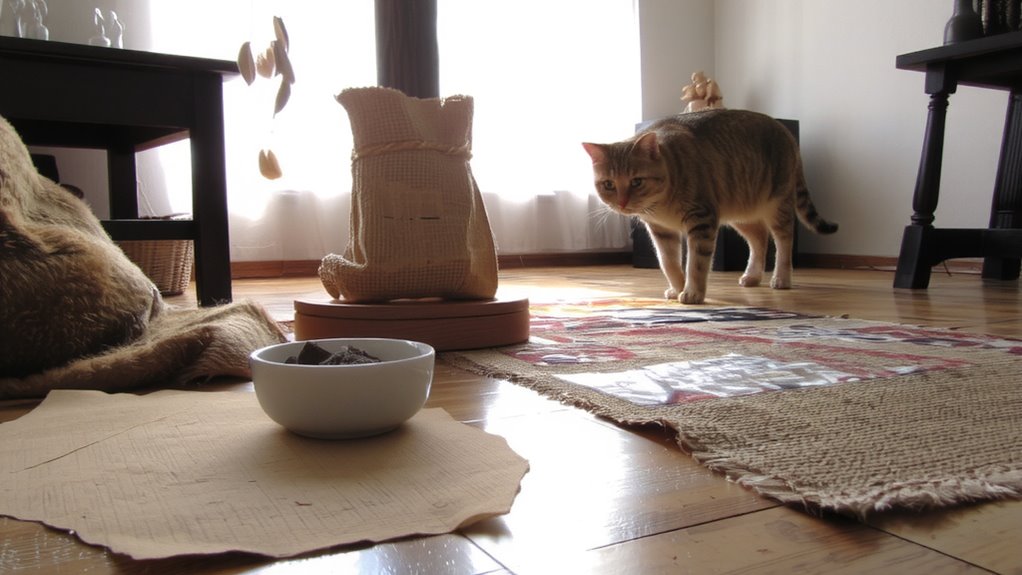
Since cats rely heavily on sensory input to interpret their environment, introducing new smells, sounds, and textures weekly sharpens their cognitive engagement. Use scented objects like untreated cedar blocks (2–3 cm wide), lavender sachets, or cotton balls with diluted essential oils (0.5% concentration max) placed 30–50 cm from resting areas. Rotate two to three scents weekly to prevent habituation. Play ambient noises at 45–55 dB, such as bird calls, rain, or household sounds, via a scheduled audio device for 15–20 minutes daily. Avoid sudden volume changes exceeding 10 dB. Introduce textured mats with varied surfaces-rubber nubs, soft fleece, crinkly film-measuring 20 x 30 cm. Place them near feeding or resting zones. These sensory inputs stimulate neural pathways linked to environmental mapping and threat assessment. Consistent weekly rotation maintains sensory responsiveness without triggering stress-based reflexes.
Rotate Toys and Play Areas Without Overload
When you rotate toys and play areas regularly, you prevent sensory saturation and maintain your cat’s investigative drive. Implement a structured play rotation every 5 to 7 days to preserve novelty. Limit available toys to 3–5 items at a time across different modalities: motorized, puzzle, and tactile. Store unused toys in opaque, airtight containers to preserve scent and texture integrity. Introduce new sets systematically, guaranteeing each offers distinct toy variety in material (e.g., plush, crinkle, rubber), movement (linear, erratic, suspended), and interaction type (solitary, chase, pounce). Avoid spatial overcrowding by designating one primary play zone per rotation cycle-each measuring 2′ x 3′ minimum. Use modular furniture (e.g., 12” LED tunnels, 9” sisal poles) for easy reconfiguration. Monitor engagement duration; sessions exceeding 15 minutes indicate sustained interest. Replace underperforming toys-those ignored past 48 hours. This method guarantees cognitive stimulation without overstimulation. For optimal results, consider including top-rated options such as expert-recommended toys that combine durability and engagement.
Turn Mealtime Into a Weekly Hunting Game
Why should mealtime be any less stimulating than playtime? Turn feeding into a hunting simulation using food puzzles and treat trails. Food puzzles require problem-solving to access kibble, mimicking prey capture. Models like the Outward Hound SlimCat dispense 10–15% of daily calories per session, promoting prolonged engagement. Treat trails-sequences of hidden morsels-trigger scent tracking, activating natural foraging instincts. Place 5–7 treats along a 3-meter path, using vertical and horizontal surfaces. This increases activity duration by 40% versus bowl feeding. Rotate puzzle types weekly: stationary, rolling, and sliding-lid variants. Each should have adjustable difficulty-differing hole sizes (1–2 cm diameter)-to match skill level. Use trails 2–3 times weekly, varying locations to prevent habituation. These methods reduce begging by 60% and improve satiety signaling. Guarantee puzzles clean easily; dishwasher-safe components maintain hygiene. Mealtime becomes cognitive enrichment, not just consumption. For optimal results, consider incorporating top-rated options from the best pet food dispensing toys list when selecting puzzle feeders.
Involve Window Views and Climbing Surprises
How often do you see your cat fixate on the window, tail twitching, eyes locked on distant birds? You can harness that natural predatory focus by installing window perches. These mounts attach securely with industrial-strength suction cups or brackets, supporting up to 30 lbs, ideal for cats 8–15 lbs. Position them at 36–42 inches high for ideal viewing. Pair them with climbing shelves, made from durable plywood or engineered wood, affixed every 12–18 inches vertically. Shelves should be 12×16 inches minimum, with non-slip surfaces. This vertical pathway mimics arboreal movement, satisfying instinctual climbing needs. Use low-profile fasteners to prevent snagging. Together, window perches and climbing shelves create a structured observation deck. They promote muscle engagement, spatial awareness, and mental stimulation. Install in sunlight-rich zones to encourage extended use. The system functions like a feline jungle gym-predictable in layout, rich in sensory input, and engineered for daily enrichment without clutter.
Watch Reactions and Adjust the Weekly Plan
What if your cat’s behavior could guide the perfect enrichment schedule? Observing your cat’s responses is essential for effective behavior tracking. Note the duration, intensity, and frequency of interactions with each novelty item-such as perch height preference or toy material engagement-within a 15-minute observation window. Use a standardized log to record data daily. Apply preference mapping to identify patterns, highlighting high-value stimuli. For example, if your cat spends over 70% of monitored time near window perches, prioritize vertical space adjustments. Rotate stimuli weekly, but delay changes if engagement exceeds 20 minutes per day. Adjust timing, placement, and texture based on documented responses. Replace underused items (less than 5 minutes daily interaction) after two weeks. Maintaining this systematic approach guarantees novel stimuli remain effective. Precision in observation and data use leads to sustained mental stimulation and improved welfare outcomes.
On a final note
You maintain control over your cat’s environment. Introducing novelty weekly prevents habituation, which scientific studies link to improved feline cognitive health. Rotate stimuli every seven days using non-toxic materials under 500 grams. Monitor pupil dilation and ear orientation to assess engagement. Use timers for sound elements-limit to 15-minute intervals at 40–60 dB. Adjust based on behavioral feedback. This structured enrichment plan supports lifelong neurological wellness in indoor cats.