Training Your Cat to Tolerate Car Rides Using Gradual Desensitization Techniques
Start with a hard-sided carrier no more than 1.5 times your cat’s length and height to limit dangerous movement during sudden stops. Place it on a non-slip mat behind the front passenger seat, secured with a seatbelt. Add familiar bedding and treats to build positive associations. Begin acclimation with 5–10 minute sessions in a parked car, gradually introducing engine sounds. Monitor for stress like lip licking or rapid breathing. Progress only when calm behavior is consistent.
Notable Insights
- Choose a hard-sided carrier that fits your cat snugly, allowing standing, turning, and lying down without excess space.
- Secure the carrier behind the front passenger seat using a seatbelt to prevent movement during transit.
- Condition your cat to view the carrier positively by keeping it accessible and adding familiar-scented bedding.
- Conduct daily 5–10 minute sessions in the parked car, gradually introducing engine sounds and rewards for calm behavior.
- Monitor for stress signs like panting or dilated pupils, and progress only when your cat shows consistent comfort.
Choose a Comfortable, Secure Carrier
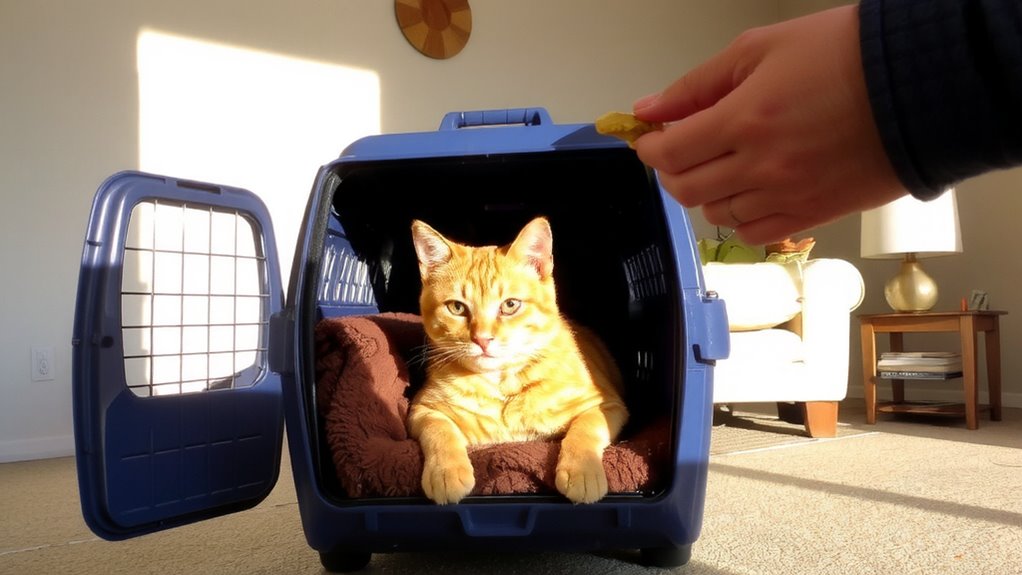
Safety starts with the right carrier. Choose one that guarantees both security and comfort. Carrier size matters: your cat should stand, turn, and lie down comfortably, but not have excessive space that increases injury risk during sudden stops. The ideal carrier measures no more than 1.5 times your cat’s length and height. Hard-sided carriers with reinforced interiors offer superior crash protection compared to soft-sided models. Carrier placement is critical: secure it on the floor behind the front passenger seat, where airbag deployment won’t threaten your cat. Use a seatbelt through the carrier’s handle or tether point to prevent sliding. Avoid placing it in the trunk or on a seat unsecured. Proper carrier placement reduces motion exposure and maintains stability. Together, correct carrier size and carrier placement form the foundation of safe travel mechanics.
Turn the Carrier Into a Cozy, Rewarding Spot
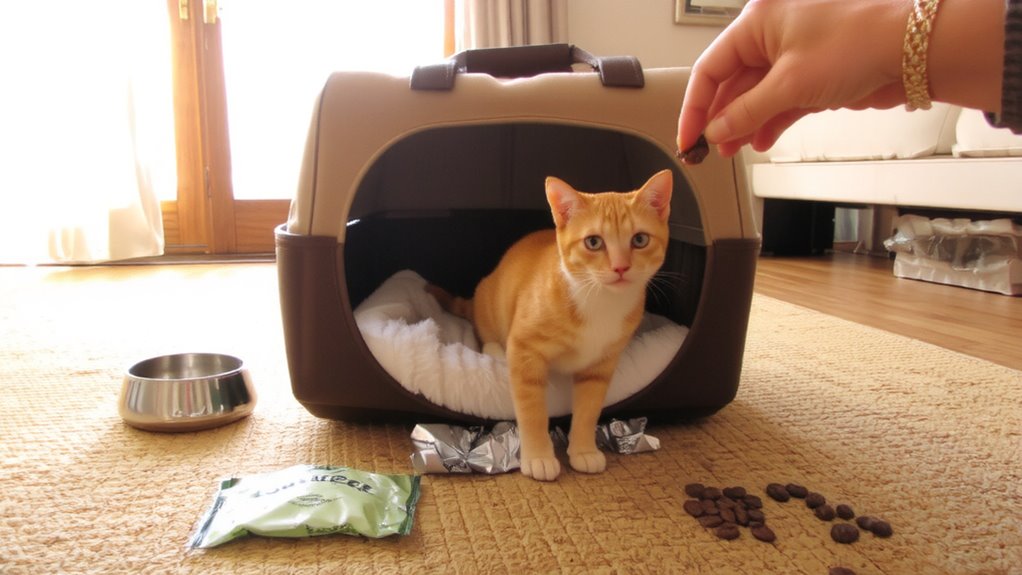
You’ve picked the right carrier and secured it properly-now it’s time to make that carrier a place your cat willingly enters. Place familiar bedding inside, such as a worn fleece blanket or slept-in towel, to provide recognizable scent cues that reduce anxiety. The carrier should remain accessible 24/7 in a quiet, low-traffic area. Use positive reinforcement by tossing small, high-value treats-like freeze-dried chicken-into the back of the carrier daily. Avoid forcing entry; instead, let voluntary exploration build confidence. Within 5–7 days, most cats begin resting inside. For best results, guarantee the bedding is machine-washable (polyester fleece, 100% cotton, or moisture-wicking fabric) and changed weekly to maintain hygiene without losing scent familiarity. Consistent positive reinforcement transforms the carrier from a threat to a predictably safe micro-environment.
Get Your Cat Comfortable With the Car First
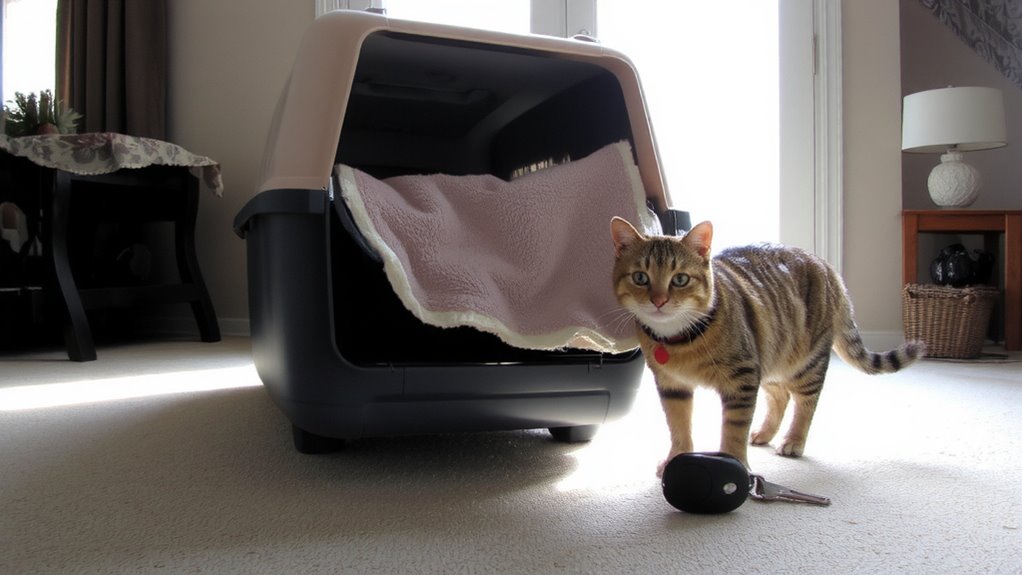
Once your cat willingly enters the carrier without hesitation, it’s time to introduce the car environment in a controlled, stress-free way. Place the secured carrier in the vehicle’s back seat or cargo area, guaranteeing it rests on a non-slip surface like a rubber mat. Fasten it with a seatbelt or bungee cord to minimize movement during transit. Allow your cat to sit in the stationary car for 5–10 minutes daily, using treats and praise to reinforce calm behavior. Gradually expose your cat to car sounds by turning on the radio or HVAC system at low volumes. After several sessions, start the engine and let it idle for 3–5 minutes. This introduces engine noise without motion, reducing sensory overload. Monitor respiration and pupil dilation as stress indicators. Repeat sessions until your cat shows no signs of distress-typically 3 to 5 days. This foundational step guarantees sound associations remain neutral before movement is added. Choosing the right carrier can significantly improve this process, so consider a model recommended in expert best cat carriers guides for optimal safety and comfort.
Try Quick, Rewarding Car Trips
With your cat remaining calm during idling sessions, it’s time to introduce brief drives. Begin with short trips under five minutes to nearby, low-stress locations. Use a secure carrier with dimensions no larger than 18 x 12 x 12 inches to limit movement while allowing basic postural adjustments. Position the carrier on a seat with a non-slip mat to reduce vibration transfer. Maintain vehicle acceleration below 0.3 g to prevent sudden jolts. Immediately upon return, offer treats containing at least 2.5 mg of L-theanine per 5 grams to support relaxation. This positive reinforcement strengthens associations between car motion and rewards. Repeat trips every 48 hours to build consistency without habituation. Do not extend duration until your cat shows consistent head-up postures and normal respiration (20–30 breaths per minute) throughout. Short trips repeated with precision enhance adaptability.
Spot Stress and Stay Calm
How can you tell when your cat’s calm exterior masks inner distress? You must recognize cues early. Subtle signs like lip licking, tail twitching, or flattened ears signal anxiety. Avoid waiting for vocalizations or panting-by then, stress is high. Watch breathing rate: normal is 20–30 breaths per minute; over 40 indicates distress. To maintain composure, regulate your own breathing and tone. Cats detect human anxiety, which escalates their stress. A diet featuring best cat food for less smelly poop can also reduce digestive discomfort that may contribute to stress during travel.
| Behavior | Meaning |
|---|---|
| Pupil dilation | Overstimulation |
| Hiding in carrier | Fear response |
| Excessive grooming | Displacement activity |
| Freezing | Anticipatory stress |
Recognize cues consistently across sessions. Use a log to track frequency and duration. Maintain composure by speaking in low, even tones. Guarantee the carrier is secure and covered partially with a breathable fabric. These responses are measurable, repeatable, and essential for effective desensitization.
Build Confidence With a Step-By-Step Plan
You’ve learned to spot the signs of hidden stress, and now you can use that awareness to shape a structured plan for building your cat’s confidence. Start with brief, controlled exposure: place your cat in a crate indoors for 5–10 minutes, increasing duration daily up to 30 minutes over two weeks. Use positive reinforcement-offer treats like freeze-dried chicken or tuna flakes immediately after calm behavior. Conduct five sessions per week to reinforce consistency. Gradually introduce the stationary car, then progress to short 5-minute engine-on sessions in the driveway. Monitor heart rate and respiration; normal resting rates are 140–220 BPM and 20–30 breaths per minute. Each phase hinges on trust building. Only advance when your cat shows no signs of hyperventilation, panting, or hiding. Complete desensitization typically requires 4–6 weeks. Record behavior daily to track progress objectively.
On a final note
You build car ride tolerance through systematic desensitization. Start with a secure, well-vent. carrier (minimum 18″ L × 12″ W × 12″ H for average adults). Pair carrier access with high-value treats (e.g., freeze-dried chicken). Gradually introduce engine sounds at idle, then progress to short 5-minute trips at 25 mph. Monitor respiration (normal: 20–30 bpm); avoid abrupt stops. Repeat sessions every 48 hours until stress markers (piloerection, vocalization) resolve.