Building a Positive Reinforcement Plan for Teaching Dogs to Wait at Doors
You can teach your dog to wait at doors using positive reinforcement. Start by creating a 3–5 foot buffer with a baby gate or leash. Require a sit-stay initiated with a flat palm signal and “wait” cue before door release. Reinforce correct behavior within one second using high-value treats. Practice three 5-minute sessions daily for 7–10 days. Gradually extend duration to 10 seconds and generalize across all doors. Consistency builds neural pathways for impulse control. Mastery occurs in 9 of 10 trials without prompting. Further refinement includes timing, context shifts, and distraction stacking to guarantee reliability in real-world scenarios.
Notable Insights
- Use a leash or baby gate to create a buffer zone, preventing door darting during training.
- Teach the “wait” command with a verbal cue and hand signal, rewarding immediate compliance.
- Reinforce sitting and staying before any door opening, using high-value treats within one second.
- Practice in short, frequent sessions at various doors to generalize the behavior across environments.
- Gradually increase wait duration and distractions, ensuring consistency to build automatic impulse control.
Start With Door Control: Set Up for Success
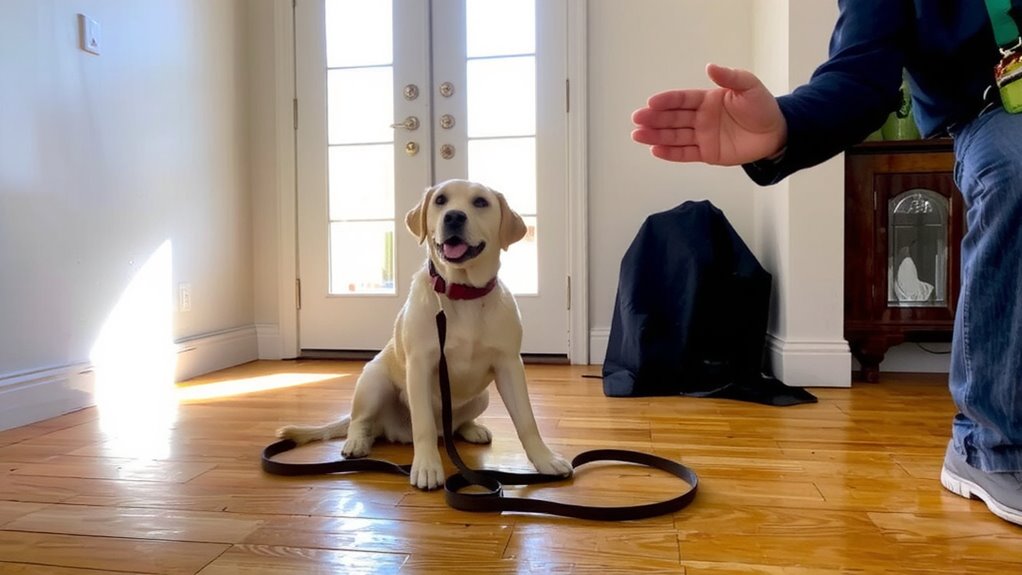
While setting the stage for effective training, starting with door control gives you a powerful tool to prevent unwanted behavior before it starts. You manage environmental cues by limiting access, reducing triggers that prompt rushing. Use a leash or baby gate to create a 3–5 foot buffer zone from the doorway-this defined space helps your dog learn boundaries. Implement consistent routines: each time you approach a door, your dog must sit and stay before release. Reinforce this sequence every time-no exceptions. Environmental cues like the sound of the doorknob or your shoes become conditioned signals only when paired with structured responses. Over 7–10 days, with 5-minute sessions 3x daily, neural pathways strengthen, increasing compliance. This predictable structure minimizes confusion, making learning efficient. You’re not just blocking behavior-you’re building impulse control through precise, repeatable conditions. Success hinges on timing, placement, and unwavering consistency.
Use Treats and Praise to Teach ‘Wait
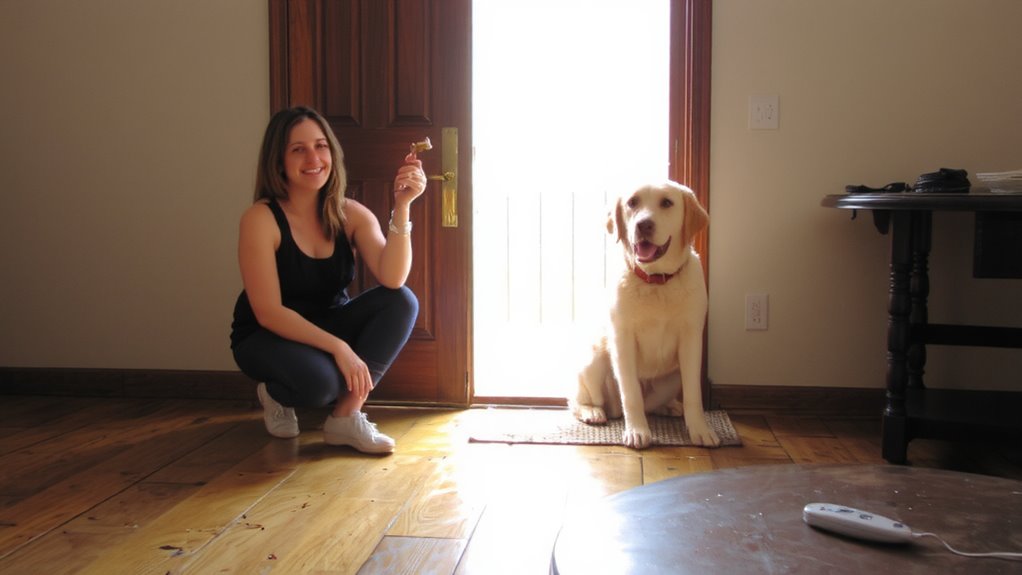
You’ve set up the environment to prevent unwanted rushing by using door control, and now it’s time to shape your dog’s behavior with active training. Begin by introducing the verbal cue “wait” just before your dog would typically lunge forward. Use precise treat timing-deliver the reward within one second of correct behavior to reinforce the association. Pair the verbal cue with a visual signal, like a raised palm, for clarity. Deliver small, high-value treats to maintain attention without overfeeding. Reinforce stationary behavior for increasing durations: start at two seconds, then gradually extend to ten. Accurate treat timing strengthens behavioral precision. Use consistent verbal cues to prevent confusion. Praise in a calm, neutral tone to avoid overexcitement. Each session should last 3–5 minutes, conducted 2–3 times daily. Over 7–10 days, most dogs achieve reliable response rates above 80% under low-distraction conditions. Choosing the right best dog treats ensures your rewards are both motivating and safe for frequent use.
Practice ‘Wait’ at Doors: Walks and Guests
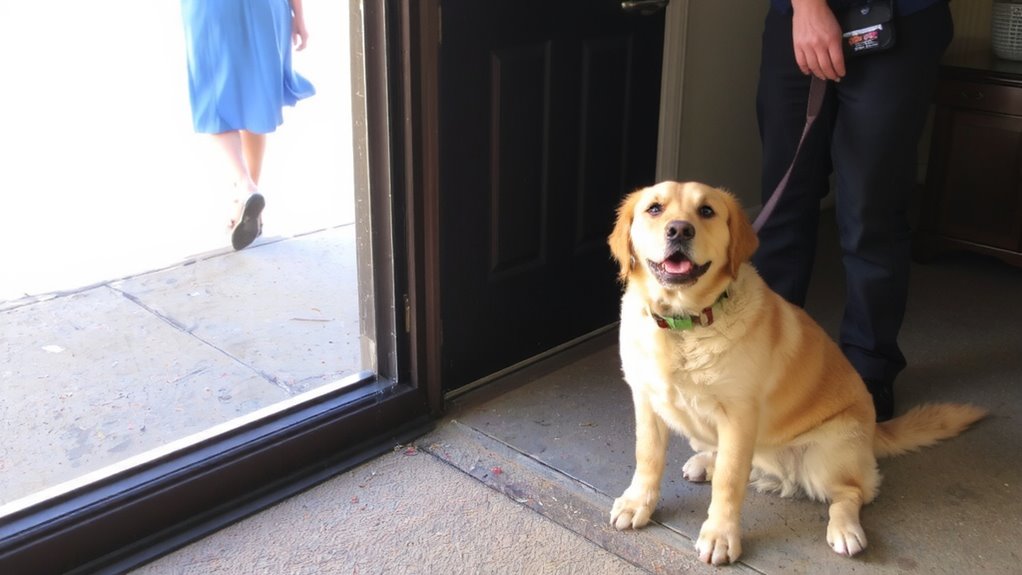
When your dog reliably responds to “wait” in low-distraction settings, it’s time to transfer the skill to real-world scenarios like doorways used for walks or guest entry. Begin with controlled situations: use a leash to prevent darting, position your dog two feet back from the threshold. Present a flat palm, say “wait,” and pause for three seconds before releasing with “okay.” Reinforce correct behavior immediately with treats and praise. Gradually increase wait duration to ten seconds. Exposure to social cues-like knocking or jingling keys-builds focus amid stimuli. Practice patience building by incrementally adding real-life variables: opening the door partially, then fully, without release. Conduct ten sessions weekly, each lasting five minutes, to solidify reliability. Use consistent verbal and visual markers. Measure progress by reduced correction frequency and improved impulse control at thresholds.
Fix Leash Lunging and Door Darting
Why does your dog surge forward the moment the door opens or a sidewalk trigger appears? It’s a lack of impulse control and underdeveloped leash manners. Dogs act on instinct unless taught otherwise through structured reinforcement. To fix leash lunging and door darting, pair door access with calm behavior, using rewards only when your dog waits. Consistency strengthens neural pathways linked to self-regulation. Below are key training phases:
| Phase | Action |
|---|---|
| 1 | Leash your dog; block door with body |
| 2 | Wait for four paws on floor before opening |
| 3 | Open door 6 inches; pause for 3 seconds |
| 4 | Reward stillness; widen door if no lunge |
| 5 | Step through only after calm exit |
Use a 6-foot nylon leash for consistent feedback. Impulse control builds over 2–4 weeks with daily 5-minute sessions. Leash manners solidify when reinforcement aligns precisely with desired behavior.
Make ‘Wait’ Automatic: All Doors, Every Time
Consistently reinforcing the “wait” command at every doorway transforms occasional compliance into automatic behavior. Door consistency is essential-apply the command at every interior and exterior door, without exception. Each repetition strengthens neural pathways linked to impulse control. Over time, your dog develops an automatic response, pausing before crossing thresholds regardless of distractions. This generalized behavior relies on uniform expectations: no door is “special” or exempt. The cue becomes context-independent, functioning in homes, cars, and public entrances. Use a clear, level tone-avoid emotional inflection-to maintain signal reliability. Practice 5–7 times daily across varying door types (sliding, swinging, narrow) to guarantee adaptability. Duration starts at 3 seconds, increasing by 1-second increments weekly. Mastery occurs when the dog waits unprompted 9 out of 10 trials. This structured repetition builds behavioral fluency, turning “wait” into a default action.
Use Positive Reinforcement at Every Door
How do you turn a practiced command into lasting behavior? You use positive reinforcement at every door. Consistent cues build neural pathways that make door manners automatic. Each time your dog waits, reward immediately with a treat or praise-this strengthens the behavior through operant conditioning. Use the same verbal cue, such as “wait,” paired with a hand signal, ensuring it’s delivered before your dog moves forward. Reinforce compliance 100% of the time during training to prevent extinction of the behavior. Apply this protocol at all entrances: interior doors, exterior doors, cars. With repetition, your dog learns the rule applies universally. Delayed or inconsistent rewards reduce response reliability. Think of reinforcement like a software update-it must be frequent and uniform to maintain performance. Mastered door manners result from precision, not preference.
On a final note
You’ve built a reliable “wait” response using positive reinforcement. Consistently pair verbal cues with treats and praise to strengthen behavioral accuracy. Practice at every door to generalize the behavior. Maintain a 1:1 reinforcement ratio during acquisition, then shift to variable schedules for durability. Leash control prevents rehearsal of lunging. With repetition, latency between cue and response drops below 1 second. The behavior becomes automatic, ensuring safety and obedience.