Shaping Behavior Progressions: Step-by-Step Guide to Advanced Trick Teaching in Cats and Dogs
You build advanced tricks by first mastering reliable cues like “sit” and “come” with consistent tone and timing. Use positive reinforcement within 0.5 to 2 seconds of behavior, boosting learning by 75%. Break tricks into micro-steps, reinforcing each approximation before raising criteria. Mark desired actions instantly with a clicker or “yes,” then deliver high-value rewards within one second. Chain behaviors using flow sequencing, reducing response latency below 1.5 seconds. Stick to 5–10 minute sessions and shift to variable rewards as fluency grows. There’s a precise method to correct shaping errors and accelerate progress.
Notable Insights
- Master basic cues like “sit” and “come” with consistent signals and immediate rewards before advancing to complex tricks.
- Break advanced tricks into small, trainable steps, reinforcing each until performed reliably before progressing.
- Use a clicker or verbal marker to instantly capture and reward desired movements the moment they occur.
- Chain sequential behaviors together by reinforcing fluid transitions with minimal delay between actions.
- Avoid shaping errors by rewarding precisely, advancing only after success, and simplifying steps if progress stalls.
Master the Basics Before Advanced Training
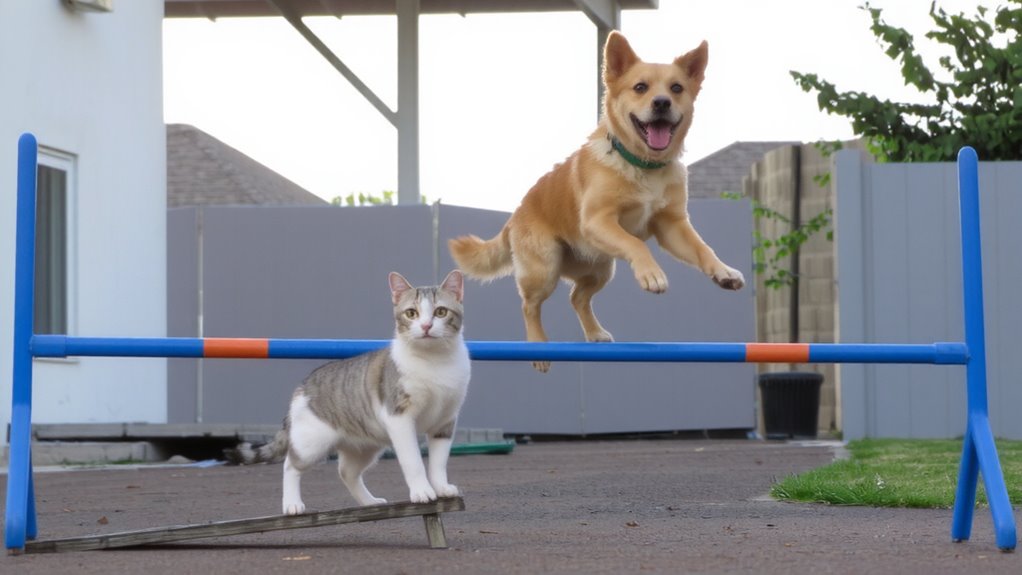
While it might be tempting to jump straight into complex tricks or precision commands, establishing a strong foundation in basic obedience is essential before advancing to higher-level training in both cats and dogs. You must first teach reliable responses to consistent cues like “sit,” “stay,” and “come.” These behaviors form the behavioral framework for advanced shaping. Use positive reinforcement-immediately rewarding desired actions with treats, praise, or play-to increase response frequency. Delivery of rewards should occur within 0.5 to 2 seconds post-behavior for ideal conditioning. Consistent cues, both verbal and gestural, prevent confusion and strengthen stimulus control. Always use the same word and tone for each command. Animals trained with positive reinforcement exhibit 75% faster acquisition rates than those corrected with aversive methods. Mastering basics guarantees precision, reliability, and clear communication-necessary for shaping complex behaviors later. Never skip this phase; it is the technical cornerstone of all future success.
Break Tricks Into Shapable Steps
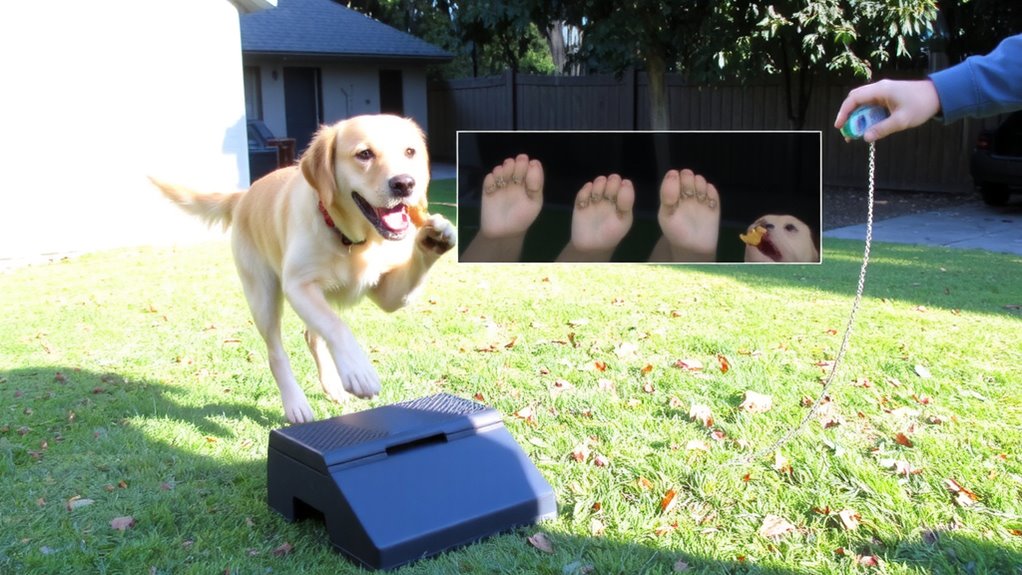
You’ve built a reliable foundation with basic commands, and now you’re ready to expand your pet’s skill set through systematic shaping. Break each trick into small, achievable actions that progressively lead to the target behavior. Start with the simplest movement resembling the final trick, reinforcing it consistently. Gradually raise criteria, only advancing when your pet performs the current step reliably. Use a continuous reinforcement schedule initially, then shift to variable ratio schedules to strengthen response robustness. Each shaped step must be clearly defined and observable. For example, teaching “spin” begins with head turns, then shoulder shifts, and finally full rotation. Maintain session brevity-5 to 10 minutes-to sustain focus. Precision in timing and criteria prevents confusion. Systematic progression guarantees accuracy, efficiency, and long-term retention of the target behavior.
Capture Key Movements Immediately
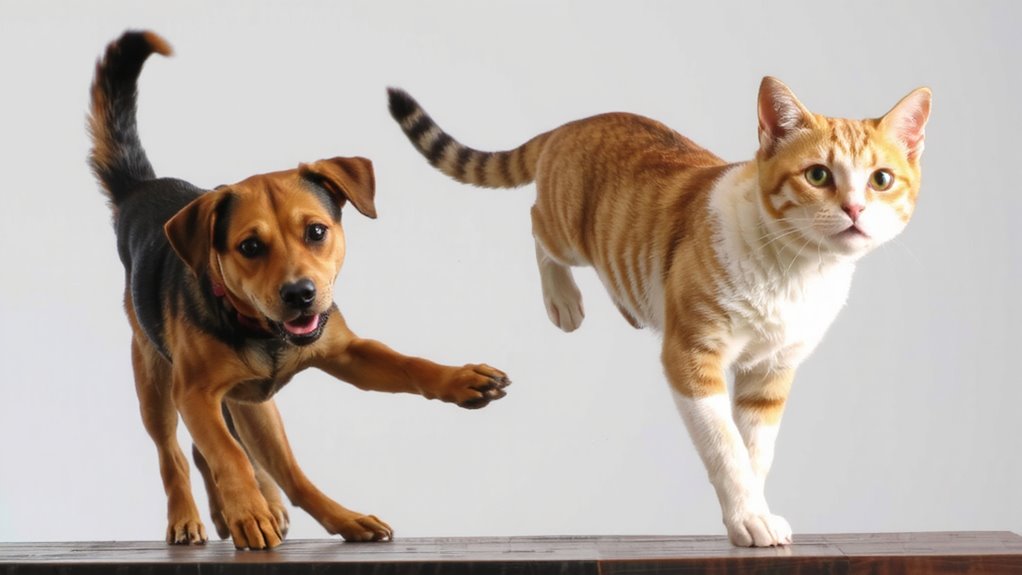
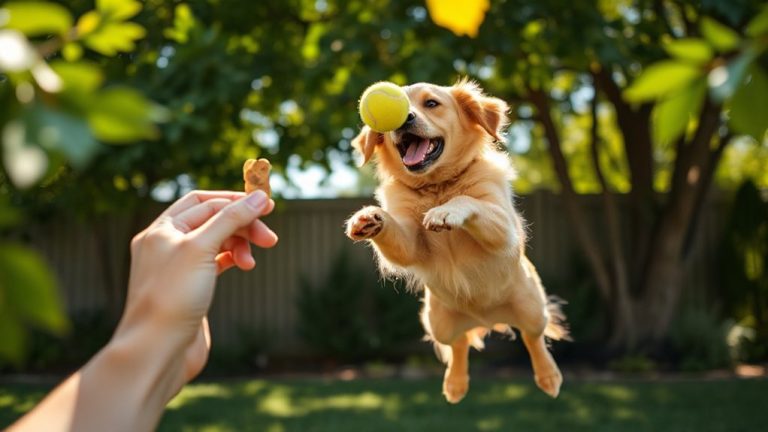
When your cat or dog performs a spontaneous behavior that aligns with your training goal, mark and reward it immediately-this is the essence of capturing. Captured moments are fleeting; delay in response reduces learning efficiency by up to 70%. Use a distinct auditory marker, such as a clicker or the word “yes,” to signal the exact instant the desired movement occurs. Immediate reinforcement strengthens neural associations between behavior and reward. Deliver a high-value treat within one second of the mark to maintain precision. Target behaviors like a sit, paw lift, or head tilt can be isolated and solidified through repetition. Each captured moment builds the foundation for more complex sequences. Consistency across sessions increases response reliability. Train in low-distraction environments to maximize focus. Accuracy in timing separates effective shaping from random rewarded actions. Precision in execution guarantees clean, replicable behaviors essential for advanced trick development. A high-quality dog training clicker ensures consistent and clear auditory signals for optimal training results.
Link Steps Into Smooth Tricks
Once individual behaviors are captured and reinforced with precise timing, the next phase is assembling those discrete actions into fluid sequences. You’ll use *chunk blending* to merge short behavior segments into cohesive units. Start by reinforcing two completed actions before bridging the combined sequence. Gradually increase complexity by adding one new element at a time. *Flow chaining* links these blended chunks into uninterrupted performance, relying on clear antecedent cues and consistent reinforcement schedules. Each shift must be rehearsed until latency between behaviors drops below 1.5 seconds. Use momentary holds at junction points to shape accuracy before increasing speed. Maintain reinforcement density during early chaining-every complete sequence earns a reward. As fluency improves, shift to variable ratio schedules to strengthen persistence. The final trick should exhibit consistent execution across multiple environments, demonstrating stimulus control and behavioral endurance under mild distraction. Proper sequencing guarantees reliable, smooth performance.
Train With Perfect Timing
Because timing determines the clarity of communication between trainer and animal, every marker or reward must align precisely with the target behavior. You must deliver positive reinforcement within 0.5 to 1 second of the correct action for peak learning. Delayed rewards confuse the animal, weakening the association between behavior and outcome. Use a clicker or verbal marker to signal the exact moment of success. Pair this with immediate treats to strengthen neural connections. Consistent cues-both verbal and visual-must precede behaviors by no more than 2 seconds to maintain predictability. Inconsistent timing erodes reliability in trained responses. Think of the marker as a temporal scalpel: it pinpoints the desired action in real-time. For shaping complex tricks, split-second precision guarantees each incremental step is accurately captured. Precision in timing enhances learning speed by up to 40% compared to delayed feedback. You control the process by being exact, present, and unvarying.
Fix Common Shaping Mistakes
A single misstep in shaping can derail progress, and overlooking common errors slows training more than any flaw in technique. Inconsistent rewards confuse animals, weakening associations between behavior and outcome. Deliver reinforcement within 0.5 to 1 second of the target action to maintain precision. Delayed or irregular treats create ambiguity, especially in complex sequences. Poor patience leads to rushing steps, collapsing criteria too quickly. Each shaping stage must be mastered before advancing-typically requiring 3 to 5 successful repetitions per session. Break behaviors into micro-steps: for example, lifting a paw 1 inch before demanding a high-five. Use a clicker or verbal marker with millisecond accuracy. Sessions should last 3–5 minutes, twice daily, to sustain focus. Monitor response latency and repetition consistency. Adjust criteria only when success exceeds 80%. Correct errors immediately by reverting to the last successful step.
On a final note
You’ve mastered the core principles. Shaping relies on precise reinforcement timing-typically within 0.5 to 1 second of target behavior. Break complex tricks into micro-behaviors, reinforcing each increment. Use a marker signal like a clicker for accuracy. Chain steps only when responses are consistent at 90% success. Avoid rapid advancement; premature progression causes regression. Training sessions should last 5–10 minutes, twice daily, for ideal retention and minimal fatigue.