Training Readiness by Age: Tailoring Programs for Optimal Results in Puppy Development
You’re ready to start training your puppy at 8 weeks using 5–10 minute sessions, 3–4 times daily. Begin with basic commands like “sit” and “stay,” using ½-inch soft treats for reinforcement. Introduce a properly sized crate per ISO 12234-2 standards to support house training. Handle paws and ears daily to build tolerance. By 12 weeks, prioritize socialization with 3–5 short, positive exposures daily. A structured, age-tailored plan guarantees ideal neural development and behavioral outcomes-you’ll see how each phase builds on the last.
Notable Insights
- At 8 weeks, start brief training sessions daily using positive reinforcement to build foundational command and crate habits.
- By 12 weeks, prioritize socialization with people and dogs in short, positive sessions during peak brain receptivity.
- At 4 months, manage teething with safe chew toys and enforce a strict potty schedule to support bladder control.
- At 5 months, begin leash training with a harness and short leash, using verbal cues and visual boundaries consistently.
- By 6 months, maintain structure with scheduled crate use, limited unsupervised time, and twice-daily obedience sessions.
Puppy Training at 8 Weeks: First Commands and Handling
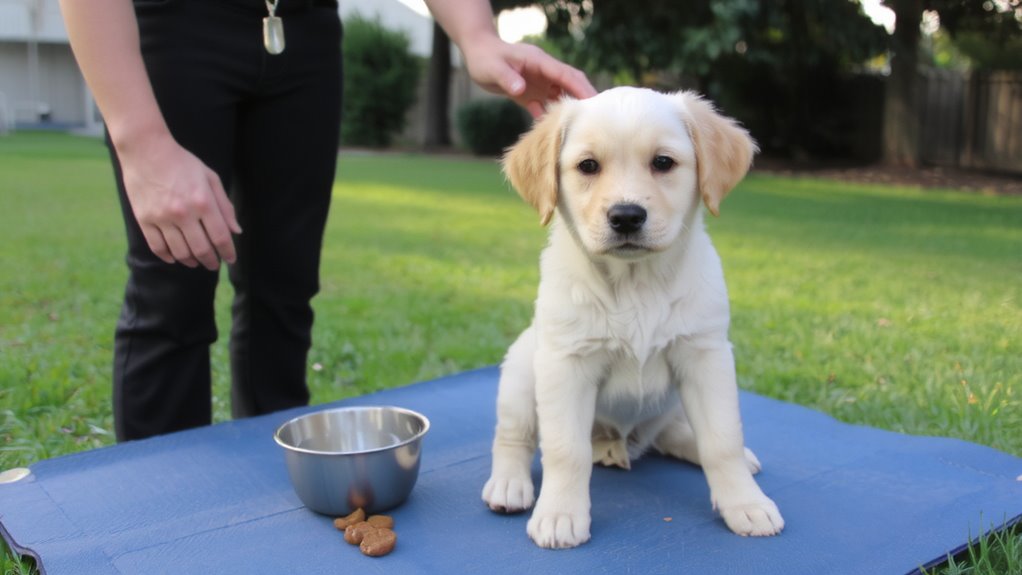
An 8-week-old puppy is ready to begin learning basic commands and proper handling, setting the foundation for lifelong behavior. You should start with short, consistent sessions of 5–10 minutes, repeated 3–4 times daily, to maintain focus without causing fatigue. Crate comfort is essential at this stage; introduce a properly sized crate-allowing just enough room to stand, turn, and lie down-to establish a secure den-like environment. Use positive reinforcement with small, soft treats (½ inch cubes) to encourage entry and calm behavior. Early bonding accelerates learning, reducing stress by up to 40% when the handler’s scent and voice are familiar. Handle paws, ears, and muzzle daily for 30–60 seconds to acclimate the puppy to grooming and vet exams. These structured interactions build trust and compliance, laying the groundwork for advanced training. Training on a designated surface like a dog training mat can help signal to your puppy that it’s time to focus and learn.
Socialization and Basic Cues at 12 Weeks
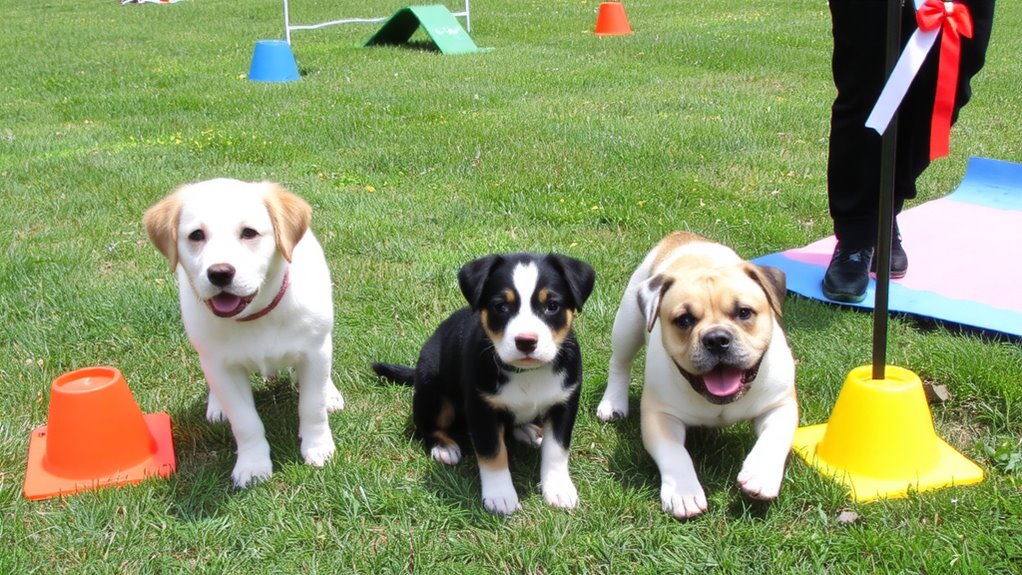
Why is 12 weeks such a pivotal point in your puppy’s development? This is the peak of the socialization window, when your puppy’s brain is most receptive to new experiences. Introducing varied stimuli now builds long-term behavioral resilience. Use positive reinforcement to reward calm, curious responses. Pairing new sights, sounds, and surfaces with play based learning enhances retention and reduces fear-based reactions.
| Stimulus Type | Training Method | Frequency/Duration |
|---|---|---|
| People | Positive reinforcement | 3–5 sessions/day, 5 min each |
| Dogs | Play based learning | 2–3 supervised playdates/week |
| Surfaces | Gradual exposure + treats | Daily, 10 min |
| Noises | Recorded sounds at low volume | Every other day, 7 min |
| Objects | Toy-mediated exploration | Daily, 15 min |
Consistency and timing are critical-optimal learning occurs in brief, repeated sessions using a reward-based framework.
Managing Chewing and Potty Training at 4 Months
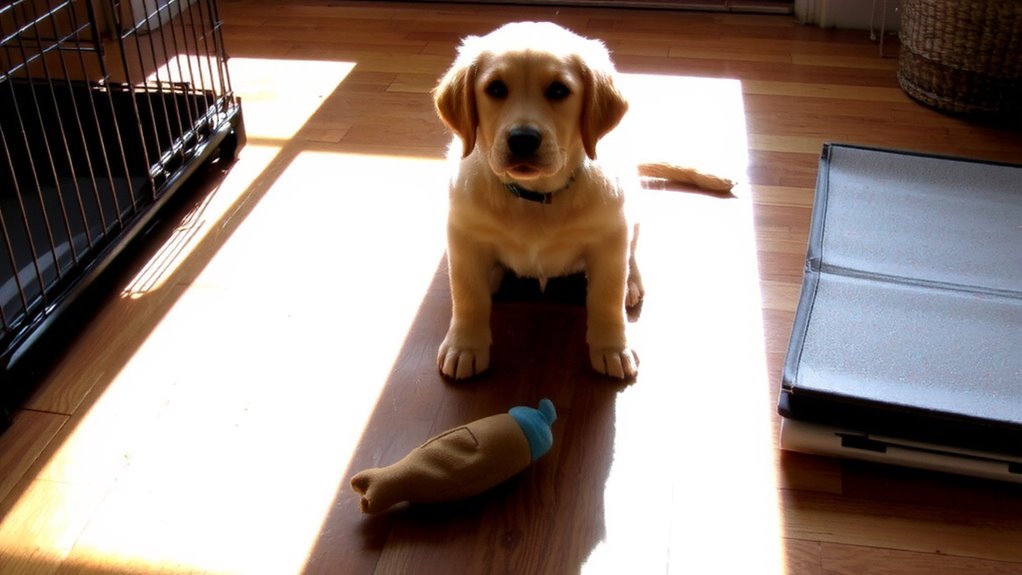
What makes 4 months such a critical juncture for managing chewing and potty training? Your puppy’s deciduous teeth are shedding, triggering an urge to chew for teething relief. Provide durable rubber toys, measured at 2–3 inches in diameter, to safely satisfy this need. Avoid small objects under 1.5 inches to prevent choking. Simultaneously, establish crate consistency using a wire or plastic crate sized to ISO 12234-2 standards-your puppy should stand, turn, and lie down comfortably, but not have excess space. This promotes bladder control by discouraging soiling in confined areas. Potty training success hinges on a strict schedule: take your puppy out every 2 hours, post-meals, and after play. Use enzymatic cleaners at 3–5% concentration on accidents to eliminate odor cues. Consistent repetition solidifies elimination habits within 14–21 days. For effective relief, consider offering one of the best teething toys for puppies that combine safety and durability for this developmental stage.
Leash Manners and Boundaries at 5 Months
As your puppy reaches 5 months, initiating structured leash training becomes essential to instilling reliable walking behavior and spatial awareness. Leash walking at this stage should occur daily for 10–15 minutes using a lightweight nylon harness and 4- to 6-foot leash to enhance control. Start in low-distraction environments, gradually increasing complexity over 2–3 weeks. Use consistent verbal markers like “heel” and “stop” paired with positive reinforcement. Boundary setting begins with marking limits via visual cues-flags or tape-to define acceptable zones. Reinforce boundaries with redirection and brief pauses when limits are breached. Maintain 90% accuracy in obedience responses before advancing terrain difficulty. This precision builds neural pathways linked to impulse control and environmental scanning. Structured repetition solidifies muscle memory, reducing pull frequency by up to 70% over four weeks. Accurate timing and consistency guarantee peak long-term leash walking proficiency and spatial comprehension.
Sustaining Progress During Puppy Adolescence (6 Months)
A majority of puppies experience a behavioral shift around 6 months, marking the onset of adolescence and requiring adjusted training strategies to maintain prior progress. Hormonal changes coincide with cognitive maturation, increasing distractibility during tasks. You must reinforce behavioral consistency through structured daily sessions. Training should last 10–15 minutes, twice daily, using positive reinforcement with high-value treats (e.g., freeze-dried liver, 6–8 mm cubes). Puppies at this stage show improved problem-solving but reduced impulse control. Use a 6-foot nylon leash (12 mm diameter) for practice in low-distraction environments before advancing. Maintain predictable routines to minimize regression. Incorporate recall, sit, and stay commands with variable reward schedules to build reliability. Monitor progress with a log, noting response latency and error frequency. Adjust criteria as attention span increases from 30 to 90 seconds. Consistent application sustains skill retention despite developmental fluctuations. To reduce allergens in the puppy’s environment, consider using best bedding to resist pet hair that minimizes loose fur accumulation on sleeping surfaces.
Your 6-Month Puppy Training Roadmap
Though adolescence introduces unpredictability, your 6-month puppy remains highly trainable with a structured, age-appropriate roadmap. Establish crate consistency by using a 36-inch wire crate for medium breeds, placed in a low-traffic area to reinforce den instincts. Maintain a fixed schedule: three crate sessions daily, each lasting 2–3 hours, to support bladder control and reduce anxiety. Implement playtime discipline by limiting unsupervised interaction to 20-minute intervals, followed by obedience drills. Use a 6-foot nylon leash during training to correct pulling, applying brief, 0.5-second pressure cues. Focus on reinforcing recall, sit-stay, and leave-it commands with 90% treat reinforcement. Rotate chew toys every 72 hours to prevent habituation. Conduct two 15-minute sessions daily, aligning with peak cognitive alertness-early morning and pre-dinner. Monitor progress via a weekly log, tracking command success rates and behavioral regressions. Adjust stimulus intensity based on attention span, typically 8–10 minutes per task.
On a final note
You establish the foundation for lifelong behavior by aligning training with developmental milestones. At 8 weeks, puppies begin learning simple commands like “sit” and “stay” with 5–10 minute sessions. By 12 weeks, socialization windows peak, requiring exposure to 15+ stimuli types. At 4–6 months, consistent potty schedules-every 2 hours-reduce accidents by up to 70%. Leash training at 5 months uses 4–6 foot nylon leashes for ideal control.