How to Use Clicker Training to Teach Dogs to Identify Their Toys by Name
You can teach your dog to identify toys by name using clicker training with precise timing. Click the instant your dog touches a distinct, novel toy-like a 6-inch bright orange rope with a rubber core-then give a treat within 0.5 seconds. Use a consistent 2,800 Hz clicker to mark behavior accurately. After charging the clicker over 3–5 days, introduce one toy name like “fox” in short, focused sessions. Mastery at 90% accuracy over three sessions allows progression to a second toy. Success relies on uniform cues, structured repetition, and incremental complexity-next steps follow a clear protocol.
Notable Insights
- Charge the clicker by clicking and immediately giving a treat to create a positive association.
- Choose a distinct toy with unique color, shape, and texture to avoid confusion.
- Use a single, consistent name for the toy and say it clearly before presenting it.
- Click the instant the dog touches or mouths the named toy, then deliver a treat.
- Train in short, frequent sessions, gradually adding new toys only after mastery.
How Clicker Training Works
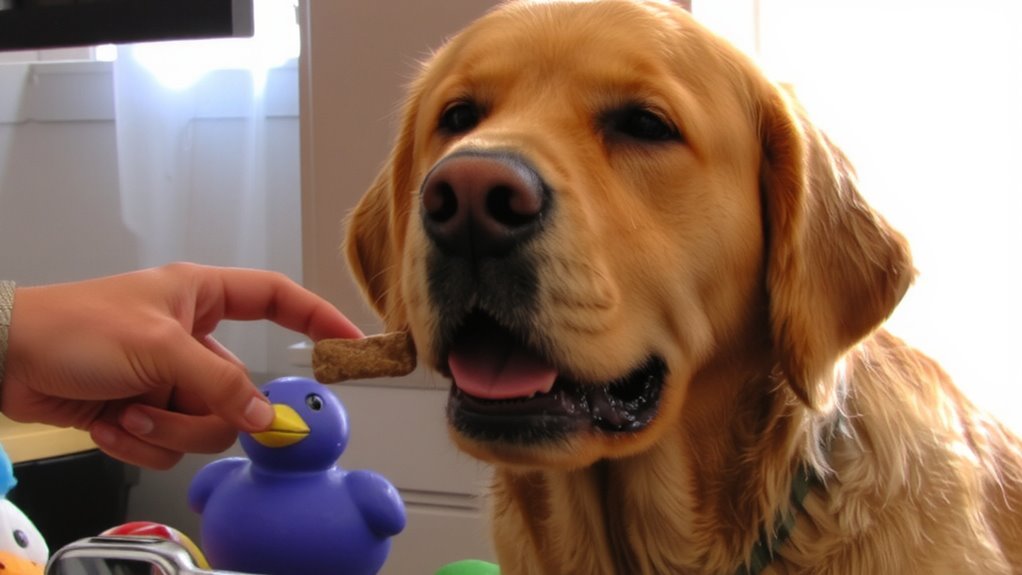
When you’re training a dog to recognize toy names, timing is critical, and that’s where clicker training proves effective. The clicker emits a consistent 2,800 Hz tone, creating a precise auditory marker. Marker timing allows you to instantly signal the exact moment your dog performs the correct behavior. This immediacy is essential because delays longer than 0.5 seconds reduce learning efficiency by up to 60%. You then follow the click with a treat, establishing positive reinforcement. The association forms through classical conditioning: the dog learns the click predicts a reward. Unlike verbal cues, which vary in tone and timing, the clicker provides uniform feedback. Each click marks a specific action, minimizing confusion. Use the clicker within 0.2 seconds of the target behavior for maximum efficacy. Consistent marker timing strengthens neural connections, accelerating name-to-object association. Over time, this method builds reliable recall, even with novel toys.
Pick Your First Distinct Toy
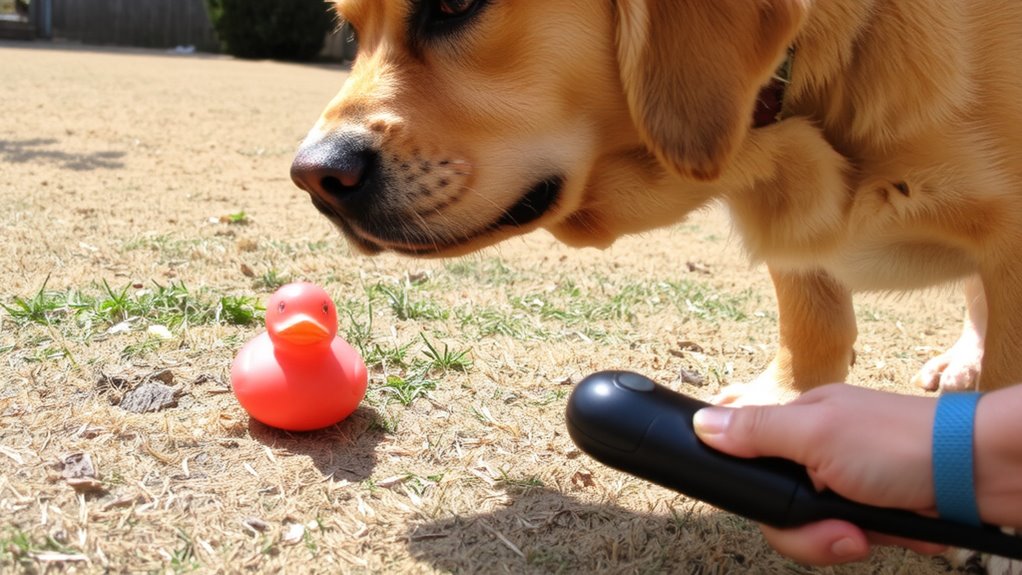
Start with a single toy that stands out in shape, color, and texture to maximize initial learning success. Toy selection is critical-choose a novel item unlike others in your dog’s collection. A bright orange rope toy with a rubber center, measuring approximately 6 inches in length and featuring a braided polyester texture, offers distinct tactile and visual cues. Avoid toys with similar names or overlapping physical traits to maintain naming consistency. Introduce only one name per toy, using a clear, single-word label like “zippy” or “tango.” This precision reduces cognitive load and supports accurate auditory discrimination. Guarantee the toy is durable, machine-washable, and free of loose parts to sustain repeated use. Consistent use of this distinct item establishes a reliable reference point for later discrimination tasks, functioning much like a control variable in experimental design.
Charge the Clicker and Begin Training
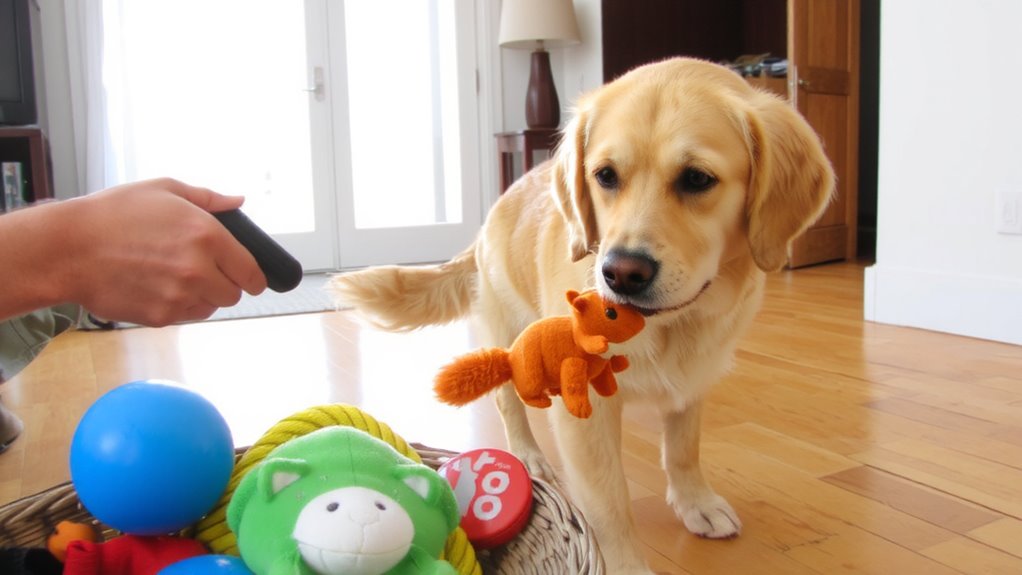
Because the clicker serves as a precise marker for desired behavior, you’ll need to establish its meaning before teaching toy names. Clicker conditioning begins by associating the clicking sound with a reward. Each click must immediately precede a treat-within 0.5 seconds-for effective training reinforcement. Start in a quiet space with minimal distractions. Click once, then deliver a small, high-value treat. Repeat this 10–15 times per session, conducting 2–3 short sessions daily. Consistency guarantees your dog understands the click predicts food. Use treats no larger than ¼ inch cubed to maintain rapid pairing without satiation. Over 3–5 days, your dog will anticipate the treat after each click, confirming successful conditioning. This precise timing creates a reliable communication tool. Once conditioned, the clicker becomes an objective signal, marking exact moments of correct attention or interaction during future naming tasks.
Teach Your Dog One Toy Name
Success begins with precision-choosing a single toy to name, and sticking to it without variation during initial training. Select a distinct toy for consistent name association; avoid similar textures or colors. Begin in a quiet space, holding the toy. Say the toy’s name clearly-“fox”-then present it. Guide your dog to interact with it. The instant they touch or mouth it, click and treat. Repeat 10–15 times per session, 2–3 sessions daily. Timing matters: the click must mark the exact moment of correct interaction. This strengthens toy retrieval accuracy. Over 3–5 days, your dog will associate the word “fox” with that specific object. Use only this toy during training; no substitutions. Reinforce consistently-every correct response earns a click and reward. Gradually increase distance during retrieval. Test recognition by placing the toy among neutral objects. Reliable response indicates solid name association.
Add a Second Toy Name Clearly
Now that your dog reliably identifies the first toy by name, you can introduce a second distinct object using the same structured method. Begin with the new toy in isolation to prevent confusion. Use the clicker the instant your dog touches the correct item, followed immediately by a treat. This reinforcement consistency strengthens accurate associations. Introduce only one new name per session to support gradual progression. Alternate between training sets: practice Toy A alone, then Toy B, then briefly together. Sessions should last 3–5 minutes, 2–3 times daily, to maintain focus. Use toys with clear sensory differences-distinct shapes, textures, or sizes-to enhance discrimination. Avoid naming similar toys too soon. Each correct response must be marked precisely; timing errors weaken learning. Accuracy before speed is critical. Over time, this systematic approach guarantees clear, reliable identification of each toy’s unique name.
Build Toy Recognition Over Time
Consistently reinforcing correct choices strengthens long-term memory and sharpens your dog’s ability to distinguish toy names over time. Reinforce slowly, allowing your dog to master two toy names before introducing a third. Begin with 5–10 training sessions per day, each lasting 3–5 minutes, using a consistent clicker-treat interval of 0.5–1 second. Once accuracy exceeds 90% over three consecutive sessions, increase complexity by adding a new toy with a distinct name and texture. Rotate toys weekly to prevent habituation. Use toys differing in shape, size, and material-such as a 12-cm rope ring versus a 9-cm rubber disc-to enhance sensory discrimination. Conduct retrieval trials at varying distances: start at 1 meter, gradually extending to 5 meters. Test recall under low distraction first, then incrementally introduce environmental variables like background noise or visual stimuli. Maintain session logs to track response latency and error rate, ensuring data-driven progression. For optimal results, use a high-quality clicker that provides consistent sound and durability.
On a final note
You now understand the mechanics of clicker training for toy identification. Each click marks the exact moment your dog interacts correctly with the named toy, reinforcing precision. Start with one distinct toy, then gradually introduce others with clear auditory differences. Use consistent naming, immediate reinforcement, and short sessions of 3–5 minutes, 2–3 times daily. Over 6–8 weeks, most dogs achieve 80–90% accuracy under controlled conditions.