Understanding Humidity Requirements by Species to Ensure Optimal Health
You must match humidity to your pet’s species-specific needs to prevent health issues. Bearded dragons thrive at 30–40% RH; levels above 50% raise respiratory and mold risks. Pacman frogs require 70–90% humidity with damp substrate for proper hydration. Leopard geckos need 30–40% ambient humidity plus a moist hide at 70–80%. Crested geckos demand 60–80% RH, supported by daily misting. Use a digital hygrometer at mid-cage level for accurate, ±2% RH monitoring. Adjust ventilation, substrates, or misting to maintain stability. You’ll find targeted strategies for every species’s ideal range just ahead.
Notable Insights
- Different reptile and amphibian species require specific humidity levels to maintain hydration, shedding, and respiratory health.
- Bearded dragons thrive at 30–40% humidity, while Pacman frogs need 70–90% to support skin and osmoregulation.
- Leopard geckos benefit from a moist hide at 70–80%, despite lower ambient humidity requirements of 30–40%.
- Crested geckos require 60–80% humidity, maintained through daily misting and proper enclosure ventilation.
- Accurate digital hygrometers placed at mid-cage level ensure reliable monitoring and help prevent humidity-related health issues.
Bearded Dragon Humidity: Is Yours Too High or Low?
Why is your bearded dragon’s enclosure feeling too damp or too dry? Improper humidity levels directly impact your pet’s hydration levels and overall health. Bearded dragons thrive in low humidity environments, ideally between 30% and 40%. Excess moisture encourages respiratory infections and mold growth, while overly dry conditions can cause dehydration and shedding difficulties. You must maintain precise ventilation balance to achieve ideal conditions. Use a wire-mesh enclosure to enhance airflow and prevent stagnation. Install a digital hygrometer at mid-enclosure level to monitor humidity accurately. If levels rise above 50%, reduce misting frequency and increase air exchange. For dry environments, brief misting or a shallow water dish helps. Proper hydration levels support kidney function and digestion. Balancing ventilation and humidity guarantees thermal regulation and mimics the arid Australian outback, their natural habitat. For reliable and consistent results, choose a high-quality best hygrometer for reptiles.
Why Pacman Frogs Need 70–90% Humidity
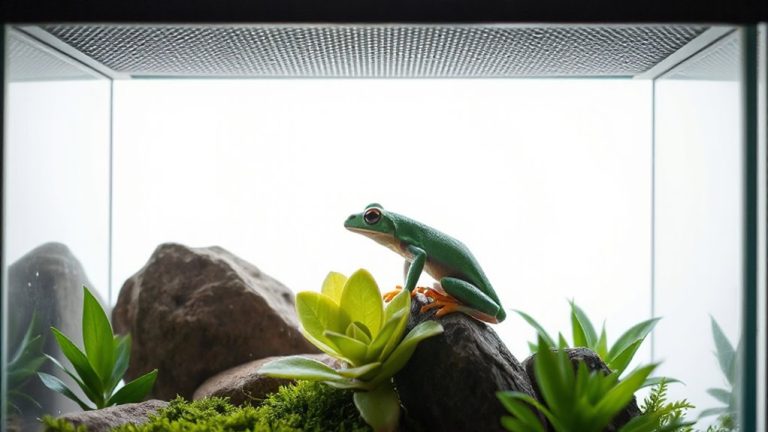
Pacman frogs require a consistently moist environment to thrive, unlike the arid conditions favored by bearded dragons. You must maintain 70–90% humidity to support proper hydration and skin function. Without adequate humidity, your frog can become dehydrated, leading to lethargy and reduced feeding. High humidity levels are only effective when paired with proper ventilation balance to prevent stagnant air and mold growth. You should use a hygrometer to monitor levels accurately. Substrate moisture is critical-use coconut fiber or sphagnum moss, which retains water well. The substrate should feel damp but not soggy, akin to a wrung-out sponge. Poor substrate moisture control leads to shedding issues and skin irritation. Maintain consistent humidity through daily misting and enclosed terrarium design. Proper environmental control guarantees strong immune function and long-term health.
Gecko Humidity by Species: Leopard, Crested, and More
While geckos share a common need for controlled humidity, specific requirements differ markedly by species and must be tailored to replicate natural habitat conditions. For leopard geckos, maintain 30–40% ambient humidity to prevent respiratory issues, with a moist hide at 70–80% for proper shedding. Crested geckos need higher levels-60–80%-to support skin and eye health. You achieve this through species specific misting twice daily, using distilled water to avoid mineral deposits. Proper gecko hydration depends on consistent moisture availability and appropriate substrate moisture retention. Use digital hygrometers for precise monitoring, placing them at cage level for accuracy. Exo Terra and Zoo Med terrariums with front ventilation work well for airflow control. Incorrect humidity disrupts osmoregulation, leading to dehydration or edema. Adjust misting frequency and enclosure ventilation based on real-time readings. Each species thrives only when humidity reflects its native environment’s microclimate.
Signs of Humidity Stress in Reptiles and Amphibians
You’ll want to recognize the early signs of humidity stress in your reptile or amphibian, as improper moisture levels can quickly compromise their health. Respiratory distress is a key indicator, especially in species requiring high humidity. You might notice open-mouth breathing, wheezing, or excess mucus, which often signals damp, stagnant air promoting bacterial growth. Conversely, low humidity can cause skin shedding difficulties, particularly in snakes and geckos. Incomplete sheds, retained eye caps, or patchy peeling suggest ambient moisture is below the ideal range-often under 50% for moderate-humidity species. Amphibians may exhibit dry, dull skin or cracks, reflecting compromised osmoregulation. Chronic exposure leads to reduced immune function and stress-induced lethargy. Immediate correction of humidity to species-specific needs-like 60–80% for most tropical frogs-prevents escalation. Early observation guarantees timely intervention and prevents long-term physiological damage.
How to Monitor Enclosure Humidity Accurately
A reliable hygrometer is the foundation of accurate humidity monitoring, just as recognizing stress symptoms starts with understanding what normal looks like. Digital hygrometers with ±2% RH accuracy provide consistent readings across temperature gradients. Place the sensor at mid-enclosure level, away from direct water sources. Hygrometer calibration is critical-use a salt test (75% RH in a sealed container with NaCl solution) monthly to verify performance. Replace units failing calibration. Ventilation balance guarantees humidity distribution without condensation buildup. Mesh lids reduce stagnant air; adjustable vents allow microclimate control. Avoid single-point monitoring-use secondary sensors in hot and cool zones to detect gradients. Infrared thermohygrometers offer spot-check precision without enclosure disruption. Record readings daily to identify patterns. Proper placement and regular hygrometer calibration maintain data integrity. Balanced ventilation prevents microclimates while preserving species-specific humidity needs. Accurate monitoring starts with equipment trust and placement logic.
Adjusting Humidity: Simple Tips for Stable Levels
How can you maintain stable humidity levels when environmental fluctuations seem inevitable? Use humidity trays to create localized moisture zones. Fill them with water-retaining substrates like sphagnum moss or hydroballs to slowly release moisture. Place them directly under heat lamps or near airflow sources to maximize evaporation rates. Maintain a ventilation balance to prevent stagnation while retaining moisture. Enclosures should have at least two adjustable vents-one near the top for hot, moist air release and one near the bottom for fresh air intake. Mesh lids allow passive airflow but reduce humidity by up to 15% compared to solid lids. Adjust vent sizes based on real-time hygrometer readings. Ideal relative humidity (RH) should stay within ±5% of target. For most tropical species, aim for 60–80% RH. Daily monitoring and minor adjustments keep levels stable.
On a final note
You must maintain species-specific humidity to prevent health issues. Bearded dragons need 30–40% RH; levels above 50% encourage respiratory infections. Pacman frogs require 70–90% RH to support cutaneous respiration and prevent dehydration. Leopard geckos thrive at 30–40%, while crested geckos need 50–70% with nighttime spikes to 80%. Use digital hygrometers calibrated with a salt test for accuracy. Adjust levels with ventilation, misting, or substrates like coconut fiber. Stable gradients support proper shedding and metabolic function.