Mitigating Noise Sensitivity: Common Triggers and Solutions for Thunderstorms and Fireworks in Cats
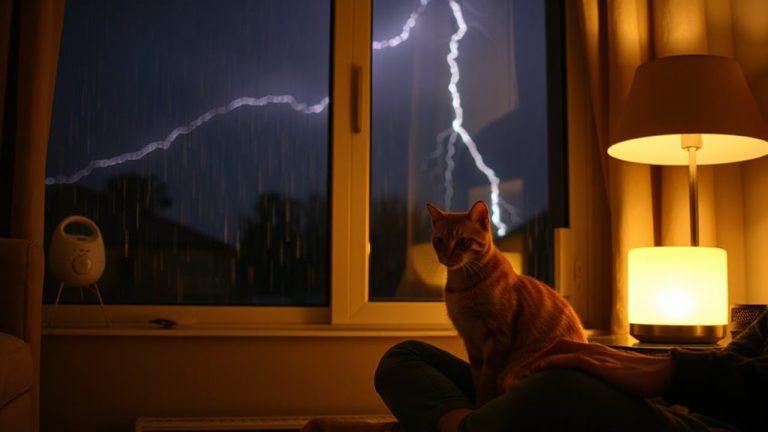
Your cat’s hearing reaches 64,000 Hz, making fireworks at 150 dB and thunder at 120 dB intensely distressing. These sounds trigger innate fear. Create a safe room using a 6 x 8 ft interior space with solid-core doors and STC 25+ acoustic panels. Use white noise at 45–60 dB to mask sudden booms. Feliway diffusers reduce anxiety by up to 70%. There’s more to optimizing your cat’s environment for peak stress reduction.
Notable Insights
- Cats’ acute hearing makes them sensitive to loud noises like fireworks and thunderstorms, triggering instinctive fear responses.
- Signs of noise-induced anxiety include hiding, trembling, excessive grooming, flattened ears, and increased vocalizations.
- Create a safe room with minimal windows, sound-dampening materials, familiar bedding, and pheromone diffusers for security.
- Use white noise machines or calming cat-specific audio to mask sudden loud sounds and reduce auditory stress.
- Consult a vet for severe reactions; treatment may include calming supplements, pheromones, or prescribed anxiolytics.
Why Cats Fear Thunderstorms and Fireworks
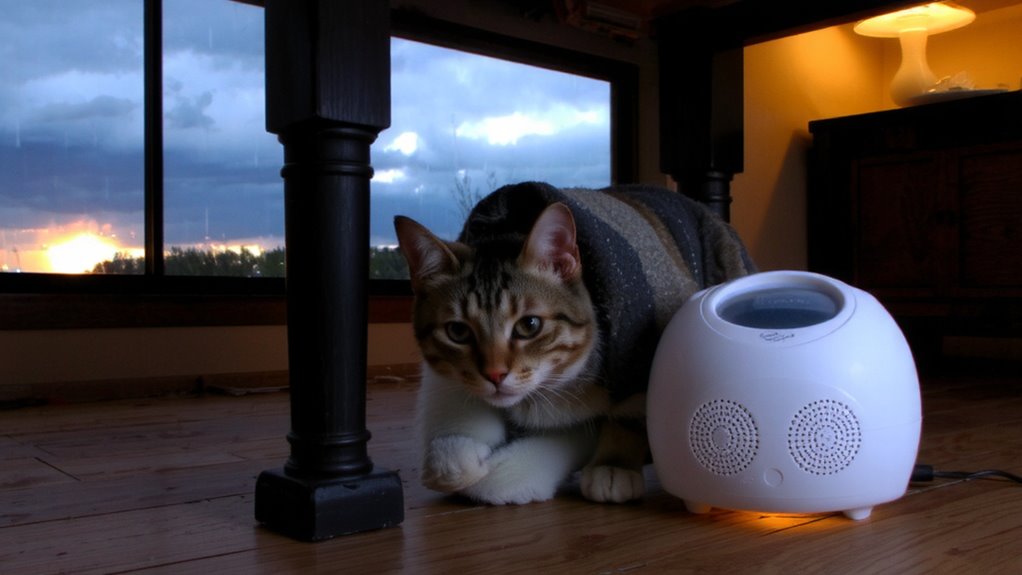
Why do loud booms send your cat sprinting under the bed? Your cat’s reaction stems from evolutionary instincts and heightened hearing. Cats detect sounds up to 64,000 Hz, far beyond the human range of 20,000 Hz. This acute auditory sensitivity allowed wild ancestors to identify prey and predators. Sudden noises like fireworks or thunder register as immediate threats. The loudness of a firework can reach 150 decibels-equivalent to a jet engine at close range. Such intensity overwhelms your cat’s auditory system. These reflexive escape behaviors are hardwired responses, not learned fear. Evolutionary instincts prioritize survival over comfort. Even indoor cats retain these neural pathways. Their brains interpret explosive sounds as danger signals. Immediate shelter-seeking, like hiding under furniture, reduces sensory exposure. This behavior serves a biological purpose. You can’t change these instincts, but you can manage the environment to reduce auditory stressors.
How to Tell If Your Cat Is Anxious During Storms?
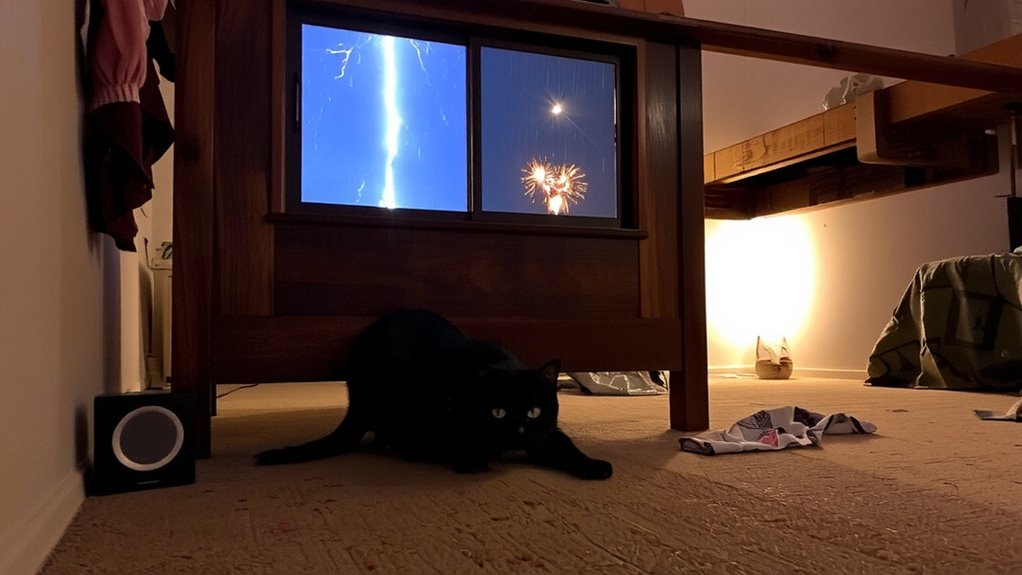
How can you recognize when your cat is struggling with anxiety during a storm? Observe changes in body language, such as flattened ears, dilated pupils, or a tucked tail-these are reliable indicators of acute stress. Pacing or trembling suggests heightened arousal, while excessive grooming may signal displacement behavior. Vocalizations like yowling or meowing more than usual often accompany distress. Most cats retreat to familiar hiding spots under furniture or in closets, seeking enclosed spaces that provide sensory shielding. These locations reduce auditory input and enhance perceived safety. Increased heart rate and panting, though less visible, are physiological markers. Monitoring these behaviors before and during storms allows for early intervention. Consistent patterns across episodes confirm noise-related anxiety. Documenting duration and intensity helps assess severity and guide appropriate mitigation strategies. Incorporating calming supplements may support your cat’s nervous system, and trying a vet-recommended stress relief supplement can make a meaningful difference in managing storm-induced anxiety.
Create a Safe Room for Your Cat Before the Storm Hits
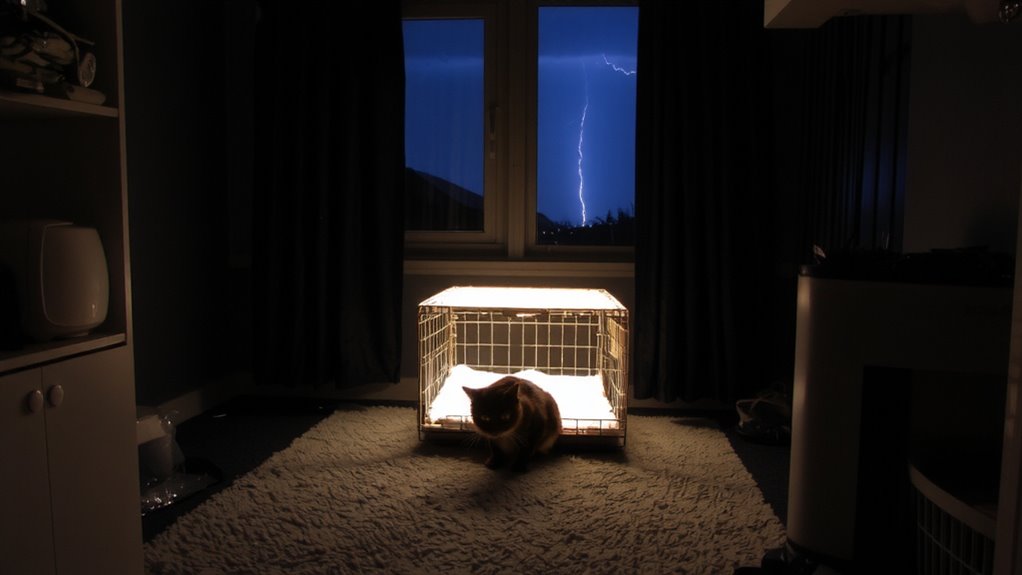
Setting up a designated safe room ahead of storm season gives your cat a predictable refuge when loud weather hits. Choose an interior room with minimal windows, such as a bathroom or closet, to maximize noise reduction. Ideal dimensions are at least 6 x 8 feet to accommodate a litter box, bed, and perch while maintaining a cozy atmosphere. Install solid-core doors (minimum 1¾ inches thick) to block sound transmission. Use acoustic panels or heavy curtains with STC (Sound Transmission Class) ratings of 25+ to dampen sudden booms. Maintain a consistent temperature between 70–75°F. Include a secure hiding box or covered carrier as a safe space-measuring at least 1.5 times your cat’s body length-to trigger a sense of enclosure and safety. Pre-condition your cat to the room using positive reinforcement. Stock it with non-spill water, familiar bedding, and pheromone diffusers to support calm behavior. Consider using a best pet recovery cone if your cat tends to become anxious or injures itself during episodes of extreme fear.
Block Scary Noises With Calming Sounds
Where do your cat’s ears focus when thunder cracks or fireworks explode? They zero in on sudden, high-decibel noises, triggering stress. You can disrupt this response using sound masking. White noise machines emit a steady 45–60 dB output across frequencies, effectively blurring sharp external sounds. These devices work by flooding the auditory environment with uniform sound, reducing the signal-to-noise ratio of alarming bursts. For best results, place the unit 6–8 feet from your cat’s safe space, ensuring even dispersion. Apps or speakers can also generate white noise, but dedicated machines offer consistent performance. Sound masking doesn’t eliminate noise-it dilutes its impact. This method is most effective when started before loud events begin. You’re not erasing the storm; you’re cloaking it. Calming audio, like species-specific music, can complement white noise. Together, they create an acoustic buffer that reduces auditory threat perception.
Train Your Cat to Stay Calm During Loud Noises
Why does your cat panic when the vacuum starts or the fireworks begin? Loud noises trigger a fear response rooted in survival instinct. You can reduce this reaction through gradual desensitization and positive reinforcement. Play recorded loud sounds at low volume while offering treats, praise, or play. Over time, slowly increase the volume only when your cat remains calm.
| Noise Type | Starting Volume (dB) | Duration (min) |
|---|---|---|
| Vacuum | 40 | 5 |
| Thunder | 45 | 7 |
| Fireworks | 50 | 10 |
| Construction | 55 | 8 |
| Traffic | 60 | 6 |
Each session should last 10–15 minutes, daily. Use consistent cues and reward quiet behavior immediately. Never force exposure. This structured approach modifies your cat’s emotional response through associative learning, making loud environments less threatening over time. Incorporating a reliable pet calming aid can further support your cat’s anxiety reduction during training sessions.
Natural Calming Aids for Cats With Noise Anxiety
Calming supplements, pheromone diffusers, and herbal remedies offer measurable relief for cats with noise anxiety when used correctly. Pheromone diffusers, such as Feliway, release synthetic facial pheromones that mimic those cats produce when relaxed, reducing stress behaviors by up to 70% in clinical trials. Plug them in 24 hours before expected noise exposure and keep the room closed for best results. They cover about 580 square feet per unit and last approximately four weeks. Herbal supplements often contain valerian, chamomile, or L-theanine. These ingredients modulate neurotransmitters like GABA and serotonin, promoting mild sedation without impairing coordination. Administer them orally 30–60 minutes before trigger events. Opt for products standardized to active compound concentrations for consistency. Always choose vet-approved herbal supplements to avoid toxicity. Combined with environmental adjustments, these natural aids improve coping mechanisms during loud events.
When to Call the Vet for Severe Thunder or Firework Fear
How do you know when your cat’s fear of thunder or fireworks goes beyond normal skittishness? If your cat experiences panic attacks-characterized by rapid breathing, dilated pupils, trembling, or hiding for hours-you should seek veterinary advice immediately. These episodes may lead to injury or extreme stress. Persistent vocalization, self-trauma, or refusal to eat or drink for more than 12 hours are clinical red flags. In severe cases, veterinarians may recommend emergency sedation with benzodiazepines like alprazolam, administered at 0.02–0.05 mg/kg orally, depending on weight and health status. Never attempt this without professional guidance. Long-term management may include behavior modification or prescription anxiolytics. Early intervention prevents conditioning. Your vet can also rule out cardiac or neurological issues mimicking noise-induced panic. Timely care secures both safety and welfare during storm seasons.
On a final note
You can effectively manage your cat’s noise sensitivity with proactive strategies. Create a sound-dampened safe room using dense materials like mass-loaded vinyl, reducing noise by up to 75%. Use white noise machines set to 60–70 dB to mask sudden sounds. Gradually desensitize with audio recordings at 40 dB, increasing by 5 dB daily. For acute cases, consult your vet about FDA-approved anxiolytics like gabapentin, dosed at 50–100 mg/kg orally.