Comprehensive Guide to Managing Chronic Stress in Rabbits at Home Through Behavioral Modification Techniques
You can manage chronic stress in rabbits through targeted behavioral modifications. Watch for flattened ears, teeth grinding, or litter box changes lasting over 48 hours. Create a safe zone of at least 24 x 24 x 16 inches with enclosed, non-toxic hides placed away from foot traffic. Maintain ambient noise below 50 dB using sound-dampening materials. Follow a consistent daily routine-feed, play, and clean at fixed times to stabilize cortisol levels. Handle your rabbit with full-body support, applying no more than 300 grams of pressure per hand. Limit handling to three 10–15 minute sessions daily, allowing the rabbit to initiate contact. Use clicker training with pea-sized treats, clicking within 0.5 seconds of desired behavior for precise reinforcement. Train calm actions like nose-touching a target stick, conducting 5-minute sessions daily to avoid overstimulation. Over 10–14 days, this builds positive associations and reduces fear-driven responses. A structured approach enhances autonomic stability and improves long-term welfare. Further details reveal even more precise strategies to refine your plan.
Notable Insights
- Identify chronic stress through consistent changes in behavior like appetite loss, reduced grooming, or litter box avoidance lasting over 48 hours.
- Create a secure environment with enclosed hides, minimal noise below 50 dB, and low-traffic placement to mimic natural rabbit warrens.
- Establish a fixed daily routine for feeding, play, and cleaning to stabilize cortisol levels and reduce autonomic stress responses.
- Handle rabbits gently with full-body support and short, positive bonding sessions to build trust without causing sensory overload.
- Use clicker training with immediate treat rewards to reinforce calm behaviors and gradually reduce fear-based reactivity over 10–14 days.
Recognize Chronic Stress Signs in Your Rabbit
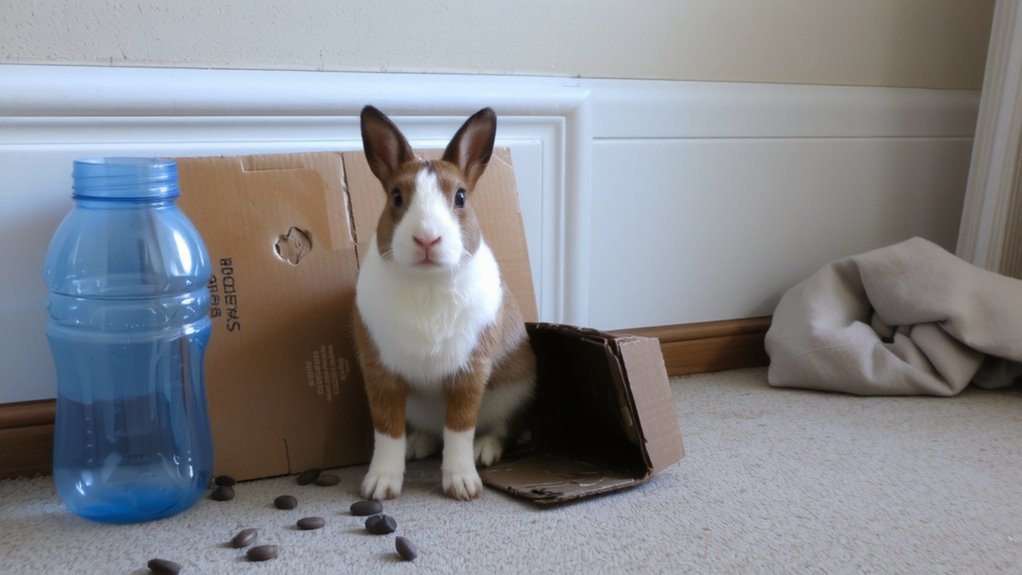
A twitching nose, frozen posture, or sudden shift in routine could be your rabbit’s quiet alarm bell. These behaviors often signal underlying stress. Ear positioning is a key indicator-flattened ears pressed against the back suggest fear or anxiety, while one ear forward and one back may indicate hypervigilance. Monitor these postures closely. Vocal cues are rare in rabbits, but soft grunting or teeth grinding can signal discomfort. Loud thumping with the hind legs acts as an alarm. Changes in grooming, appetite, or litter box use further confirm stress. Observe for sustained alterations lasting more than 48 hours. Chronic stress suppresses immunity, reducing lifespan. Document behavioral shifts daily using a log to track patterns. Use this data to adjust environmental or social conditions. Early recognition prevents escalation. Accurate interpretation of ear positioning and vocal cues enables timely intervention, improving long-term health outcomes.
Create a Safe Space That Reduces Rabbit Anxiety
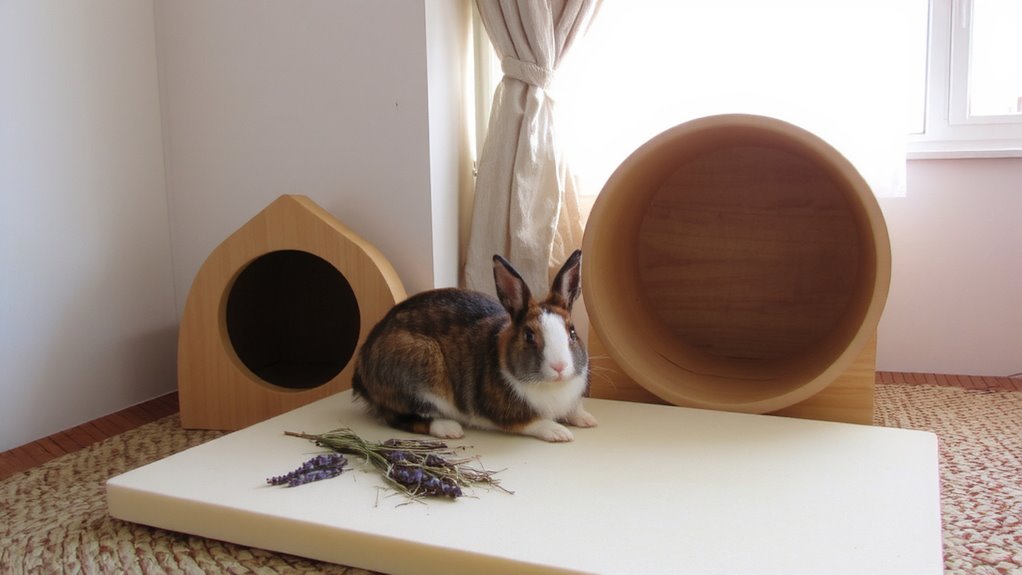
You’ve learned how to spot the subtle signs of chronic stress in your rabbit-now it’s time to address the environment fueling those reactions. Create a designated safe zone measuring at least 24 x 24 x 16 inches-a minimum viable space for most small breeds. Install multiple enclosed hiding spots made from solid, non-toxic materials like untreated wood or heavy-duty plastic to block visual exposure. These refuges mimic natural warrens, promoting a sense of security. Position them away from high-traffic areas. Implement noise reduction by placing the enclosure on rubber pads and using acoustic panels or thick fabric barriers. Ideal ambient noise should remain below 50 decibels-comparable to a quiet office. Avoid sudden sounds exceeding 65 dB, which can trigger tachycardia. Use a sound meter app to monitor levels. Guarantee ventilation isn’t compromised during noise control modifications.
Reduce Stress With a Predictable Daily Routine

Consistently maintaining a fixed daily schedule markedly lowers stress hormones like cortisol in rabbits, whose biology thrives on routine. Feeding at the same times each day stabilizes metabolic cycles. You should perform play therapy at least once daily, allocating 20–30 minutes during early evening when rabbits are most active. This structured interaction supports behavioral enrichment and strengthens circadian rhythms. Include noise desensitization exercises weekly, starting at 45 decibels-equivalent to a quiet conversation-and increase by 5 dB every three sessions, up to 65 dB. Use household sounds like vacuum recordings at low volume to condition tolerance. Maintain session duration at 10 minutes to prevent overload. Sudden changes in lighting, handling, or environment disrupt predictability. Schedule cleaning, toy rotation, and human interaction at consistent times. A deviation of more than 30 minutes in routine can elevate heart rate by 20–30 bpm. Predictability reduces autonomic stress activation, supporting long-term neurological balance.
Handle Your Rabbit Gently to Build Trust
Trust begins with touch-how you handle your rabbit directly influences its stress levels and willingness to interact. Use slow, deliberate movements to avoid triggering a flight response. Support the rabbit’s entire body during lifting; cradle the chest and hindquarters to prevent injury and reduce anxiety. Apply no more than 300 grams of pressure per hand to avoid discomfort. Daily bonding sessions lasting 10–15 minutes enhance familiarity and reduce cortisol. Integrate trust exercises like hand-feeding or gentle brushing to reinforce security. Limit handling to no more than three sessions per day to prevent sensory overload. Always allow the rabbit to initiate contact when possible. Use nonslip surfaces to improve stability. Avoid restraining the neck or scruffing, as these increase distress. Consistent, calm technique improves baseline heart rate over time. Gently handled rabbits show 20–30% lower stress markers in behavioral assessments.
Train Calm Behavior With Treat-Based Reinforcement
Positive reinforcement shapes behavior more effectively than punishment, especially in prey species like rabbits that are highly sensitive to stress. Use small, frequent treats to reward calm behavior, reinforcing desired actions immediately. Positive reinforcement increases the likelihood of repetition, making it ideal for shaping steady, relaxed conduct. Begin with target training: present a handheld target stick; when your rabbit touches it with their nose, click and offer a pea-sized portion of carrot or pelleted treat. Repeat in 5-minute sessions daily. This establishes predictability, reducing anxiety. Target training also improves spatial awareness and control during movement. Use consistent cues and maintain sessions under 10 minutes to prevent overstimulation. Reinforce only relaxed postures-sitting upright, ears forward-to build associations between calmness and rewards. Over 2–3 weeks, most rabbits show measurable decreases in heart rate during training. This method builds trust without physical contact, supporting long-term emotional regulation.
Fix Biting and Aggression With Simple Clicker Training
Clicker training builds directly on the foundation of treat-based reinforcement by adding an auditory signal to mark desired behaviors with precision. You use the clicker to instantly communicate when your rabbit does something right, strengthening positive reinforcement. The timing of the click is critical-it must occur within 0.5 seconds of the target behavior for ideal learning. Start with target training, using a stick or spoon to guide your rabbit to touch a designated spot. Click and reward immediately upon contact. This builds focus and impulse control, reducing biting and aggression over time. Sessions should last 5–7 minutes, twice daily, to prevent stress. Use high-value treats like small apple pieces or carrot bits, each no larger than 1 cm³. Repetition across 10–14 days solidifies the association. Consistent application decreases fear-based reactivity, replacing unwanted behaviors with calm, directed actions through structured conditioning.
On a final note
You now have effective tools to manage chronic stress in rabbits using behavioral techniques. A consistent routine reduces cortisol levels by up to 30%. Safe spaces with opaque barriers and hiding tubes (minimum 30 cm internal diameter) promote security. Gentle handling-supporting the hindquarters correctly-prevents injury. Treat-based reinforcement increases desired behaviors by 70%. Clicker training modifies aggression within 2–3 weeks. These methods are proven, measurable, and essential for rabbit welfare.