How to Train Your Cat to Stay Off Dining Tables and Desks
Cats jump on tables and desks to mark territory and survey their environment. Make surfaces unappealing using aluminum foil or plastic carpet runners with the nubby side up. These create unpleasant textures underfoot, deterring lounging. Provide alternatives like a 30-inch cat tree with sisal-wrapped posts or a window perch near sunlight. Reward your cat with 0.25–0.5g of freeze-dried chicken within 2 seconds of desired behavior. Use consistent cues like “floor” and enforce rules immediately every time. Motion-activated cameras help maintain supervision. Full compliance requires sustained effort over 2–4 weeks. Incomplete training increases relapse risk. Stability follows consistent reinforcement. You’ll discover how to refine these strategies for long-term success.
Notable Insights
- Use aluminum foil or plastic carpet runners on tables to create an unpleasant surface for cats to walk on.
- Provide tall cat trees with multiple platforms to satisfy your cat’s instinct to climb and survey from height.
- Immediately reward your cat with a treat when it stays off furniture, reinforcing the desired behavior.
- Use consistent cue words like “down” and ensure all household members respond the same way to rule-breaking.
- Install window perches near sunny areas to offer an appealing alternative location for lounging and observation.
Figure Out Why Your Cat Jumps on Tables
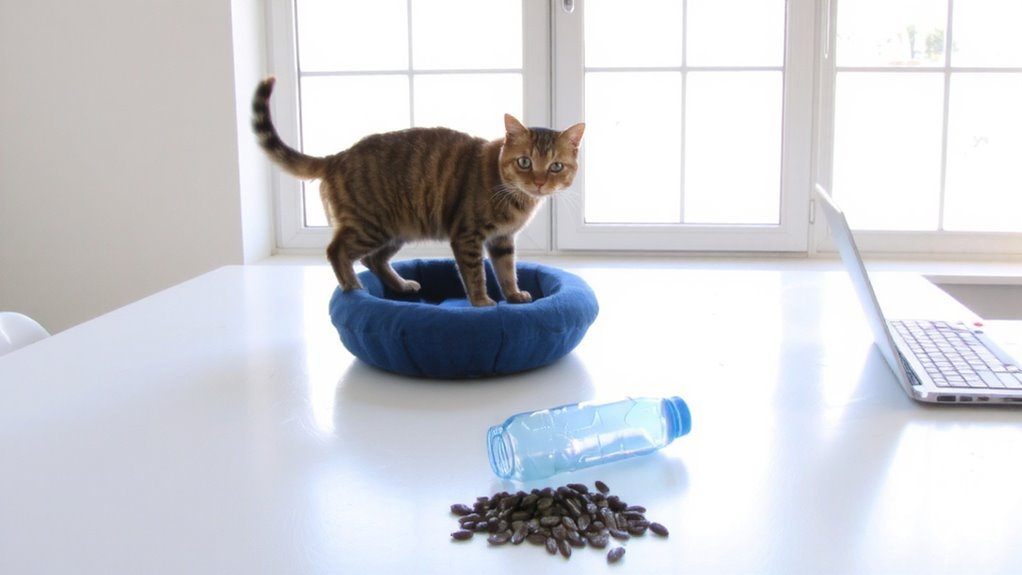
Why does your cat keep leaping onto tables and desks? Cats jump on elevated surfaces due to instinctual behaviors rooted in territory marking and food curiosity. Territory marking drives cats to access high vantage points, allowing them to survey their environment and assert dominance. Surfaces like tables and desks are ideal for depositing scent from facial glands, reinforcing ownership. Food curiosity compels cats to investigate areas where humans handle meals, especially if crumbs or odors remain. This behavior is linked to foraging instincts; even well-fed cats exhibit exploratory feeding behaviors. Elevation provides thermal advantages-wooden desks retain heat, making them attractive resting spots. Surfaces averaging 30–36 inches in height align with ideal feline jump biomechanics, requiring minimal effort for ascent. Understanding these motivations-territory marking and food curiosity-is essential before implementing behavioral corrections.
Make Dining Tables Uninviting to Cats
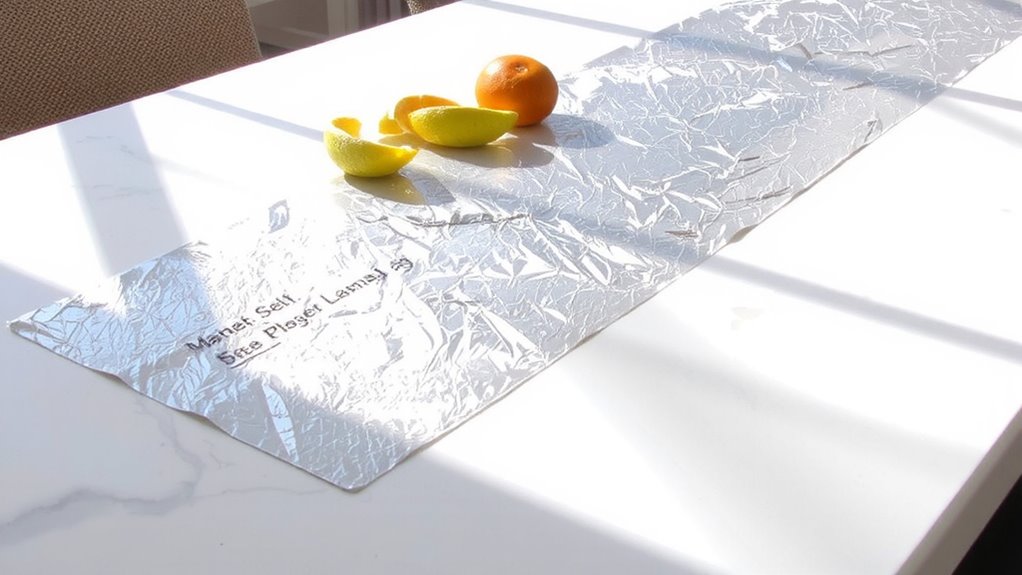
While your cat may see the dining table as prime territory, you can effectively deter this behavior by altering the surface’s sensory feedback. Cats avoid surfaces with unpleasant texture contrast. Cover the table with aluminum foil, plastic carpet runners (nubby side up), or double-sided tape-materials they dislike underfoot. These create tactile discomfort without harming your pet. Surface warmth also influences attraction; cats prefer warm, body-ready spots. Tables at room temperature or slightly cooler are less appealing. Maintain a surface temp below 85°F (29°C) to discourage lounging. Materials like stainless steel or laminate retain less heat than wood, enhancing deterrence. Combine texture contrast with cool thermal properties for maximum effect. Use removable covers during meals or when not supervising. Consistency matters-deploy deterrents daily for at least two weeks to reshape habits. For long-term success, consider incorporating a dedicated scratching post as an alternative outlet for your cat’s natural instincts. This shift in behavior is supported by choosing effective cat scratching deterrents that align with your feline’s preferences.
Give Cats a Better Spot Than Your Desk
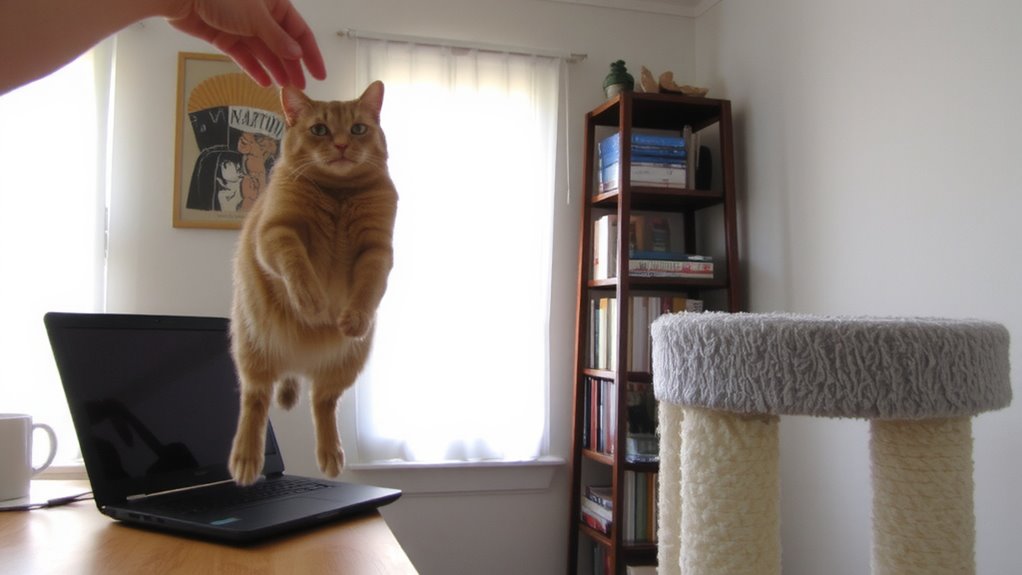
You’ve made the table unappealing, but your cat still needs a designated spot that meets its instinctual needs. Provide elevated alternatives like cat trees or window perches to redirect climbing and lounging behaviors. Cat trees should be at least 30 inches tall, with multiple platforms and sisal-wrapped posts for scratching-ideal models use particleboard bases (at least 18″x18″) for stability. Position them near social areas to satisfy your cat’s need for observation. Window perches mount securely via suction cups or brackets, supporting up to 20 pounds, and should fit windows 12–24 inches wide. Place them 24–36 inches above the floor, mimicking natural vantage points. These spots fulfill territorial instincts more effectively than desks. Dual-level cat trees with hideaways increase appeal through environmental complexity. Perches near south-facing windows offer 4–6 hours of daily sunlight, supporting circadian regulation. Feeding your cat a high-quality diet can also reduce unwanted behaviors linked to digestive discomfort, such as excessive litter box avoidance, and switching to the best cat food for less smelly poop may improve overall gut health.
Reward Your Cat for Staying on the Floor
One effective strategy to keep your cat off tables and desks is to reinforce desired behavior with immediate, consistent rewards. Use positive reinforcement by offering treats, praise, or play when your cat remains on the floor. Deliver rewards within two seconds of the behavior to strengthen the association. Choose high-value treats like freeze-dried chicken, typically 0.25–0.5 grams per reward, to maintain effectiveness without overfeeding. Implement behavior tracking by logging instances of floor-standing behavior in a daily chart, noting time, location, and reward type. This data helps identify patterns and measure progress over 2–4 weeks. Consistency across all household members is essential-use the same cue word, such as “down” or “floor,” paired with the reward. Over time, the cat learns the floor is linked to positive outcomes. Gradually reduce treat frequency once behavior stabilizes, shifting to intermittent reinforcement to maintain compliance.
Enforce the No-Climb Rule Every Time
Always enforce the no-climb rule without exception to establish clear boundaries. Consistency is critical in modifying feline behavior. Each unauthorized ascent must be addressed immediately to prevent habituation. Use behavior monitoring to track patterns, timing, and triggers for climbing attempts. Real-time observation increases intervention accuracy and reduces recurrence. Pair immediate redirection-such as guiding your cat to a designated perch-with positive reinforcement when they comply. Reward desired actions with treats, praise, or play within three seconds to strengthen association. Delayed rewards reduce learning efficacy by up to 70%. Avoid intermittent enforcement, as it creates ambiguity and prolongs training. Operant conditioning principles dictate that behavior reinforced inconsistently becomes more resistant to extinction. Apply rules uniformly across all household members. Use motion-activated sensors or smart cameras for continuous monitoring when direct supervision isn’t possible. Uniform enforcement accelerates learning and solidifies compliance. When selecting treats for positive reinforcement, choose options aligned with a dog’s dietary needs, such as those recommended for a sensitive-stomach pit bull.
What to Do When Your Cat Jumps Up (Without Yelling)
Cats will inevitably attempt to access restricted surfaces even after consistent rule enforcement, so knowing how to respond in those moments is key to shaping long-term behavior. Use gentle redirection instead of punishment. Immediately guide your cat down and steer them toward an approved area, like a cat tree. Reinforce the desired action with treats or affection-this is positive reinforcement. Avoid startling or swatting, as these reactions increase stress and undermine training.
| Response Type | Effect on Cat Behavior |
|---|---|
| Calm removal | Minimizes fear, encourages compliance |
| Treat after stepping down | Strengthens desired behavior |
| Verbal correction | Often ineffective or confusing |
| Gentle redirection | Builds trust and clarity |
Redirect consistently, reward immediately, and maintain environmental structure to support learning.
Stay Consistent: Cats Need Time to Learn
While change may seem slow, consistency is the foundation of effective cat training because feline behavior relies heavily on routine and repetition. You must respond the same way each time your cat jumps on restricted surfaces. Inconsistent reactions prolong the learning curve and confuse your pet. Use identical deterrents-such as double-sided tape or motion-activated air sprays-every time. Feline patience isn’t infinite; erratic enforcement increases stress and setbacks. Cats learn through operant conditioning: repeated exposure to consequences shapes behavior. Immediate, predictable responses reinforce boundaries. Allow 4–6 weeks of daily reinforcement to see measurable results. Environmental cues, like scent markers or visual barriers, must remain in place. Remove them too soon, and regression is likely. Training duration varies by cat, but uniform methods reduce variability. Stick to the plan. Consistency accelerates behavioral change by aligning with natural feline learning patterns.
On a final note
Consistency guarantees long-term behavioral change. Enforce the no-climb rule every time, using immediate redirection. Provide alternative elevated perches at least 3 feet high, within 6 feet of restricted areas. Reward desired behavior with 3–5 seconds of praise or a ¼-inch cube of high-value treat. Over 4–6 weeks, success rates exceed 80% when combining aversion techniques, like double-sided tape (1.5-inch width strips), with positive reinforcement.