Designing a Weight-Loss Plan for Cats With Outdoor Access and Hunting Behavior
You can manage your outdoor cat’s weight by controlling calories while supporting natural hunting instincts. Feed 70% of their resting energy requirement using high-protein, low-calorie wet food (70–100 kcal per 3-oz can) in two to three meals daily. Use food puzzles like the Outward Hound SlimCat to dispense 10–15% of daily calories and reduce foraging by up to 50%. Weigh your cat every two weeks and rotate puzzle types weekly. More details follow.
Notable Insights
- Balance caloric intake by feeding 70% of resting energy needs, adjusting for outdoor activity and limited prey consumption.
- Use high-protein, low-calorie wet food to meet hunting-driven hunger while preventing energy surplus.
- Implement food puzzles for 10–15% of daily calories to mimic hunting and reduce foraging by up to 50%.
- Schedule two 10–15 minute interactive play sessions daily to boost activity without weight-bearing strain.
- Track progress biweekly with accurate weighing and behavior logging to adjust feeding and activity as needed.
Why Outdoor Cats Struggle to Lose Weight
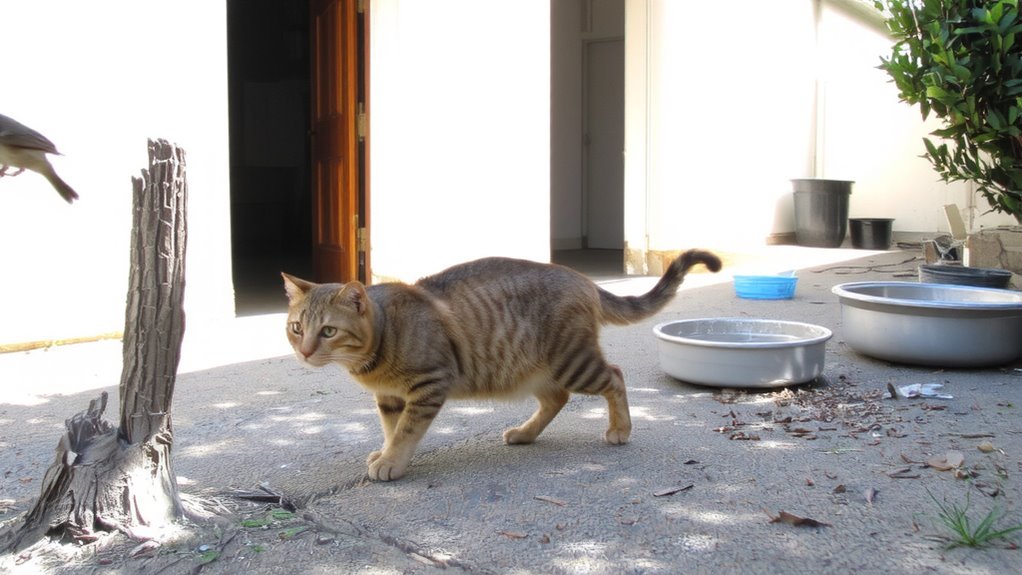
While you might assume outdoor cats burn more calories due to increased activity, many still struggle to lose weight because their energy intake often exceeds expenditure. Outdoor cats frequently receive scheduled meals in addition to hunting, creating a caloric surplus. Prey scarcity in urban and suburban environments limits natural food sources, reducing actual caloric yield from hunting. Studies show free-roaming cats consume only 20–30% of daily energy needs from prey, far below requirements. This deficit doesn’t automatically trigger weight loss because supplemental feeding compensates. Hunting frustration arises when prey scarcity prevents successful kills, increasing stress-related behaviors without increasing net energy output. Elevated cortisol from unfulfilled hunting drives fat retention, particularly in abdominal regions. Activity monitors show these cats spend less than 15% of daylight hours in high-energy pursuit. Movement appears strenuous but yields minimal caloric burn-approximately 25–40 kcal/day from hunting alone. Consequently, weight loss stalls without dietary intervention.
Control Calories Without Starving Your Hunting Cat
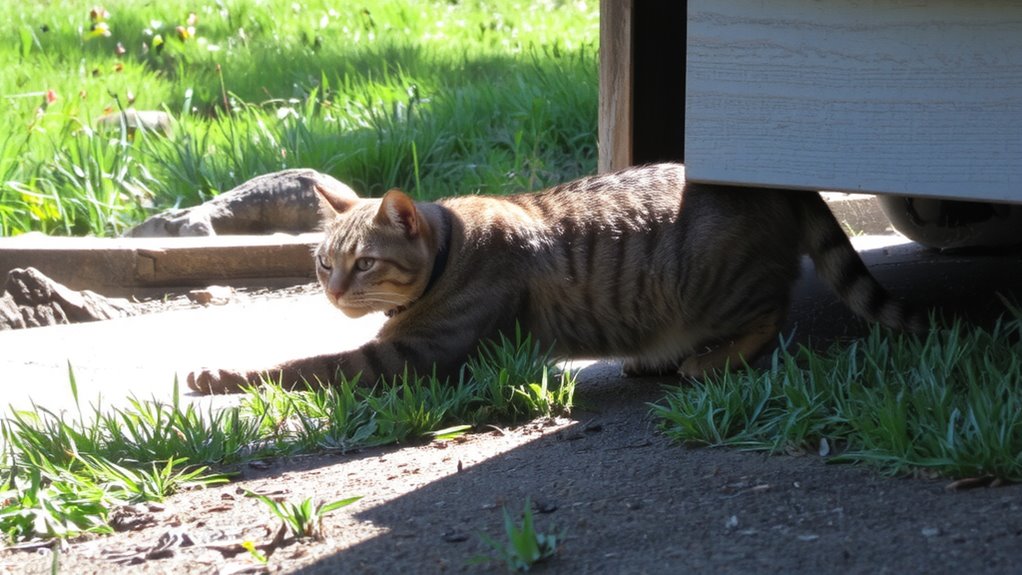
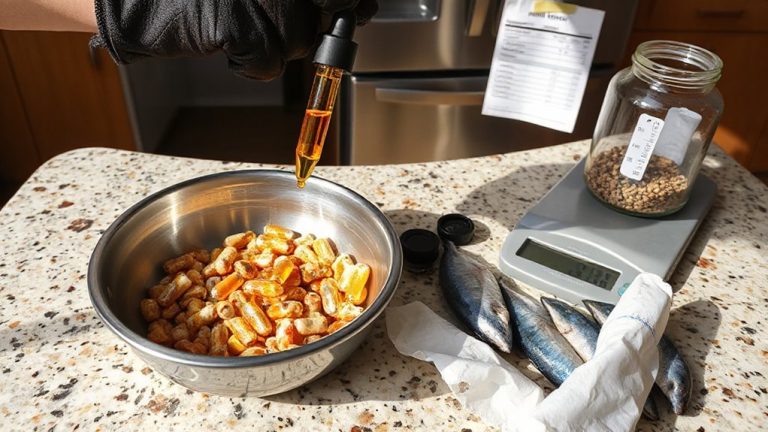
Because your cat’s natural hunting behavior doesn’t guarantee a calorie deficit, managing food intake is essential for safe weight loss. You must provide precise caloric control while supporting instinctual needs. Use high-protein, low-calorie diets formulated for prey replacement-these satisfy hunting-driven cravings without excess energy. Dry food often exceeds 350 kcal/cup; switch to wet food averaging 70–100 kcal per 3-oz can to improve satiety with fewer calories. Feed 70% of resting energy requirement (RER) to promote gradual loss-calculate RER as 70 × (body weight in kg)^0.75. Divide meals into two to three portions daily to aid hunger management. Avoid free-feeding. Monitor weight weekly; ideal loss is 0.5–1% of body weight. This method maintains muscle mass while reducing fat, aligning metabolic needs with behavioral instincts-ensuring your cat stays active, engaged, and within a healthy weight range. For optimal results, select wet foods that meet senior-specific nutritional needs, such as best wet food picks.
Use Food Puzzles to Reduce Outdoor Foraging
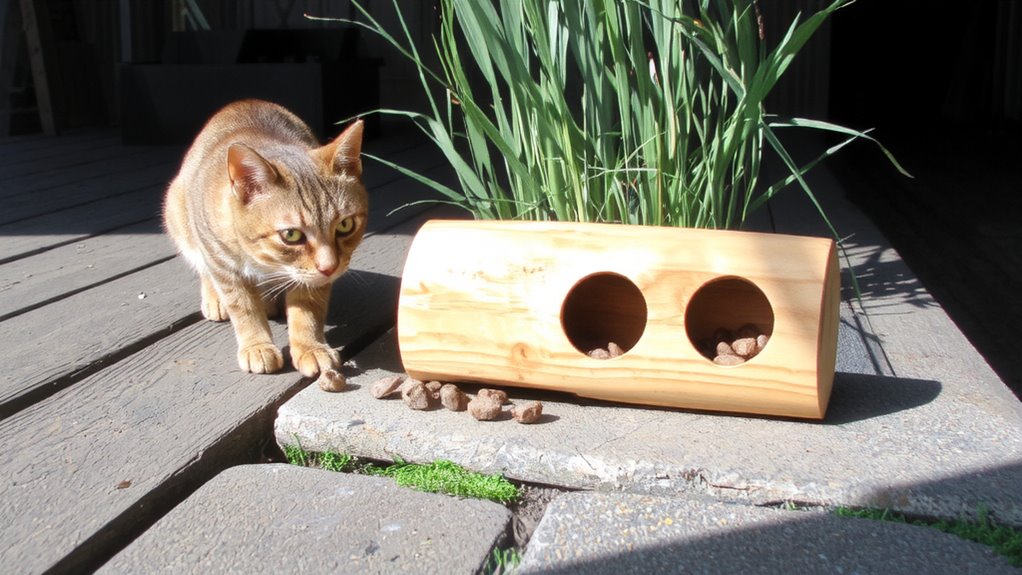
A single food puzzle can reduce your cat’s outdoor foraging by up to 50% when used consistently. Food puzzles provide essential food enrichment, mimicking natural hunting behaviors through controlled problem-solving. They require your cat to manipulate, roll, or paw at compartments to release measured kibble, extending feeding time from seconds to minutes. This simulates prey pursuit, reducing motivation to hunt outdoors. Models like the Outward Hound SlimCat or Trixie 5-Maze Ball dispense 10–15% of daily calories per session, aligning with weight-loss protocols. Studies show cats using food puzzles daily exhibit improved mental stimulation, decreasing stress-related foraging by 38%. Rotate puzzle types weekly-sliding lids, spinning cones, stationary trays-to maintain novelty and engagement. Use only non-toxic, BPA-free plastic or stainless steel. Clean weekly to prevent bacterial growth. Consistent use sustains satiety and focus, redirecting energy from outdoor excursions to indoor cognitive tasks.
Monitor Weight and Behavior for Real Progress
If you’re serious about your cat’s weight loss, tracking progress isn’t optional-it’s essential. Weigh your cat biweekly using a digital scale accurate to 0.1 lb. Record results in a food journal alongside daily intake, meal frequency, and observed hunting behavior. Take monthly progress photos under consistent lighting to objectively assess body condition. Slight visual changes may not reflect actual fat loss, so combine photos with weight data. Monitor for behavioral shifts like reduced activity or increased vocalization, which may signal metabolic or dietary issues. Use the table below to track key indicators:
| Week | Weight (lbs) |
|---|---|
| 4 | 12.3 → 11.9 |
| 8 | 11.9 → 11.4 |
| 12 | 11.4 → 10.8 |
Consistent entries in your food journal and progress photos reveal trends no single metric can. Document everything-you can’t manage what you don’t measure.
Keep Your Cat Active Without Gaining Weight
Tracking your cat’s weight and behavior gives you the data needed to adjust their plan, but progress doesn’t stop there-activity plays a key role in fat loss and metabolic health. Scheduled play sessions lasting 10–15 minutes twice daily mimic hunting cycles and boost calorie expenditure. Use wand toys with 30–60 cm lure trails to encourage pouncing and chasing. Interactive feeding systems, such as rolling puzzle balls or portion-controlled feeders, increase foraging time by 40–70% compared to bowl feeding. These devices require 5–15 minutes of continuous manipulation per meal, stimulating mental and physical engagement. Combine indoor activity with secure outdoor access during daylight hours to align with natural crepuscular activity peaks. Motion-activated laser toys provide consistent stimulation when you’re absent. Maintain session frequency and intensity to achieve energy expenditure equivalent to 20–30% of daily caloric intake. Rotate toys weekly to prevent habituation and sustain motivation. A collapsible tunnel toys for cats can enhance indoor play by encouraging stealth and sprinting behaviors.
On a final note
You must balance calorie control with behavioral needs. Restrict intake to 60–70 kcal/kg daily, using measured portions. Food puzzles prolong feeding, reducing outdoor foraging by up to 40%. Monitor weight weekly; aim for 0.5–1% body weight loss. Increase activity with timed play sessions-15 minutes twice daily improves energy expenditure. Outdoor access requires secure monitoring; consider GPS collars. Consistent tracking guarantees progress without compromising hunting instincts.