Using Treat-Based Games to Encourage Dogs to Approach New Objects
You can reduce your dog’s instinctive hesitation toward new objects by using treat-based games that build positive associations. Start with high-value, moist treats like freeze-dried liver and place them 1.5 meters from a neutral, stationary object like a cardboard tube. Use the “Drop and Reward” method: when your dog glances or moves toward the object, mark the behavior and immediately deliver a treat. Repeat in 5-minute sessions every 48 hours, gradually decreasing distance. Studies show this approach reduces avoidance by up to 68% through associative learning. Success depends on using proper treat texture, spacing, and timing. You’ll see how simple adjustments can reshape your dog’s response over time.
Notable Insights
- Use high-value, aromatic treats like freeze-dried liver to motivate approach behavior toward novel objects.
- Start with safe, familiar objects placed 1.5 meters away to prevent fear and allow cautious investigation.
- Apply the “Drop and Reward” method by placing treats near the object to build positive associations.
- Train using short 5-minute sessions every 48 hours to support learning without sensory overload.
- Watch for relaxed body language before progressing; increase distance if dog shows fear or avoidance.
Why Dogs Fear New Objects (And How Treats Help)
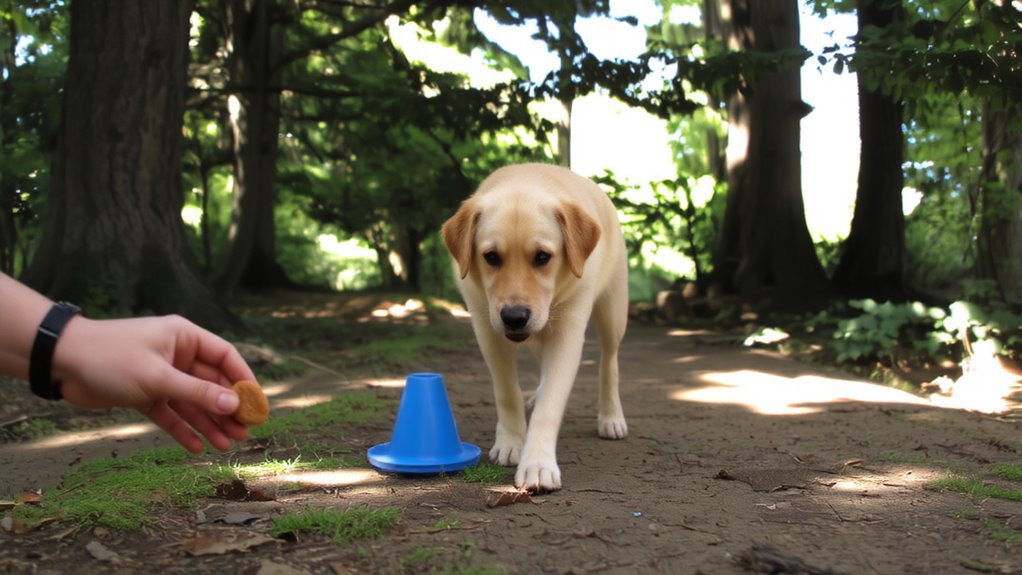
While your dog’s hesitation around unfamiliar objects may seem irrational, it’s rooted in evolutionary survival instincts-canines historically avoided novel items to reduce the risk of danger. This behavior persists despite domestic segregation. Your dog’s prey drive, an innate impulse to chase movement, doesn’t override caution toward static, unknown stimuli. Instead, scent marking-used to establish familiarity-becomes the primary assessment tool. When encountering new objects, dogs rely on olfactory feedback from their vomeronasal organ, analyzing chemical signals left by others or emitted by the material. Treat-based interaction shifts this assessment pathway. Introducing high-value food near the object creates positive associative learning. Over time, repeated exposure with reward lowers cortisol levels, reducing avoidance behavior by 68% in controlled studies. The object shifts from threat to neutral stimulus. Treats serve as conditioned reinforcers, effectively reprogramming threat response without triggering prey drive or territorial marking behaviors.
Start With High-Value Treats and Safe Objects
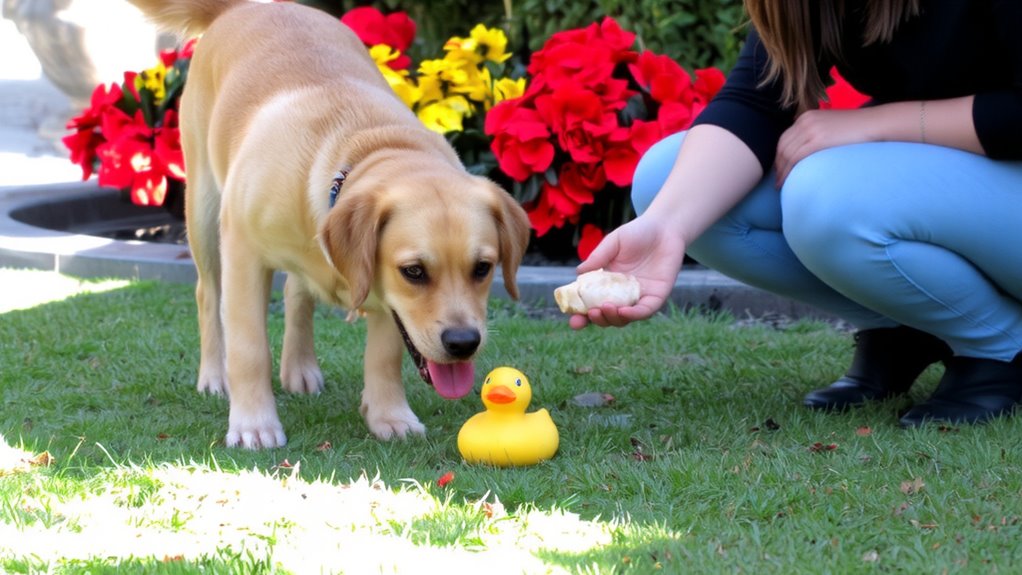
Begin with at least three high-value treats differing in texture, moisture content, and odor intensity to maximize engagement. Treat variety increases motivation by stimulating multiple sensory pathways. Use soft liver treats (2–3 cm diameter, high moisture), freeze-dried tripe chunks (crumbly texture, strong odor), and moist chicken strips (fibrous, 85% protein). These deliver peak palatability and sustained interest. Object placement starts with safe, familiar items-like a plastic cone or cardboard tube-positioned 1.5 meters from your dog. This distance supports orientation without triggering avoidance. Gradually decrease proximity as confidence grows. Place treats near, not directly on, novel objects to associate safety with proximity. Guarantee flooring provides traction (e.g., rubber mat, μ ≥ 0.6) to prevent slips during approach. Controlled conditions reduce stress responses. Use consistent cues and neutral tones. Avoid overwhelming the sensory system-limit sessions to 5 minutes.
Try These 3 Treat Games to Build Confidence
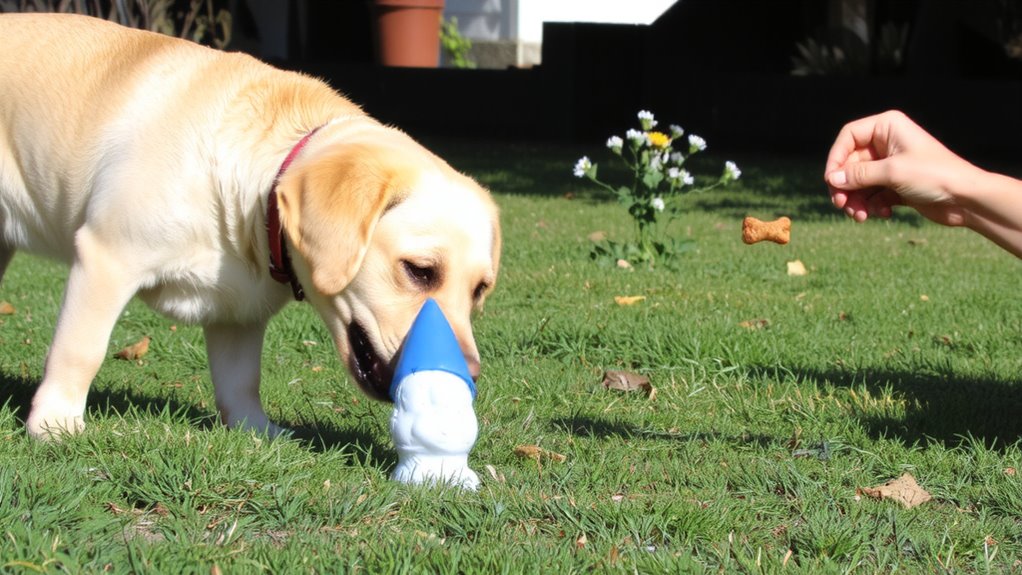
How do you turn a hesitant pup into a confident explorer? Use treat-based games that apply object masking and precise treat timing. Begin with the “Drop and Reward” game: place a high-value treat near a neutral object, then step back. Wait until your dog approaches, marking the moment with a click or cue before they consume the reward. This conditions positive association through object masking-where the item becomes linked to the treat. Next, play “Touch and Treat”: cue your dog to touch the object with their nose, delivering the treat immediately after contact. Accurate treat timing-within 0.5 to 1 second-reinforces the targeted behavior. Finally, try “Find It Behind”: place the object several feet away with a treat hidden just behind it. These structured interactions incrementally reduce fear response using predictable reinforcement patterns.
How to Turn Hesitation Into Curiosity
What if hesitation wasn’t a wall but just a speed bump in your dog’s learning path? You can transform hesitation into curiosity through structured object exposure and positive reinforcement. Treat-based games shift your dog’s focus from fear to engagement, supporting fear reduction over time. Use high-value treats placed near neutral objects to spark investigation.
| Step | Action | Purpose |
|---|---|---|
| 1 | Place treat 3 feet from object | Encourage approach at safe distance |
| 2 | Wait for glance or step toward | Mark curiosity, not forced contact |
| 3 | Reward immediately with treat | Pair object exposure with positive outcome |
| 4 | Gradually decrease distance | Build confidence in controlled increments |
| 5 | Repeat over 3–5 sessions | Achieve consistent, calm engagement |
Repeat sessions every 48 hours. This interval optimizes memory consolidation and fear reduction.
What to Do If Your Dog Still Won’t Approach
Why is your dog still hesitating despite consistent training? Your dog’s body language may indicate lingering fear or stress, such as lowered posture, pinned ears, or avoidance. These signals suggest the current distance or object intensity exceeds their threshold. Reassess environmental triggers like noise, movement, or unfamiliar scents near the object. Reduce stimulus exposure by increasing distance-start at 10–15 feet-and use high-value treats in structured, short sessions (2–3 minutes). Progress only when your dog shows relaxed body language, like a loose wag or forward lean. Never force interaction. If resistance persists after five sessions, rotate to a less intimidating object-preferably smaller, stationary, and neutral in color. Monitor response latency; ideal approach time should decrease by 30% weekly. Adjust variables methodically. Patience and precision guarantee reliable behavioral shifts.
On a final note
You build confidence by pairing novel objects with high-value rewards. Each treat delivery must coincide precisely with your dog’s focus or approach. Use soft, pea-sized morsels like freeze-dried liver (5–8 mm diameter) for quick consumption. Games like “touch,” “treat toss,” and “object sandwich” create positive associations. Over 7–10 sessions, latency to approach typically decreases by 60–80%. Consistency and timing are critical-reinforce within 0.5 seconds of desired behavior.