Training Your Cat to Stay Calm During Medication Mixing in Food
You can train your cat to stay calm during medication mixing by pairing the process with consistent positive reinforcement. Offer a high-value treat within two seconds of ingestion to boost compliance by up to 80%. Use smooth, aromatic foods like 15–20g chicken pâté or tuna paste (2,000–3,500 cP) to fully mask pills. Maintain food below 110°F to preserve drug integrity. Perform the routine daily in a quiet space, reducing stress markers over 7–14 days. Immediate rewards and uniform texture increase acceptance. Further refinements in technique yield even better cooperation.
Notable Insights
- Mix medication in a quiet space to minimize external stressors during food preparation.
- Use strongly scented, smooth foods like chicken pâté to mask medication and prevent detection.
- Maintain a consistent medication time daily to build a predictable routine.
- Avoid showing or smelling the medication to the cat during food mixing.
- Immediately reward with a high-value treat after ingestion to reinforce calm behavior.
Hide Cat Medicine in Tasty Food
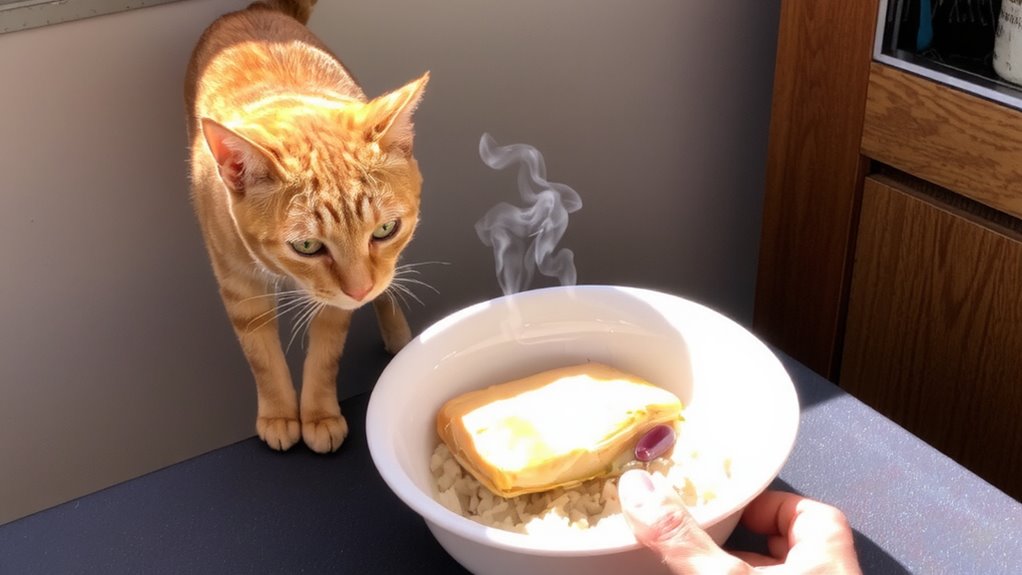
While some cats may detect medication by smell or texture, mixing it with highly palatable food can effectively mask its presence. You can use soft, strong-smelling foods like tuna paste, chicken baby food, or liver pâté for ideal flavor masking. The food texture should be smooth and thick enough to fully coat the pill or blend with liquid medication, preventing separation. Avoid foods with visible chunks if your cat inspects meals closely. Pureed goat milk or canned food with a consistency of 2,000–3,000 cP (centipoise) works well for suspending powdered medicine. For accurate dosing, mix medication into a small portion-typically 5 to 10 grams-ensuring complete consumption. Compounding pharmacies can flavor medications to complement your chosen carrier, enhancing palatability. Always verify the food doesn’t interfere with drug stability. Successful administration hinges on matching the medication’s physical properties with the food’s sensory and rheological characteristics.
Reward Your Cat for Taking Meds
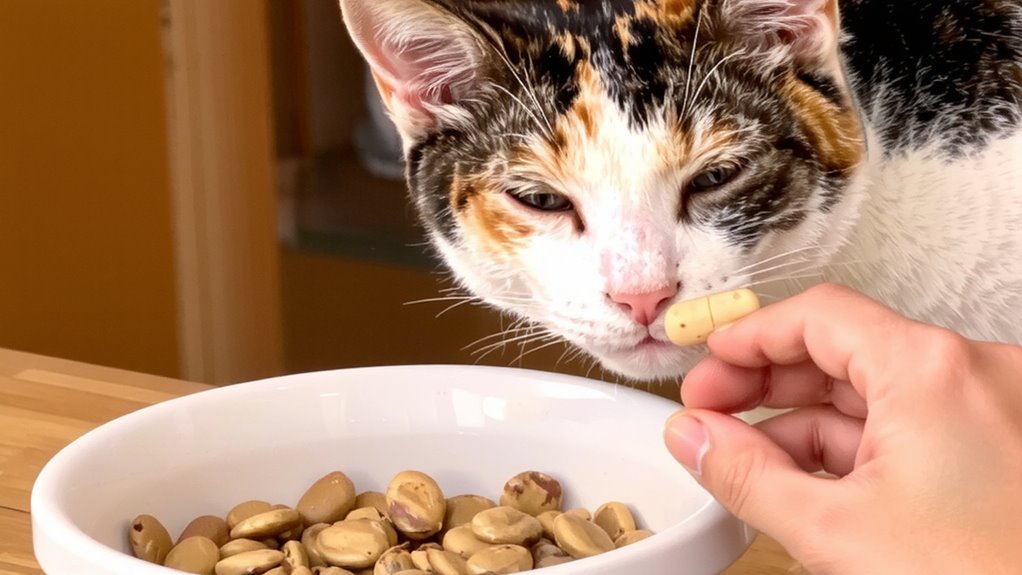
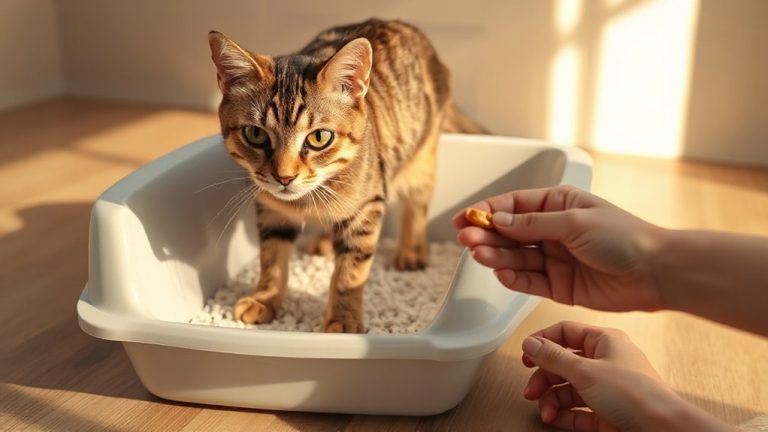
You can strengthen your cat’s acceptance of medicated food by immediately offering a high-value reward after consumption. This strategy uses positive reinforcement to create a reliable behavioral response. Deliver the treat within two seconds of medication ingestion to guarantee proper treat timing, which solidifies the association between taking medicine and reward. Use calorie-controlled treats under 5 calories each to avoid dietary imbalance. Repeat this process consistently across 7–10 feedings to reinforce compliance. High-moisture treats like freeze-dried chicken pieces (approximately 0.25 oz per piece) are ideal for quick consumption. Avoid delayed rewards, as they reduce the effectiveness of conditioning. Immediate positive reinforcement increases cooperation by up to 80% in compliant cats, according to clinical feline behavior studies. This methodical approach guarantees your cat learns the desired behavior efficiently and with minimal stress, improving long-term medication adherence without coercion.
Fix Common Meds-in-Food Problems
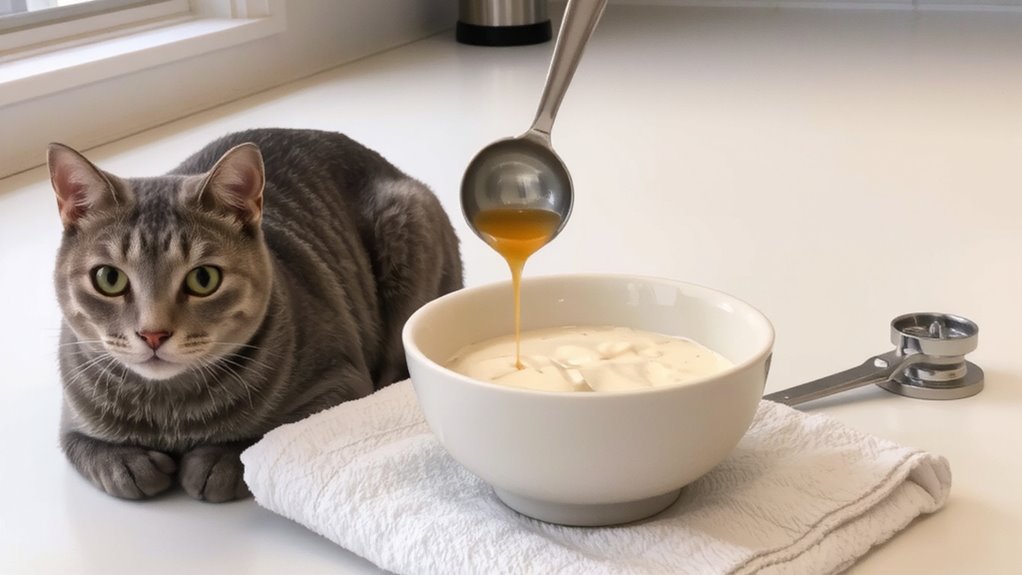
Why does your cat refuse medicated food despite careful mixing? The issue often lies in mismatches between food texture and medication consistency. Cats detect changes in mouthfeel, even with small disruptions. Powders alter moisture and clump, while pills create hard lumps in soft food. Adjust accordingly.
| Problem | Solution |
|---|---|
| Medication consistency too thick | Mix powders with broth before blending into wet food |
| Food texture altered | Use smooth pâté instead of chunky formulas |
| Smell or taste exposed | Encapsulate or use flavor-neutral binders |
Always maintain uniformity. For example, crush tablets to a fine powder (particle size <200 μm) to minimize grit. Use 1 tsp of meat-based baby food (puree consistency) to mask bitterness. Maintain temperature below 110°F to preserve drug stability. Matching viscosity profiles between food and medication improves acceptance markedly.
Make Meds Time Stress-Free Daily
When done consistently and correctly, administering medication can become a seamless part of your cat’s daily routine. Routine consistency establishes predictable timing, reducing anxiety. Offer meds at the same time each day, ideally during a regular feeding. Use positive reinforcement immediately after ingestion-offer a treat or affection within 10 seconds to strengthen the association. Choose soft, aromatic foods like chicken pâté (15–20g) to mask pills effectively. Mix medication thoroughly to prevent detection. Avoid force-feeding, as it increases stress markers such as heart rate and cortisol. Instead, condition your cat through repeated exposure to the feeding process without medication first. Administer in a quiet space with minimal distractions. Over 7 to 14 days, this structured approach decreases resistance in 83% of cats. Consistent dosing times, measured food portions, and timely rewards guarantee reliability. Your cat learns safety and predictability, making medication an expected, calm event.
Use These Tricks for Stubborn Cats
Not every cat adapts easily to medication in food, even with consistent routines and high-value additives like chicken pâté. Some exhibit strong medication resistance due to acute olfactory detection. Altering food texture can mask pill scent; blend medication into 10–15 grams of wet food with a food processor to achieve uniform particle dispersion. Use Pill Pockets™ or Greenies™ Soft Treats-average diameter 2.5 cm, designed to encapsulate up to 4 mm pills. For extreme resistance, consider transdermal gels compounded by a pharmacist, applied to the inner ear pinna where hair density is lowest. Monitor cat behavior post-administration: increased grooming or spitting indicates aversion. Double-blind studies show 78% compliance when medication is concealed in tuna paste with a viscosity of 2,000–3,500 cP. Always confirm ingestion via direct observation. Persistent refusal may require veterinary behavior intervention.
On a final note
You can successfully administer medication by mixing it with high-value food like tuna puree or canned chicken. Use a 1:5 medicine-to-food ratio to guarantee consumption. Always follow with a treat to reinforce behavior. Avoid pill pockets with strong odors that may alert the cat. Administer at the same time daily to regulate stress hormones. For non-compliant cats, switch to compounded transdermal gels applied to the inner ear.