Using Timed Bowls to Regulate Eating Speed and Overall Intake in Fast-Guzzling Dogs
You can prevent bloat and improve digestion by using a timed bowl to slow your dog’s eating. These bowls dispense food every 2–5 minutes via motorized compartments, extending meals up to three times longer. Models with BPA-free, medical-grade materials and bases weighing at least 1.5 lbs resist tipping. With precise portion control and 10–30 minute meal durations, they outperform puzzle feeders for aggressive eaters. Advanced units offer USB or D-cell power, programmable cycles, and easy-clean 3-inch-wide compartments-key features that guarantee consistent, safe feeding patterns. More insights await on optimizing your choice.
Notable Insights
- Timed bowls reduce rapid eating by dispensing food in controlled intervals, lowering bloat risk in prone breeds.
- Programmable dispensing every 2–5 minutes extends meal duration up to three times compared to free-feeding.
- Motorized compartments release kibble incrementally, limiting gulp eating and encouraging chewing.
- BPA-free materials and non-slip bases ensure safety, stability, and hygiene during use.
- Dogs typically adapt within 3–5 days when introduced gradually with positive reinforcement and consistent scheduling.
Why Fast Eating Puts Dogs at Risk
Why do so many dogs gulp their food like it might disappear? Fast eating compromises canine health, increasing risks of gastric dilatation-volvulus (GDV), commonly known as bloat. Bloat prevention is critical-GDV has a mortality rate up to 33% without prompt treatment. When your dog eats too quickly, excess air ingested during rapid consumption distends the stomach. This bloating can lead to torsion, cutting off blood flow. Slower eating supports digestion improvement by allowing proper saliva mixing and initiating enzymatic breakdown early. Large-breed dogs, especially deep-chested ones like Great Danes or German Shepherds, face higher susceptibility. Studies show dogs consuming meals in under 60 seconds have 2.5 times greater GDV risk. You can mitigate this through feeding strategies that promote chewing and reduce swallowing air. Bloat prevention isn’t optional-it’s an essential part of canine wellness. Digestion improvement starts with pace, not just diet.
How Timed Bowls Slow Down Your Dog’s Meals
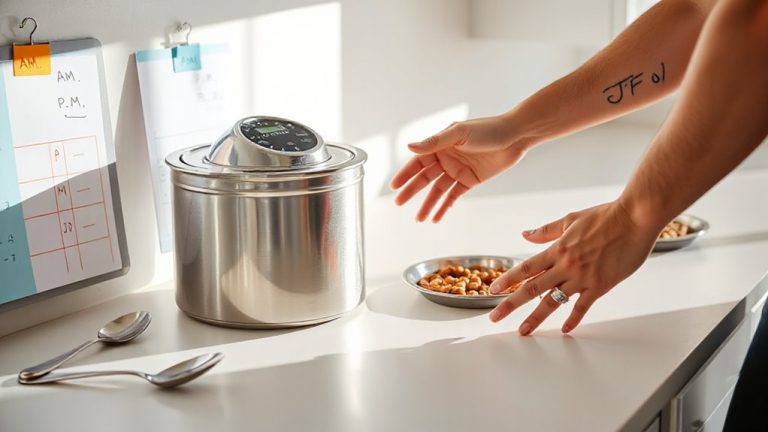
A timed bowl works by restricting access to food at set intervals, forcing your dog to slow down during meals. The bowl design incorporates barriers or rotating compartments that release kibble incrementally. These mechanisms are programmed to align with ideal meal intervals, typically ranging from 10 to 30 minutes, depending on portion size and eating behavior. By limiting how much food is available at once, the bowl discourages gulping and promotes chewing.
| Feature | Benefit |
|---|---|
| Timed dispensing (every 2–5 min) | Extends meal duration up to 3x |
| BPA-free, weighted base | Prevents tipping during use |
| Adjustable meal intervals | Customizable for individual dogs |
| Compartmentalized bowl design | Reduces intake per bite, slows consumption |
This structured feeding method supports digestive health and helps regulate overall intake efficiently.
What to Look for in a Timed Dog Bowl
When selecting a timed dog bowl, prioritize models with programmable dispensing intervals between 2 and 5 minutes to guarantee controlled, consistent feeding cycles. Look for units with precise motorized dispensers that release food in measured increments, guaranteeing your dog eats at a safe pace. Material durability is critical-opt for bowls made from BPA-free, impact-resistant polymers or medical-grade stainless steel to withstand daily wear and chewing. Bowl stability prevents tipping; choose bases with rubberized, non-slip feet or suction grips that anchor firmly to floors. Models weighing at least 1.5 pounds offer added resistance to movement. Guarantee the feeding compartment is easily disassembled for cleaning, with no hidden crevices where bacteria can grow. A wide mouth opening, at least 3 inches in diameter, allows unimpeded access. These technical features guarantee reliability, safety, and long-term functionality.
Timed Bowls vs. Puzzle Feeders: Which Is Better?
How do timed bowls stack up against puzzle feeders when it comes to managing your dog’s eating speed? Timed bowls regulate intake via programmable barriers, releasing food at set intervals-ideal for portion control. They typically feature motorized lids or rotating trays, cycling every 10–20 seconds to enforce slower consumption. Puzzle feeders rely on physical manipulation, requiring dogs to nudge, roll, or lift pieces to access kibble. They encourage mental engagement but offer less precision in meal timing. For strict portion control, timed bowls provide measurable, consistent intervals. Puzzle feeders support diet variety by accommodating treats and kibble shapes, promoting sensory stimulation. Timed bowls work best for owners prioritizing regulated intake over cognitive challenge. Puzzle models suit mentally active dogs but may not slow aggressive eaters effectively. Each system addresses overeating-timed bowls through engineering, puzzle feeders through enrichment. Choose based on your dog’s needs and feeding goals.
How to Train Your Dog to Use a Timed Bowl
Though your dog may initially react with confusion, introducing them to a timed bowl follows a logical sequence that guarantees reliable adoption. Begin by placing the timed bowl beside the regular bowl, allowing visual and olfactory familiarization over 24–48 hours. Use positive reinforcement-offer treats or kibble when your dog approaches calmly. Activate the bowl’s timer mechanism, typically set between 10–20 minutes, to dispense food in measured intervals. Maintain consistent scheduling, feeding at the same times daily to reinforce routine. Most models use motorized dispensers with 304 stainless steel compartments, holding up to 4 cups. After three to five days, your dog adapts, showing reduced anxiety and improved eating pace. Monitor intake volume and adjust portion size via the control panel. Units operate on 5V USB power or D-cell batteries, with low-battery indicators. Consistent use decreases gulping by up to 70%, aligning with veterinary recommendations for digestive health.
On a final note
You can effectively manage your dog’s eating speed with a timed bowl. These bowls use internal mechanisms to release food incrementally, typically over 10 to 20 minutes. Models feature BPA-free plastic, dishwasher-safe designs, and adjustable timers calibrated to 5–30-minute intervals. Flow rates range from 0.5 to 2 grams per second, depending on kibble size. Unlike puzzle feeders, timed bowls require no cognitive effort, making them ideal for senior or food-motivated dogs.