Teaching Your Cat to Play With Wand Toys Without Biting Hands
You can stop hand biting during wand play by keeping your hands out of your cat’s strike zone-use a wand at least 24 inches long with a 3–5 gram feather or plush attachment. Move the toy in zigzags or low glides, keeping the tip 30–45 cm from your hand. Still hands prevent targeting; if biting occurs, give a 15-second time-out. Reward toy-focused strikes with freeze-dried treats. Consistent sessions yield 70–90% fewer bites in weeks-and there’s a proven method to refine timing and motion.
Notable Insights
- Use a wand toy with a handle longer than 24 inches to keep hands safely out of your cat’s strike zone.
- Choose lightweight, 3–5 gram attachments like feathers or faux fur to mimic natural prey movement.
- Keep hands still and maintain at least 30–45 cm between hand and toy to redirect focus to the tip.
- Employ erratic motions with pauses to simulate prey behavior and sustain your cat’s hunting interest.
- Immediately enforce a 10–15 second time-out if biting occurs, resuming only when the toy is targeted correctly.
Why Cats Bite Hands During Wand Play
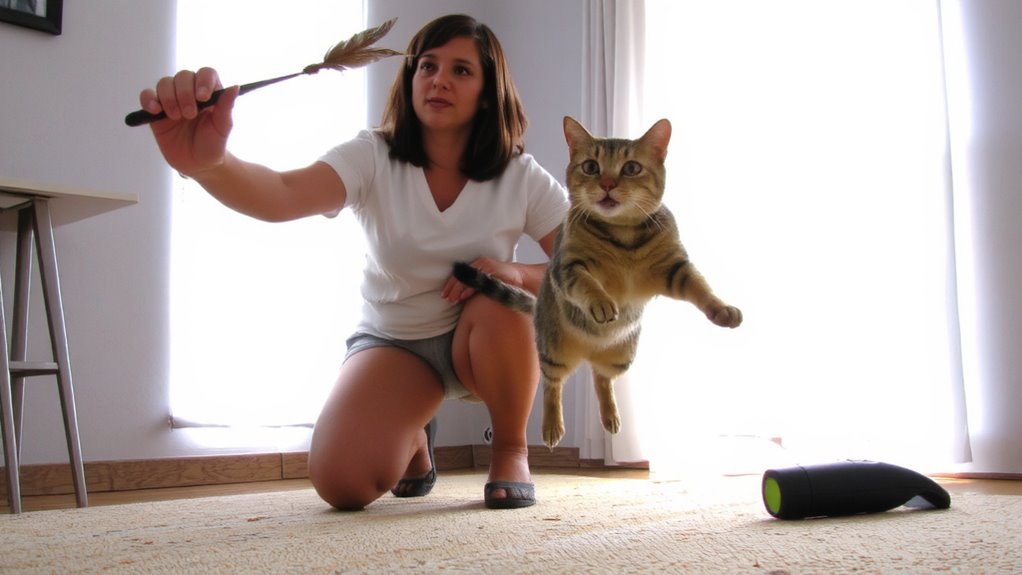
While you’re waving the wand toy to mimic prey-like motion, your cat may suddenly snap at your hand instead of the lure. This behavior stems from your cat’s innate prey drive, which triggers a hunting response when movement stimulates predatory instincts. The wand’s motion simulates fleeing prey, but if your hand enters the strike zone-typically within 12 inches of the toy-your cat may misdirect the attack. This isn’t aggression; it’s a targeting error. Additionally, hand biting can be attention seeking, especially if your cat previously received interaction from nipping. Cats learn through operant conditioning: if biting ends play or earns a reaction, the behavior is reinforced. To prevent misdirected strikes, maintain at least 18 inches between your hand and the lure. Use a wand with a flexible shaft (minimum 24-inch length) to keep hands out of range while allowing fluid motion that sustains focus on the toy, not you.
Stop Hand Biting With the Right Wand Toy

Your cat’s hunting instinct doesn’t discriminate between the right toy and an accidental target, so choosing a wand toy designed to prevent hand biting is critical. Proper toy selection directly impacts success. Choose wands with long handles (minimum 24 inches) to keep hands out of strike range. Attachments should mimic prey: feathers, faux fur strips, or lightweight plush bodies weighing 3–5 grams. Avoid toys with string ends near your hand to reduce accidental biting. Guarantee your play environment is free of distractions-no other pets or loud noises. Use the table below to compare effective toy features:
| Feature | Poor Choice | Ideal Choice |
|---|---|---|
| Handle Length | <18 inches | ≥24 inches |
| Attachment Weight | >10 grams | 3–5 grams |
| Material | Exposed string end | Fully secured fasteners |
Correct equipment minimizes risk and supports natural predatory behavior.
Keep Focus on the Toy, Not Your Hands
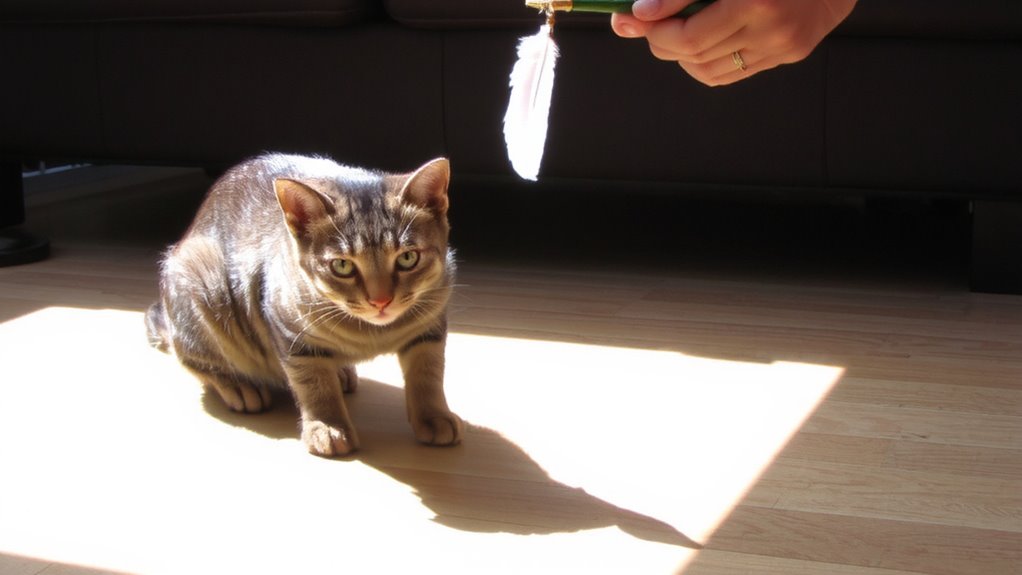
You can’t expect your cat to focus on the toy if your hands are constantly in motion nearby. Keep your hands still and let the toy do the work. Effective toy selection is critical-choose wand toys with feather, fur, or fish-line attachments at least 18 inches long to distance your hands from your cat’s mouth. Lightweight materials weighing under 3 grams mimic prey movement more naturally. Play timing also impacts focus. Engage your cat in short, 5- to 10-minute sessions timed with natural activity peaks-dawn and dusk-when predatory instincts are strongest. These sessions should simulate hunting cycles: stalk, chase, pounce, and capture. Avoid prolonged play, which causes overstimulation and refocuses attention on your moving hands. Use toys with realistic motion profiles-erratic zigzags or fluttering drops-to sustain attention. Consistent movement patterns increase engagement with the toy, not your hands.
Move the Wand to Avoid Triggering Bites
When your cat starts to bite at the wand instead of the toy, it’s often because the motion doesn’t mimic real prey closely enough. Effective prey simulation requires natural movement patterns that trigger instinctual chase responses, not hand-focused aggression. Use erratic, unpredictable motions-slow stalks, sudden darts, and quick escapes-to replicate live prey behavior. Avoid sweeping arcs near your body, as these invite bites.
| Movement Pattern | Purpose |
|---|---|
| Zigzag flicks | Mimics fleeing insect paths |
| Pause-and-pounce | Builds anticipation, increases focus |
| Low glides | Simulates ground-dwelling prey |
| Fast retreats | Encourages chase, reduces lunging at hands |
Maintain a 30–45 cm distance between your hand and the toy tip. This spacing, combined with lifelike movement patterns, enhances prey simulation and reduces accidental hand targeting during play.
Use Time-Outs to Stop Biting Immediately
If the cat redirects its biting toward the wand handle despite proper movement techniques, a brief time-out is necessary to reinforce appropriate target focus. Immediately stop all movement and turn away, withholding attention for 10–15 seconds. This pause disrupts the play session and helps enforce boundaries by signaling that biting ends fun. After the time-out, resume play only if the cat shows interest in the toy’s tip, not the handle. Use this moment to redirect attention to the feather or faux fur lure, ensuring it remains the primary stimulus. Consistent time-outs condition the cat to associate biting with play cessation. Enforce boundaries uniformly across all sessions to prevent confusion. Each repetition strengthens the association between appropriate behavior and continued interaction. Time-outs are most effective when applied instantly and calmly, without punishment. They serve as feedback, not retaliation, maintaining trust while shaping behavior.
Build a Bite-Free Routine With Rewards
A consistent bite-free play routine begins with immediate reinforcement of desired behavior using targeted rewards. Use positive reinforcement by offering treats or affection the moment your cat swats or chases the wand toy without biting. This creates a clear association between toy interaction and reward. Administer high-value treats-like freeze-dried chicken pieces (approximately 3–5 mm in size)-within 1–2 seconds of correct behavior for ideal conditioning. Pair positive reinforcement with consistent scheduling: conduct play sessions daily at the same times, ideally 10–15 minutes each, to align with your cat’s natural activity cycles. Scheduled predictability improves behavioral retention. Rotate wand toys weekly to maintain novelty but keep the routine unchanged. Track progress in a log, noting bite incidents and reward responses. Over 2–4 weeks, most cats reduce hand-targeted biting by 70–90% when protocols are followed with precision.
On a final note
You can stop hand biting during wand play with consistent technique and the right tools. Use a wand toy at least 24 inches long to keep hands out of the strike zone. Move the lure erratically, mimicking prey with quick direction changes. Reward desired behavior immediately with treats. Apply a 10–15 second time-out if biting occurs. Repeat sessions daily for 5–7 minutes to reinforce focus on the toy.