Teaching Dogs to Self-Initiate Return After Off-Leash Exploration
You can teach your dog to return self-initiated off-leash by using a clicker or “yes” mark the instant they begin coming, followed immediately by a high-value treat within 1–2 seconds. Start at 5–10 feet in a distraction-free area, achieving 90% success over 10 trials before increasing distance. Use consistent cues, short 3–5 minute sessions, and a 30-foot line for safety. Reinforce check-ins within 0.5 seconds. Progress depends on mastery at each level. Mastering this sequence activates predictable, repeatable performance in complex environments.
Notable Insights
- Use marker training to immediately reinforce spontaneous returns during off-leash exploration with a click or “yes” followed by a high-value treat.
- Start in low-distraction environments to build reliable self-initiated returns before progressing to more complex settings.
- Reward unprovoked check-ins within one second using a marker and high-value food to strengthen attention and recall urges.
- Gradually introduce distractions only after achieving 90% success in return behavior during controlled practice.
- Practice frequent, brief recall sessions during real-world off-leash outings to reinforce independence and reliability.
Build a Reliable Recall With Positive Reinforcement
How do you guarantee your dog comes back every time you call? You build a reliable recall using positive reinforcement. Marker training is essential-use a clicker or verbal cue like “yes” to pinpoint the exact moment your dog begins returning. This immediate signal strengthens association between behavior and reward. Deliver high-value treats within one to two seconds after marking. Consistency building secures your dog responds the same way every time, regardless of environment. Use the same recall cue-never vary words like “come,” “here,” or “back.” Practice daily, starting with short distances of 5–10 feet. Gradually increase to 30 feet. Reinforce every successful return. Avoid calling your dog to end play-it teaches avoidance. Instead, recall, reward, then release to continue fun. This method creates a conditioned response backed by neuroscience and operant conditioning principles.
Start Training in Low-Distraction Areas
Begin training in a quiet, enclosed space like a fenced backyard or a small indoor room with minimal stimuli-this controlled environment limits competing distractions so your dog can focus solely on the recall cue. Focus timing is critical: reward within 1–2 seconds of return to strengthen association. Use high-value treats and immediate praise to reinforce success. Establish consistency by practicing 3–5 sessions daily, each lasting 3–5 minutes, using the same verbal cue and hand signal.
| Environment Type | Distraction Level | Ideal Use Case |
|---|---|---|
| Fenced backyard | Low | Initial recall drills |
| Indoor room | Minimal | Puppies or high-energy dogs |
| Quiet park | Moderate | Next-phase training |
| Forest trail | High | Advanced practice |
| Urban sidewalk | Very high | Mastery testing |
Repeat trials under identical conditions to solidify response reliability.
Add Distractions Gradually to Test Returns
Once your dog reliably responds to the recall cue in low-distraction environments, you can introduce controlled variables to test consistency. Begin with mild distractions, like a stationary person or toy, at a distance of 10 feet. Use gradual exposure, increasing complexity only when your dog succeeds in 9 of 10 trials. Progress to moving stimuli-such as a walking dog on-leash-while maintaining a 20-foot buffer. Distraction mastery is achieved when your dog recalls promptly despite competing stimuli. Test in varied environments: urban sidewalks, parks, trails. Each setting presents unique sensory loads-auditory, olfactory, visual. Maintain a 90% success threshold before advancing. Use a long line (15–30 feet) for safety and correction, ensuring immediate intervention if needed. Consistent repetition under escalating conditions solidifies reliability. Gradual exposure builds neural resilience, much like resistance training strengthens muscle. Success hinges on systematic desensitization, not repetition alone.
Reward Your Dog for Self-Initiated Check-Ins
Your dog’s ability to return on cue under distraction lays the foundation for voluntary engagement, where self-initiated check-ins become a trained behavior. You reinforce this by delivering rewards the moment your dog looks at you without prompting. Use high-value treats delivered with consistent timing-ideally within 0.5 to 1 second of the check-in. This precise window strengthens neural associations. Pair the behavior with positive cues like a quiet “yes” or clicker. Over time, dogs learn that monitoring you is beneficial, even amidst stimuli. Practice in low-distraction environments first, gradually increasing complexity. Each check-in should be brief and immediately reinforced. Avoid delaying rewards, as inconsistent timing weakens conditioning. Think of it like a sensor recalibrating: frequent, predictable feedback maintains accuracy. With repetition, your dog defaults to checking in, forming a reliable behavioral loop that supports off-leash safety and responsiveness.
Strengthen Off-Leash Recall With Real-World Practice
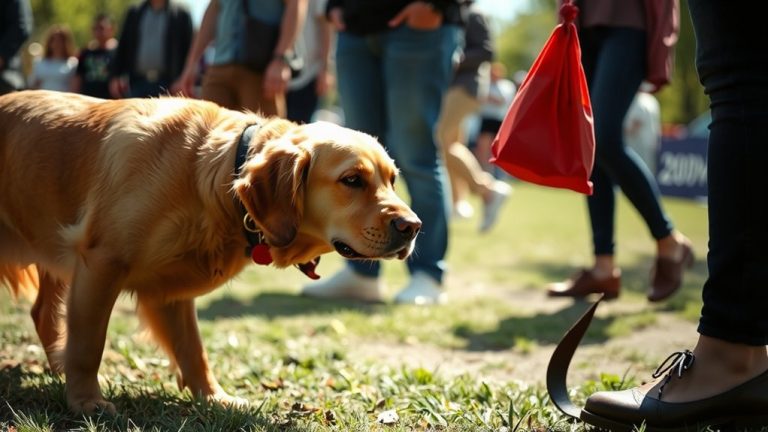
A well-trained dog’s recall is only as reliable as the real-world conditions under which it’s been practiced. Start with controlled urban environments, where distractions like traffic, pedestrians, and other dogs test focus. Use a 30-foot training leash to simulate freedom while maintaining safety. Gradually increase complexity by introducing auditory stimuli-bicycles, sirens, or loud conversations-to raise the cognitive load. Shift to unstructured outdoor adventures in parks or trails, where natural scents and wildlife heighten arousal. Practice the “check-in” cue every 5–7 minutes, reinforcing attention amid shifting stimuli. Conduct sessions at least 3 times per week, each lasting 15–20 minutes, to solidify neural pathways. Real-world practice builds behavioral resilience, guaranteeing reliable recall even when distractions peak. This methodical exposure guarantees performance consistency across variable environments.
Fix Common Self-Initiated Return Problems
Why do some dogs hesitate to return when off-leash, even after mastering recall cues? Leash dependency often underlies this issue. Dogs conditioned to constant tethering may perceive freedom as unstructured, triggering uncertainty. Without the physical boundary of a leash, they lack a reference point, increasing reliance on visual or auditory cues you might not consistently reinforce. Environmental anxiety further compounds the problem. Novel stimuli-such as sudden noises, unfamiliar animals, or unpredictable movement-activate a dog’s stress response, elevating cortisol levels and impairing decision-making. This reduces recall compliance by up to 60% in high-distraction zones. You must systematically desensitize your dog using controlled exposure, starting at 10-meter distances and increasing by 5 meters weekly. Pair calm returns with high-value rewards delivered within 2 seconds. Use a fixed recall command-preferably one syllable-to minimize cognitive load. Consistency reduces ambiguity, turning hesitation into reliable self-initiated returns.
On a final note
You now have the tools to build a reliable self-initiated recall. Start with high-value rewards for check-ins in low-distraction zones. Gradually increase environmental complexity-parks, trails, urban paths-by introducing motion, scent, and auditory stimuli. Use a 15-foot recall success rate metric: aim for 95% compliance before advancing. Consistent cue pairing and reward timing strengthen neural pathways. Off-leash freedom depends on structured repetition, not luck.