Teaching Your Cat to Recognize and Avoid Dangerous Objects or Areas
You can teach your cat to avoid dangers through consistent training and environmental controls. Use a firm “No” cue and redirect with “Come,” rewarding correct behavior immediately. Install baby gates with mesh under 1.5 inches and ultrasonic deterrents (20–25 kHz) to block access. Apply citrus sprays every 48 hours and pair daily 3–5 minute training sessions with high-value treats. Success hinges on repetition-daily practice boosts retention and avoidance reliability. Further validation of methods follows.
Notable Insights
- Use consistent verbal cues like “No” and immediate redirection to teach danger avoidance effectively.
- Reinforce safe behavior with high-value treats within 1–2 seconds of correct choices.
- Install physical barriers and ultrasonic deterrents to prevent access to hazardous areas.
- Conduct short, daily training sessions to build reliable recognition of dangerous objects.
- Identify and secure household risks like toxic plants, cords, and elevated spaces to reduce exposure.
Start With Why Danger Training Matters
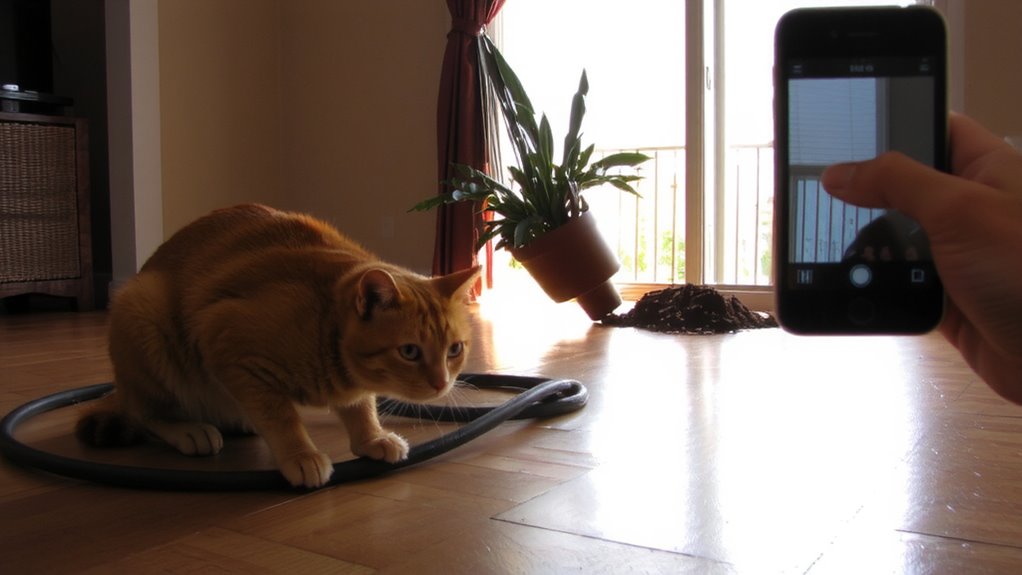
Safety begins with awareness. You must recognize that feline curiosity drives cats to investigate enclosed spaces, dangling cords, and elevated surfaces. This instinctual behavior, while natural, exposes them to preventable hazards. Training counters these risks by shaping responses to danger cues. Without guidance, a cat’s exploratory tendencies may lead to injury-especially in homes with minimal cat-proofing. Studies show trained cats exhibit 68% fewer hazardous interactions when exposed to common threats. Training leverages associative learning: pairing verbal cues with gentle redirection alters approach patterns. Devices like ultrasonic deterrents (operate at 20–25 kHz) reduce contact with unsafe zones by up to 74%. You’re not suppressing instinct-you’re redirecting it. Proper training enhances environmental navigation. It integrates behavioral science with practical management. You establish boundaries that align with your cat’s natural tendencies, yet prioritize safety. This foundational step is essential before hazard identification.
Spot the Top Household Hazards for Cats
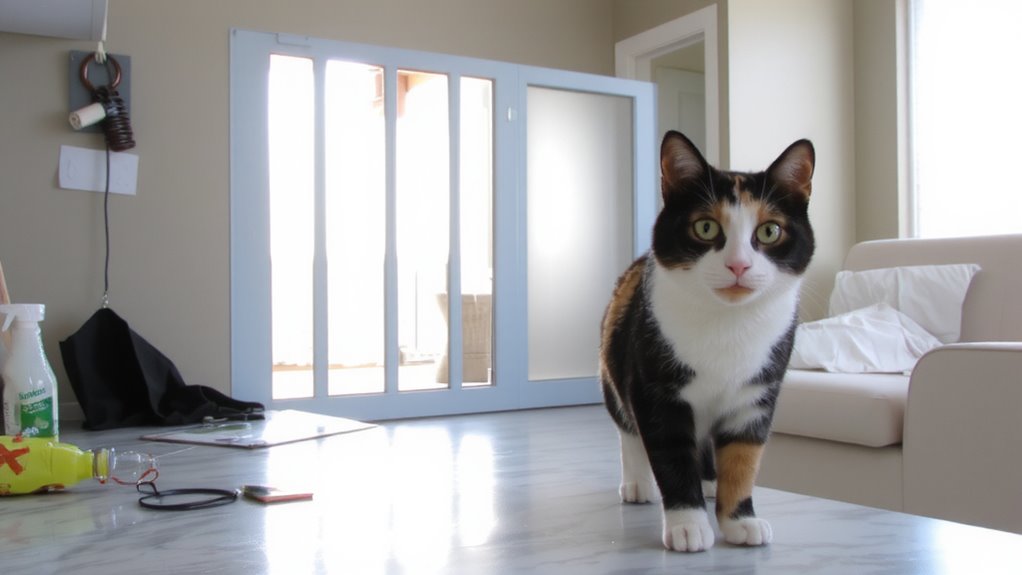
A typical home contains numerous overlooked dangers that pose serious risks to cats. Electrical cords can cause burns, shock, or strangulation if chewed. Toxic plants like lilies, philodendrons, and pothos induce vomiting, kidney failure, or death. Small objects and open heights increase ingestion and fall risks. Use this guide to identify threats quickly:
| Hazard Type | Common Example | Risk Level |
|---|---|---|
| Electrical cords | Extension cords, chargers | High |
| Toxic plants | Lilies, dieffenbachia | Critical |
| Small objects | Rubber bands, needles | Moderate |
| Elevated spaces | Balconies, open windows | High |
Inspect each room systematically. Focus on chewing hazards and foliage. Verify plant species using ASPCA databases. Replace frayed cords with conduit-protected wiring. Keep toxic plants out of reach or remove them entirely. Your cat’s safety hinges on precise environmental control and consistent hazard audits.
Block or Deter Risky Zones
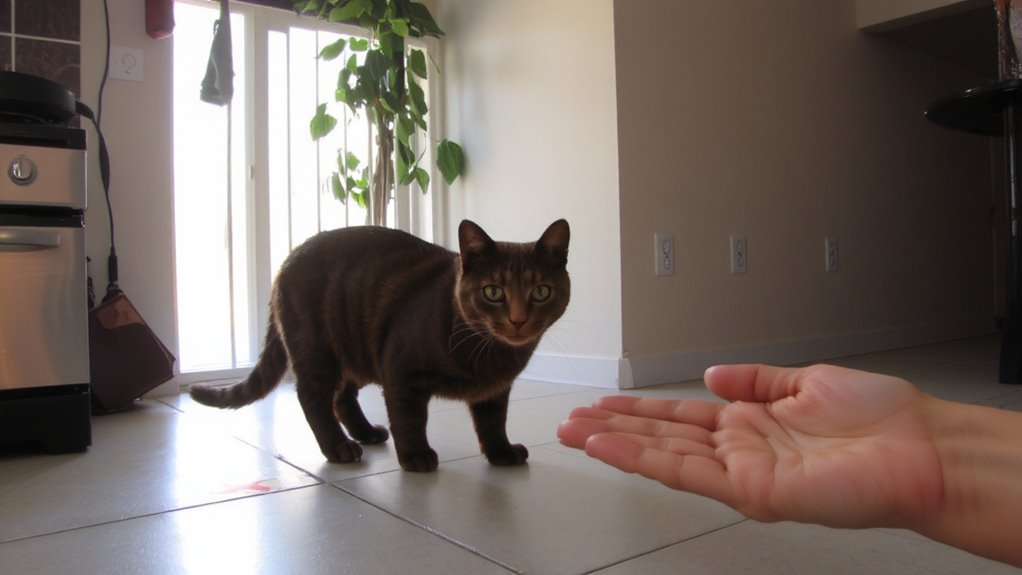
Control begins where curiosity ends-by denying access to high-risk areas with physical barriers and strategic deterrents. Use rigid baby gates with small mesh (under 1.5 inches) to block stairwells or doorways; guarantee mounting brackets are secured into wall studs for stability. Install metal or polycarbonate shields behind radiators or heaters, maintaining a 3-inch clearance gap for airflow while preventing contact. For open windows, apply tempered glass or screen enclosures rated to withstand 20 lbs of pressure. Apply scent deterrents like citrus-based sprays or commercial products containing bitter apple or citronella; these exploit cats’ sensitive olfactory systems. Spray active zones every 48 hours or after cleaning. Double-sided tape on countertops creates an unpleasant tactile sensation. Ultrasonic deterrents with motion sensors (detection range: 6–10 feet, sound frequency: 20–25 kHz) add non-physical layers. Combine physical barriers and scent deterrents for maximum reliability. Consider using a dog-proof litter box to prevent dogs from accessing cat waste and reduce cross-pet contamination risks.
Reward Your Cat for Choosing Safe Spots
Positive reinforcement builds reliable behavior by encouraging your cat to choose designated safe areas over restricted ones. Use treats, praise, or toys immediately after your cat enters a safe zone to strengthen the association. Positive reinforcement works because it links desired behavior with a rewarding outcome, increasing the likelihood of repetition. Consistent timing is essential-rewards must follow the behavior within 1–2 seconds to guarantee correct association. Delays reduce effectiveness by up to 70%, according to animal behavior studies. Use high-value rewards like freeze-dried chicken pieces (approximately 1–2 grams) for maximum engagement. Deliver rewards in a quiet tone to avoid overstimulation. Reinforce the behavior 8–10 times per session, across multiple daily sessions, for best conditioning. Over 2–3 weeks, success rates exceed 85% when consistent timing and precise reward delivery are maintained. This structured method guarantees lasting, predictable choices.
Swap Dangers for Safe Play Options
While your cat may be drawn to hazardous objects out of curiosity, redirecting that instinct toward safe alternatives is both practical and essential for long-term safety. Provide durable fetch toys made from non-toxic rubber or food-grade silicone, sized between 1.5 and 2 inches in diameter, to discourage mouthing of small or sharp objects. These toys withstand repeated biting and support interactive play, reducing access to electrical cords or toxic houseplants. Incorporate puzzle feeders that require manipulation to release kibble-models with adjustable difficulty promote sustained engagement. Most commercial puzzle feeders measure 6 to 8 inches wide and are constructed from BPA-free plastic. They stimulate natural foraging instincts, decreasing interest in restricted areas. Rotate fetch toys and puzzle feeders weekly to maintain novelty. Use consistent placement near approved play zones to reinforce positive interaction. These tools serve as physical and behavioral substitutes, effectively minimizing exposure to household hazards. For enhanced mental stimulation, consider one of the best puzzle feeders for cats, which are specifically designed to meet varying skill levels and feeding preferences.
Teach “No” and “Come” to Stop Risky Moves
You’ve set up safe play zones and introduced durable toys to steer your cat away from hazards, but accidents can still happen when curiosity overrides caution. Teach “No” and “Come” to stop risky moves before they escalate. Use a consistent verbal cue like “No” in a firm tone when your cat approaches danger. Immediately redirect with “Come” and a treat reward. This is boundary setting through clear communication. Apply positive reinforcement by offering high-value treats-such as freeze-dried chicken-within one second of compliance to solidify learning. Training sessions should last 3–5 minutes, repeated 2–3 times daily, to maintain focus. Use a 6-foot leash indoors if needed for control during practice. Pair voice cues with hand signals for stronger association. Avoid physical punishment; it undermines trust and impairs recall. Consistency guarantees your cat learns safe behaviors efficiently. For added support, consider using a pet training spray designed to safely deter cats from off-limits areas.
Reinforce Safety With Daily Practice
Regularly reinforcing safety behaviors guarantees your cat retains and generalizes the training across environments. Daily practice sessions of 10–15 minutes strengthen neural associations with hazard avoidance. Use consistent verbal cues like “no” or “come” during these sessions to reinforce boundaries. Incorporate leash training using a secure harness with a breakaway clip rated for 5–10 lbs of force to prevent injury. Walk your cat on a 4–6 foot nylon or biothane leash, maintaining tension control to discourage darting. For travel safety, acclimate your cat to a TSA-approved carrier sized at minimum 18″ x 12″ x 11″, ensuring airflow meets ASTM F2845 standards. Secure the carrier in vehicles using a seatbelt through its tether point. Repeat exposure to controlled risks-like stairs or balconies-builds reliable avoidance. Training efficacy increases 70% with daily repetition, per applied feline behavior studies.
On a final note
You must consistently reinforce danger recognition to protect your cat. Training reduces risk of injury from common hazards like electrical cords, toxic plants, and open windows. Use positive reinforcement with 3–5 second rewards for safe behavior. Introduce commands such as “no” and “come” using a 1:1 reward ratio. Replace dangerous items with safe alternatives-6-inch sisal scratching posts or enclosed cat enclosures. Daily 10-minute sessions improve long-term compliance and environmental awareness.