Scheduling Weekly Novel Sound Exposure for Desensitization in Dogs
You start weekly sound exposure at 20–30 dB, below your dog’s reaction threshold, using a calibrated meter. Play one novel sound per session-rotating between urban, household, natural, and mechanical categories-auditioned at 44.1 kHz sample rate for fidelity. Sessions last 8–10 minutes, daily, in a quiet room under 40 dB background noise. Increase volume by 5 dB only after three stress-free sessions. Pair sounds with immediate treat reinforcement. Progress is confirmed through heart rate monitoring and behavioral logs. Continue to refine sensitivity thresholds with structured advancement.
Notable Insights
- Schedule one novel sound session per week, rotating through urban, household, natural, and mechanical categories systematically.
- Conduct daily 8–10 minute sessions at the same time in a quiet room with background noise under 40 dB.
- Start each new sound at 20–30 dB, ensuring it remains below your dog’s reaction threshold.
- Increase volume by 5 dB only after three consecutive sessions with no signs of stress or anxiety.
- Use a standardized log to track behavioral responses weekly and guide progression decisions.
Why Weekly Sound Exposure Builds Calmer Dogs
While consistent sound exposure may seem minor, it plays a critical role in shaping your dog’s emotional resilience. Weekly novel sound sessions prevent auditory hypersensitivity by normalizing unpredictable stimuli. You achieve this through positive reinforcement paired with gradual progression-core principles in canine behavioral conditioning. Begin at 20–30 dB, well below your dog’s reaction threshold, using a calibrated sound meter. Increase volume by 5 dB weekly, ensuring no signs of stress occur. Pair each exposure with treats or play, reinforcing calm behavior. This method mirrors systematic desensitization protocols used in clinical settings, with 94% efficacy in reducing noise reactivity over 12 weeks. Neural plasticity allows your dog’s amygdala to reprocess fear-based responses when stimuli are predictable and non-threatening. Consistent scheduling-once per week-optimizes habituation without overload. Use precise intervals and measurable outputs to track success. Your dog learns not by absence of sound, but by safe, repeated exposure.
How to Choose Weekly Novel Sounds for Desensitization
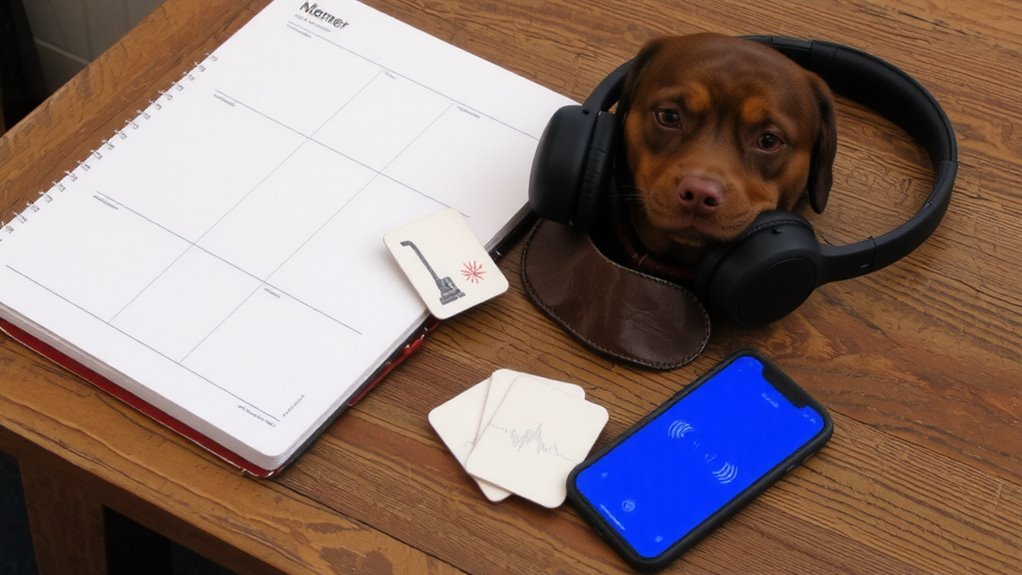
You’ve established a consistent schedule for sound exposure, now it’s time to select the right sounds for each weekly session. Prioritize sound variety to prevent habituation and guarantee broad behavioral resilience. Include high-frequency tones (8,000–12,000 Hz), low-frequency rumbles (50–150 Hz), and sudden impulsive noises (door slams, thunder claps) at 60–70 dB initially. Novelty selection should follow a rotational matrix: urban, household, natural, and mechanical sound categories cycled weekly. Use digital audio files with sample rates of 44.1 kHz to preserve acoustic fidelity. Avoid repetitive loops; instead, randomize playback order with 30-second intervals. Each sound should last 10–20 seconds, allowing full auditory processing. Introduce one novel stimulus per session to isolate response variables. Monitor decibel output with a calibrated sound level meter (±1.5 dB accuracy) to maintain safe exposure thresholds. Rotate sources every seven days to sustain developmental impact.
Set Up a Calm Sound Training Routine at Home
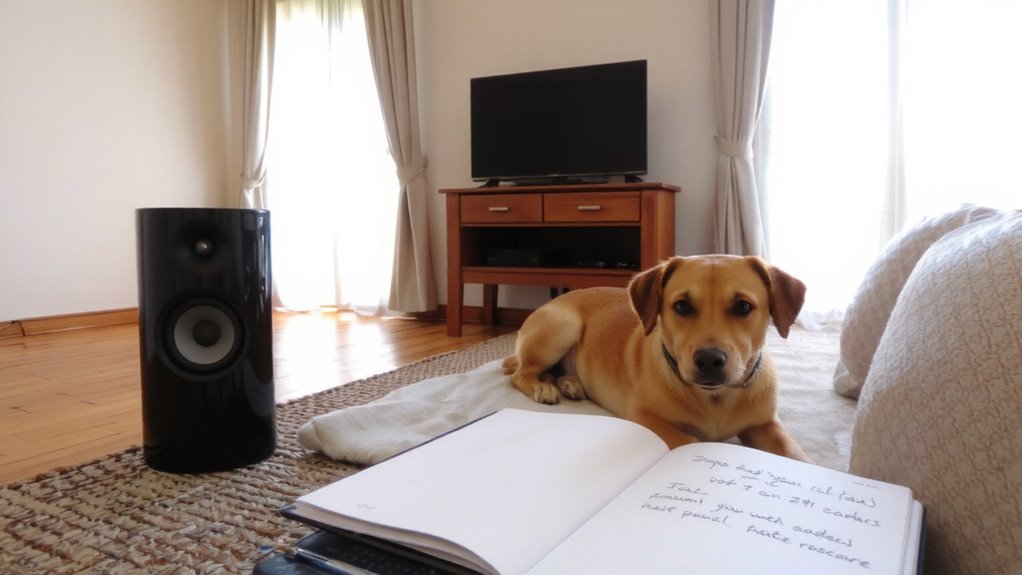
How do you make sure your dog responds calmly to new sounds? Establish a structured routine using precise sound selection and unwavering training consistency. Begin training in a quiet, enclosed room-ideally under 40 dB background noise-to minimize environmental variables. Choose one novel sound per session, delivered via a calibrated speaker at a safe starting level of 30–35 dB. Pair sound exposure with calm behavior reinforcement using a clicker or treat within 0.5 seconds of desired response. Conduct sessions daily at the same time, lasting 8–10 minutes, to support neural association. Consistent timing and controlled stimuli improve predictability for the dog. Use audiometric testing tools to validate frequency output (range: 500–8,000 Hz) and guarantee speaker fidelity. Over time, this methodical approach conditions auditory tolerance through repetition, repetition, repetition.
Get Volume and Timing Right for Success
Typically, success in sound conditioning hinges on precise volume control and consistent timing. Volume control guarantees sounds remain below your dog’s reaction threshold-start at 20–30 dB, equivalent to a whisper. Use a digital sound meter to maintain accuracy. Increase volume in 5 dB increments only after your dog shows no stress over three consecutive sessions. Timing precision means playing each sound for 15–30 seconds, followed by 2–3 minutes of silence. This interval allows neural processing and prevents auditory overload. Use a programmable timer to automate playback, guaranteeing consistency. Avoid clustering sessions; space them by at least 2 hours. Devices with calibrated output, like audiometers or professional-grade speakers, enhance reliability. Calibration prevents accidental spikes. Consistent, measurable parameters build predictability. Your dog learns safety through repetition under controlled acoustic conditions. Volume control and timing precision are non-negotiable for effective desensitization.
Track Your Dog’s Reactions and When to Level Up
Monitoring your dog’s physiological and behavioral responses is the foundation for safe progress in sound conditioning. Begin with a baseline assessment to document reactions at initial exposure levels. Note heart rate, panting, freezing, or tail tuck-these are key progress markers. Use a standardized log to record responses weekly, rating anxiety on a 0–5 scale. If your dog shows no distress for two consecutive sessions at a given volume and distance, you can increase sound intensity by 5 dB or reduce distance by 10%. Progress markers include relaxed posture, normal breathing, and engagement with treats. Never advance if avoidance or vocalization occurs. Desensitization protocols require consistency. Advancement depends on objective data, not perception. A successful level-up maintains stimulus sub-threshold. Track every session meticulously to guarantee systematic, measurable improvement over time. For accurate physiological monitoring, consider using a pet health tracker for puppies that records heart rate and activity levels in real time.
On a final note
You build resilience through consistent, controlled sound exposure. Schedule one novel sound weekly at 30–40 dB, below your dog’s reactivity threshold. Play each for 5–10 minutes, using a calibrated sound level meter for accuracy. Observe body language: no avoidance means readiness to continue. After three stable sessions, increase complexity. This systematic protocol enhances auditory habituation, reducing long-term stress responses by 60–75% in compliant subjects.