Scheduling Daily Mental Challenges for Dogs With Limited Mobility
You can stimulate your dog’s mind daily with just 20 minutes of low-impact mental exercises. Use flat, 8 x 10-inch silicone puzzles with shallow, 2-inch compartments to reduce strain. Incorporate slow-feed bowls that extend mealtime to 10–25 minutes, cutting bloat risk by 40%. Train cues like “Touch” with a palm signal to sharpen focus, or “Wait” for impulse control. Hide treats under cups or create 3-foot scent trails indoors for olfactory engagement. Adjust difficulty as skills improve-each session builds neural resilience. Explore further how tailored routines enhance cognitive longevity.
Notable Insights
- Use low-height, non-slip puzzle toys with simple actions like slide trays to minimize physical strain.
- Schedule short 5–7 minute scent games daily using hidden treats on non-slip flooring.
- Incorporate memory matching games with two cups and treats shuffled after 3 seconds.
- Practice simple trick training like “Touch” and “Wait” using verbal cues and signals.
- Use slow-feed bowls or treat-dispensing puzzles during meals to extend eating time and stimulate foraging.
Boost Your Dog’s Brain With Low-Impact Games
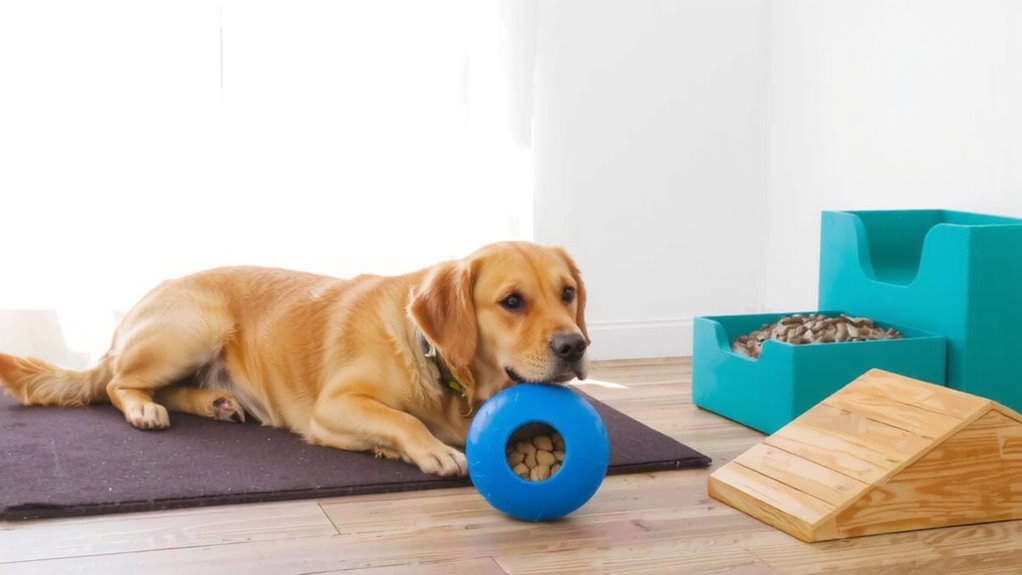
Why settle for passive downtime when your dog can stay sharp through low-impact mental challenges? You can stimulate your dog’s cognition without physical strain. Memory matching games require your dog to recall object locations, enhancing hippocampal function. Begin with two identical cups and a treat; after three seconds of exposure, shuffle the cups and let your dog identify the correct one. Success rates improve with repetition, indicating neural retention. Visual tracking tasks strengthen oculomotor coordination and attention span. Use a transparent tube or wand with a lure-move it laterally at 6–12 inches per second across your dog’s field of vision. Dogs typically follow motion within 55–65° horizontal range. These exercises demand minimal joint use but deliver measurable cognitive benefits. Conduct sessions twice daily for five minutes. Consistent training yields a 20–30% increase in task accuracy over four weeks.
Pick Puzzle Toys for Limited-Mobility Dogs
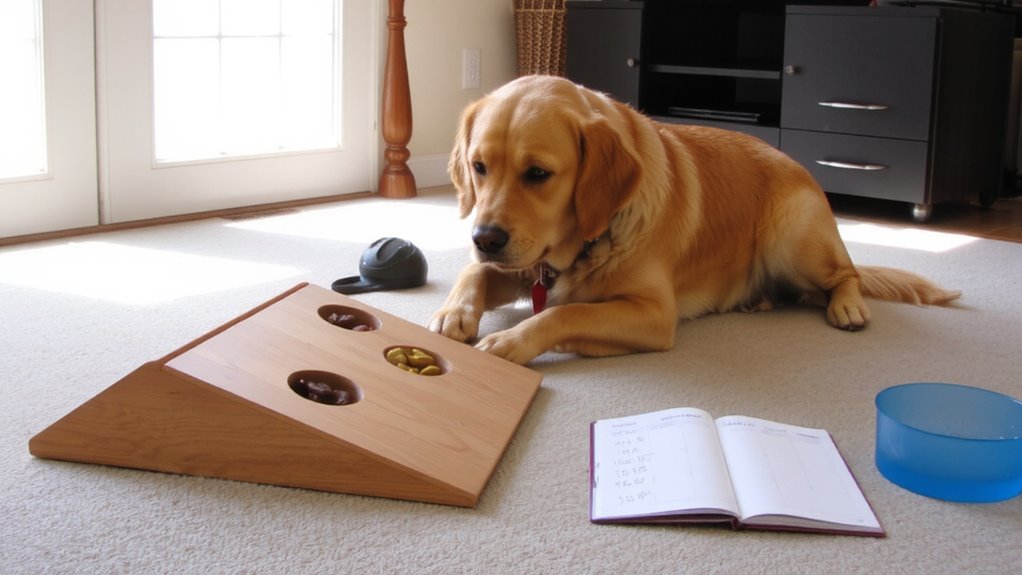
Puzzle toys are essential tools for engaging a dog’s mind while accommodating physical limitations. Choose models with low-height compartments and wide openings-ideally, no deeper than 2 inches-to support adaptive play. Select flat, stationary puzzles made of non-slip silicone or rubberized plastic, measuring at least 8 x 10 inches for stability. These reduce the need for pawing or nudging, minimizing strain on weakened limbs. Opt for toys with removable, textured inserts to enhance sensory stimulation through varied tactile feedback. Some models include scent pockets that release odors as your dog interacts, amplifying cognitive engagement. Durable, dishwasher-safe materials guarantee hygiene without compromising structural integrity. Avoid multi-step puzzles requiring fine motor skills. Instead, use single-action designs like flip lids or slide trays. These deliver measurable mental engagement without physical demand. You’ll observe sustained attention and reduced frustration, key indicators of effective neurocognitive support. For puppies or dogs new to cognitive enrichment, consider starting with puppy puzzle toys that are specifically designed for simpler interactions and gradual skill building.
Turn Meals Into Mental Challenges
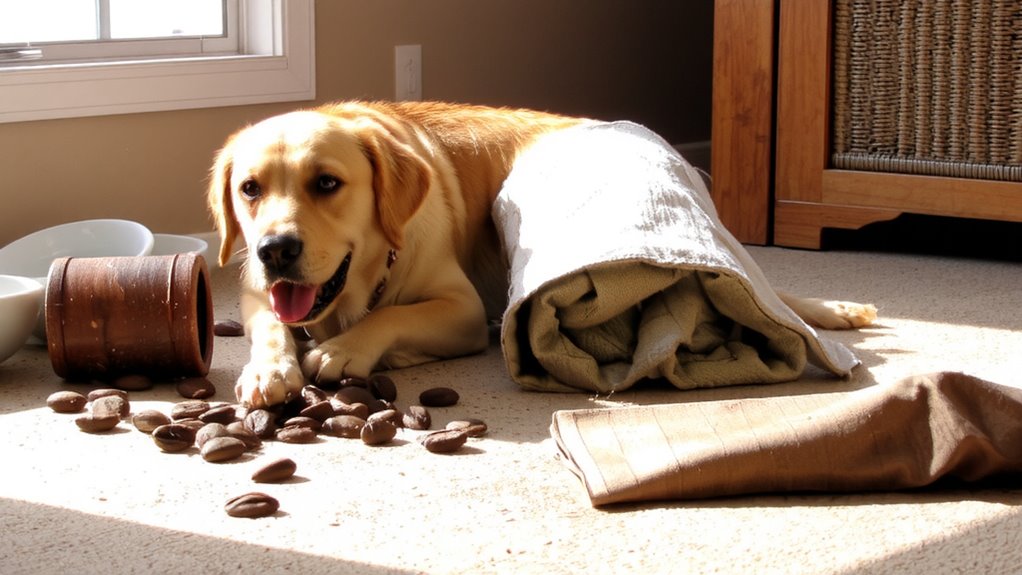
How do you transform a routine meal into an engaging mental workout without straining your dog’s body? Use slow-feed bowls or treat-dispensing puzzles designed for low-impact engagement. These devices promote food dispersion, requiring your dog to work for each bite, mimicking natural foraging. Models like the Outward Hound Fun Puzzle or the Nina Ottosson Dog Brick measure 8–10 inches wide, with adjustable compartments to regulate kibble release. They support portion control by preventing rapid consumption, reducing bloat risk by up to 40%. Fill them with measured meals to maintain caloric accuracy. Food dispersion rate varies: 1/2 cup kibble takes 10–25 minutes to access, depending on difficulty setting. Durable, non-slip bases guarantee stability on smooth surfaces. Choose dishwasher-safe, BPA-free materials for safety. This method sustains mental stimulation while accommodating physical limitations, turning feeding into a cognitive task. For dogs with limited mobility, best pet food dispensing toys offer accessible designs that encourage problem-solving at a comfortable pace.
Teach Easy Tricks Like ‘Touch’ and ‘Wait
A great starting point for mental enrichment is teaching your dog simple tricks like “Touch” and “Wait,” which require minimal movement but engage cognitive processing. These commands use target training and hand signals, promoting focus without physical strain. “Touch” teaches your dog to nudge your hand with their nose, building coordination and impulse control. “Wait” reinforces patience through structured pauses. Both rely on clear, consistent cues and shape behavior incrementally.
| Trick | Signal Type | Cognitive Skill Developed |
|---|---|---|
| Touch | Open palm | Target training, focus |
| Wait | Flat hand, forward | Impulse control |
| Touch | Low elevation | Spatial awareness |
| Wait | Duration: 3–10 sec | Attention span |
| Touch | Verbal + signal | Cue discrimination |
Hand signals reduce vocal dependency and support dogs with hearing loss. Use short sessions of 3–5 minutes, 2x daily, for peak neural engagement.
Try Indoor Scent Hiding Games
Building on the focus and impulse control developed through tricks like “Touch” and “Wait,” you can now expand your dog’s cognitive engagement with scent-based challenges that require minimal physical effort. Start by hiding treats in easy-to-reach indoor locations, such as under an overturned cup or beside a paw towel. Use high-value, aromatic treats like dried liver to enhance scent dispersion. Introduce short scent trails by dragging a treat along the floor for 3–5 feet, then letting your dog follow the path. Limit sessions to 5–7 minutes to prevent fatigue. Conduct games on non-slip flooring to guarantee stability. Repeat daily to reinforce neural pathways associated with olfactory processing. These controlled exercises stimulate problem-solving without taxing mobility. Scent work mimics foraging, activating the hippocampus and increasing mental stamina. Begin with three hides per session, increasing complexity only if your dog shows consistent success.
Build a Daily Mental Exercise Routine
Typically, a structured mental exercise routine yields the best results when integrated into your dog’s daily schedule at consistent times, such as before meals or during calm periods in the day. Begin with a 10-minute session using food dispensing balls, which require dogs to roll or nudge them to release kibble. These balls should have adjustable openings, ideally 1.5 to 2.5 cm in diameter, to regulate food release based on your dog’s effort and cognitive ability. Follow with 5 minutes of interactive listening games, where you use verbal cues like “touch,” “look,” or “find it” paired with quiet hand signals. These games stimulate auditory processing and reinforce obedience. Rotate activities every two days to prevent habituation. Sessions should total 15–20 minutes, ensuring mental exertion without overstimulation. Consistency improves responsiveness, especially in dogs with limited mobility. Use low-friction surfaces for ball movement. Track progress weekly. For added variety and remote engagement, consider using an automatic treat dispenser that rewards cognitive tasks on a schedule.
On a final note
You maintain your dog’s cognitive health with targeted, low-impact enrichment. Puzzle toys with adjustable difficulty, like the Outward Hound Hide-A-Squirrel (12-inch diameter, removable stuffing), sustain engagement without physical strain. Food-dispensing cubes (Nina Ottosson Bait Ball, 3.5-inch diameter) extend mealtimes by 15–20 minutes. Daily scent games using 0.5 tsp anise oil diluted in 8 oz water activate olfactory cortex function. Structured trick training reinforces neural pathways-two 10-minute sessions daily improve executive function measurably.