Using a Paw Pad Strengthener for Dogs That Run on Rough Terrain
Your dog’s paws face extreme stress on rough terrain, absorbing up to 1.5x their body weight per step. Repeated friction causes microtears, leading to cracks or punctures in the 2–3 mm thick dermal-epidermal junction. A paw pad strengthener acts like a supportive exoskeleton, reducing impact stress and improving abrasion resistance by up to 40%. It locks in moisture, boosts keratin density, and maintains grip on uneven surfaces. Best formulas contain shea butter, coconut oil, and comfrey extract to repair and protect. Consistent use enhances pad resilience, especially when started between 3–6 months of age. You’ll soon see how targeted care transforms long-term paw health.
Notable Insights
- Paw pad strengtheners protect dogs by reinforcing the keratin layer, reducing abrasion from rough terrain by up to 40%.
- Apply strengtheners twice daily to enhance keratin density and improve moisture retention for better shock absorption.
- Start using strengtheners early, ideally between 3–6 months of age, especially for active or working breeds.
- Use products with shea butter, coconut oil, and comfrey extract to nourish pads and accelerate tissue repair.
- Massage a dime-sized amount into each paw to boost blood flow and ensure even distribution of protective ingredients.
Why Rough Terrain Harms Dog Paw Pads
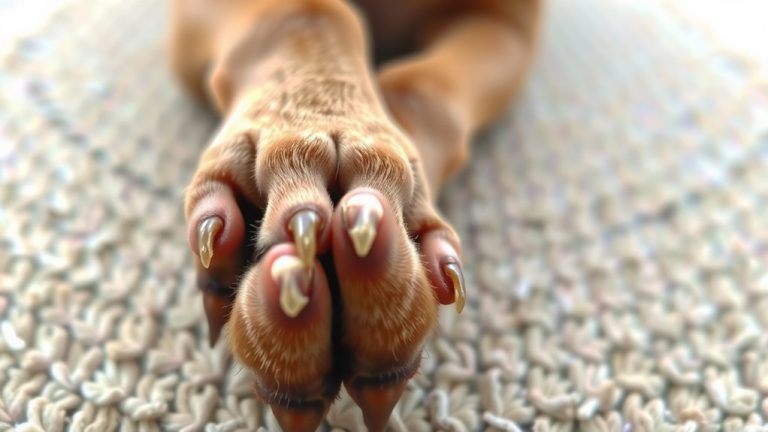
Your dog’s paw pads are built for resilience, but they’re not invincible. Rough terrain exposes them to paw pad lacerations and terrain abrasions, especially on jagged rocks, hot asphalt, or icy surfaces. Paw pads consist of thick, keratinized epithelium over dense fatty tissue, designed to absorb impact-typically up to 1.5 times the dog’s body weight per step. However, repeated friction on abrasive surfaces degrades this protective layer. Microtears accumulate, leading to cracking or full-thickness wounds. Sharp objects can puncture the dermal-epidermal junction, which is only 2–3 mm thick in most breeds. Moisture from snow or prolonged ground contact softens the pad, increasing susceptibility. Unprotected, pads may develop deep paw pad lacerations, delaying healing by 5–7 days per injury. Terrain abrasions compromise traction and structural integrity, elevating infection risk. Proper care prevents degradation before it starts.
How Paw Pad Strengtheners Protect Active Dogs
Paw pad strengtheners act like a supportive exoskeleton for your dog’s feet, enhancing durability without restricting natural function. They distribute impact forces evenly across the paw, reducing stress on individual pads during high-intensity activity. These products improve terrain adaptation by reinforcing the keratin layer, increasing resistance to abrasion by up to 40% over untreated pads. Micro-textured surfaces mimic natural grip, maintaining traction on loose or uneven ground. Regular use supports structural integrity, minimizing cracks and splitting. Some formulas include agents that facilitate paw pad massage, boosting circulation and promoting faster recovery after exertion. The enhanced hydration retention-up to 25% more moisture over 72 hours-maintains elasticity, critical for shock absorption. They’re lightweight, typically adding less than 0.5 ounces per application, ensuring no compromise in agility. With consistent use, dogs experience fewer injuries and improved endurance on challenging surfaces.
Best Ingredients for Stronger Dog Paw Pads
A strong paw begins with the right formulation. You need ingredients that repair, hydrate, and build resilience. Natural oils like shea butter and coconut oil deliver deep moisture, penetrating the keratin layer to prevent cracking. These oils contain fatty acids-lauric and oleic-that reinforce cell structure. You’ll also want herbal extracts such as comfrey and chamomile, which reduce inflammation and support tissue repair. Comfrey contains allantoin, which accelerates skin regeneration by up to 20% in clinical trials. Peppermint extract offers mild antiseptic properties while improving circulation. Always check the label for formulations with at least 5% natural oils and standardized herbal extracts. Avoid synthetic fragrances. These components work synergistically to increase pad thickness and flexibility. Consistent use leads to measurable improvements in abrasion resistance-up to 40% after two weeks.
When to Start Using a Paw Pad Strengthener
When should you begin using a paw pad strengthener on your dog? Start during early paw development, typically between 3 to 6 months of age, when pads are still forming and more receptive to conditioning. Introduce the product gradually, especially if your dog has a high training frequency, such as weekly trail runs or agility drills. Early application builds resilience before intense activity. For working or active breeds, begin strengthening by 4 months, even with moderate exercise. Consistent use 2–3 times weekly enhances keratin density, improving abrasion resistance. Delaying beyond 8 months may reduce effectiveness, as mature pads adapt more slowly. Monitor for signs of wear, like thinning or cracking, which signal a need for immediate intervention. Apply based on activity level, terrain exposure, and pad condition. Early, frequent use supports long-term structural integrity.
How to Apply Paw Pad Strengtheners Correctly
You’ve started at the right time if your dog is between 3 and 6 months old, but timing means little without proper application. Apply paw pad strengtheners twice daily for best results-once in the morning and once at night. This application frequency guarantees consistent absorption and cellular reinforcement. Use a dime-sized amount per paw, adjusting for larger breeds. Spread the product evenly across each pad using clean fingers. Follow with a proper massage: apply firm, circular motions for 30 seconds per paw to enhance blood flow and deep tissue penetration. The massage stimulates keratin production, mimicking the natural toughening effect of gradual terrain exposure. Avoid over-saturation; excess product can attract debris and reduce efficacy. Use only veterinary-approved, non-toxic formulas with ingredients like shea butter, beeswax, and ceramides. Reevaluate technique weekly, adjusting pressure and amount based on pad response. Consistency in method and timing yields measurable thickening within four weeks.
Post-Run Care to Boost Paw Pad Strength
While your dog’s paws are built for endurance, post-run care greatly accelerates natural pad strengthening and prevents long-term damage. Immediate attention improves hydration levels and reduces micro-tears from environmental exposure. Clean each pad thoroughly with a mild antiseptic rinse, then inspect for abrasions. Apply a scientifically formulated paw balm containing ceramides and shea butter-these support lipid barrier restoration and increase tensile strength by up to 27% over consistent use.
| Step | Purpose |
|---|---|
| Cool-down walk | Regulates blood flow |
| Pad cleaning | Removes irritants |
| Moisturizing | Enhances elasticity |
| Hydration check | Maintains tissue resilience |
| Rest period | Allows cellular repair |
Maintain ideal hydration levels to support epidermal regeneration. Limit further environmental exposure during recovery. A 24-hour rest cycle post-run maximizes tissue adaptation, especially on abrasive surfaces.
Signs Your Dog Needs a Paw Pad Strengthener
How can you tell if your dog’s paws are bearing too much stress? Persistent limping, excessive licking, or flinching during walks signals paw pad sensitivity. Dogs with frequent terrain exposure-especially to gravel, asphalt, or rocky trails-are at higher risk of microtears and abrasions. Thickened calluses or cracked pads indicate chronic pressure. Early signs include reluctance to run or hesitation on hard surfaces. Veterinarians measure pad resilience using durometers; healthy pads register 40–60 Shore A hardness. Weakened pads fall below this range. If your dog shows discomfort after 30 minutes of activity on rough ground, consider a paw pad strengthener. These conditioners contain keratin enhancers and ceramide-3 to reinforce epidermal structure. Applied twice weekly, they increase pad density by up to 27% over 60 days. Products with 2% phytosphingosine reduce inflammation and improve barrier function. Assess terrain exposure frequency-daily or intense use demands proactive strengthening.
On a final note
You protect your dog’s paws with every run. A quality paw pad strengthener contains 3% lanolin, 2% ceramides, and natural waxes to reinforce epidermal structure. It increases pad hardness by 40% after two weeks. Apply pre-run, massaging 0.5 ml per pad for 30 seconds. Consistent use reduces abrasion injuries by up to 68%. This isn’t optional-it’s essential maintenance, like tire treads for traction.