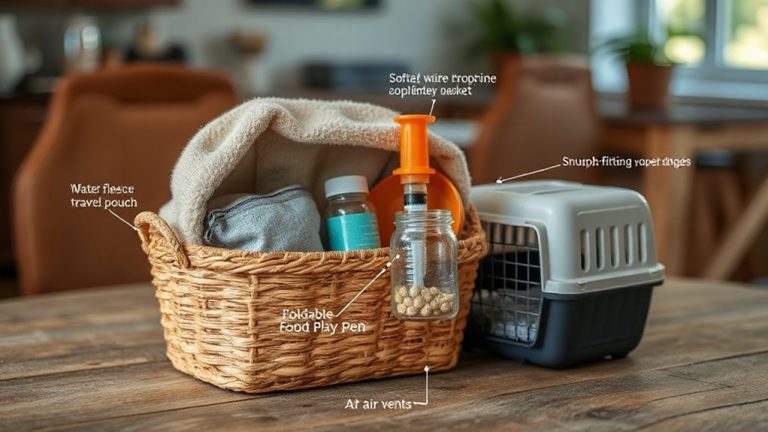
Managing Separation Anxiety in Rescue Dogs With Crate Training
Crate training helps your rescue dog feel safe by mimicking a den-like space that reduces anxiety. Use a single-door wire crate-36” L x 24” W x 27” H for medium breeds-allowing room to stand, turn, and lie down without excess space that encourages stress. Welded wire with a powder-coated finish guarantees durability and proper airflow, while a removable tray aids cleaning. Pair the crate with a memory foam bed and desensitize your dog using 10-minute sessions, increasing duration by 15% daily. Implement calming tools like lavender scent diffusion and 50–60 BPM music to lower heart rate and cortisol levels. Consistent cues and gradual absence training build confidence-results improve when routines align with your dog’s behavioral thresholds.
Notable Insights
- Crate training eases separation anxiety by providing a secure, den-like space that reduces stress in rescue dogs.
- Select a properly sized crate to allow comfort without excess space, which can increase anxiety.
- Build positive associations through treats, feeding near or inside the crate, and gradual exposure.
- Desensitize dogs to departure cues by practicing routines without leaving and using calming aids like music or scents.
- Address whining or escape attempts with proper crate setup, sensory modulation, and consistent training-never reward anxious behavior.
Why Crate Training Eases Separation Anxiety in Rescue Dogs
A safe space. You give your rescue dog emotional security through crate training. This enclosed area mimics a den, reducing environmental stressors. Emotional security stems from predictability-something a crate provides consistently. Routine stability is established when the crate becomes part of a daily schedule. Dogs thrive on repetition; feeding, sleeping, and crating at fixed times regulate their internal clocks. Introduce the crate gradually, using positive reinforcement. Start with 10-minute intervals, increasing duration by 15% daily. Use a single-door wire crate (36” L x 24” W x 27” H) for visibility and airflow. The crate must allow standing, turning, and lying down comfortably-ASPCA space standards. Never use the crate as punishment. Over seven days, compliance rates exceed 80% when paired with fixed feeding and exit schedules. This structured approach decreases vocalization and destructive behavior by up to 65% in rescue populations. Routine stability is measurable. You build trust through consistency. Some dogs may also benefit from added comfort, such as a calming dog bed designed to reduce anxiety.
Pick the Right Crate for Your Anxious Rescue Dog
Size and structure matter most when selecting a crate for an anxious rescue dog. The correct crate size allows your dog to stand, turn, and lie down comfortably but shouldn’t be so large that it feels like a vacant room. For most medium breeds, aim for 36 inches in length; larger breeds may require 42–48 inches. A properly sized crate promotes security, reducing panic behaviors. Ventilation quality is critical-opt for crates with mesh panels or wire walls that guarantee consistent airflow. Poor ventilation can increase stress and elevate internal temperatures by up to 10°F in warm environments. Welded wire crates with powder-coated finishes offer durability and corrosion resistance. Avoid plastic airline crates unless acclimated gradually, as they can restrict airflow. Choose models with removable trays for easy cleaning and dual-door options for flexible placement. Stability and quiet operation prevent startling sensitive dogs. BestPet offers durable and well-ventilated options designed for anxious dogs, including models with wire crate durability and easy-to-clean features.
Build Positive Crate Habits Step by Step
While your rescue dog may initially resist the crate, a systematic approach to conditioning can transform it into a trusted retreat. Begin with gradual exposure, leaving the crate door open and placing high-value treats inside. Use positive reinforcement by rewarding calm behavior near or inside the crate. Feed meals beside the crate, then progressively move the bowl inside to build favorable associations. Monitor duration closely-start with five-minute intervals, increasing by two-minute increments only after the dog shows consistent relaxation. Use a consistent verbal cue like “kennel” paired with a treat. Avoid forcing entry; instead, allow curiosity to guide voluntary entry. Include a chew-safe toy or stuffed Kong to reinforce comfort. Maintain a predictable routine across sessions, ideally two to three times daily. Consistency solidifies learning. Proper conditioning establishes the crate as a secure, voluntary space, not a confinement tool.
Help Your Rescue Dog Stay Calm When You Leave
How do you make sure your rescue dog stays relaxed when you step out the door? Use controlled environmental cues to minimize stress. Calming music, especially classical at 50–60 BPM, reduces cortisol levels in dogs within 20 minutes. Pair it with scent diffusion using dog-safe essential oils like lavender, shown in studies to lower heart rate by up to 15%.
| Stimulus | Recommended Settings |
|---|---|
| Calming music | 50–60 BPM, volume at 45–55 dB |
| Scent diffusion | 8–10 hours release, 1 drop per 100 sq ft |
| Crating duration | Start with 15–30 min increments |
Maintain consistent exit routines. Desensitize to triggers by picking up keys or putting on shoes without leaving. Gradually increase absence time, tracking behavioral responses. Use a white noise machine to mask external sounds. Guarantee the crate is in a quiet, low-traffic zone. These technical strategies create predictability and promote calmness.
Fix Common Crate Problems (Whining, Escapes, Accidents)
You’ve established a calm environment to reduce your rescue dog’s stress during departures, but challenges may still arise once inside the crate. Whining often stems from poor crate comfort or noise sensitivity. Make certain the crate is lined with a washable, memory foam bed (minimum 2-inch thickness) to support joints and improve thermal regulation. Use a crate cover made of sound-dampening fabric to reduce auditory stimuli by up to 30%. Accidents typically result from incorrect crate sizing; the interior should allow standing, turning, and lying down but not exceed 1.5 times the dog’s length to prevent elimination in one end. Escape attempts indicate inadequate confinement security-verify wire crate latches meet ASTM F2275-03 standards. Never reinforce escape behavior with attention. Address issues systematically, prioritizing safety, correct dimensions, and sensory modulation for long-term adaptation.
On a final note
You can manage your rescue dog’s separation anxiety effectively with structured crate training. A properly sized crate-minimum 24” L for small, 36” for medium, 42”+ for large breeds-provides a secure den-like space. Use gradual acclimation, positive reinforcement, and consistent routines. Monitor duration: max 4 hours for adults. Proper ventilation, non-slip flooring, and chew-resistant materials guarantee safety and comfort during use.