How to Train Your Dog to Identify the Scent of a Specific Person’s Jacket
Start by using a clean cotton jacket free of perfumes to preserve the person’s unique odor signature. Let your dog sniff it for 3–5 seconds, then immediately reward with a high-value treat. Use stainless steel scent containers and 100% organic cotton swabs for consistent training. Conduct 3–5 short sessions in a 10 x 10 foot area, using a verbal cue like “find it.” Proper technique builds reliability-and there’s a precise way to advance from here.
Notable Insights
- Use a clean cotton jacket free of perfumes to preserve the person’s unique scent for training.
- Let your dog sniff the jacket for 3–5 seconds, then immediately reward with a treat or toy.
- Introduce a consistent verbal cue like “find it” before each scent search session.
- Conduct short 3–5 minute sessions in a distraction-free 10×10 feet area, repeating 3–5 times.
- Gradually increase difficulty by adding distractions and expanding the search area to 30×30 feet.
Start Scent Training With a Jacket and Rewards
A clean cotton jacket-free of perfumes or detergents that could mask scent-forms the foundation of early odor detection training. You introduce the target odor by having the dog sniff the jacket for three to five seconds. Immediately after, you reward with a treat or toy. This creates positive reinforcement, linking the scent to a desirable outcome. Use a consistent cue like “find it” before each search. Start in a small, distraction-free room measuring 10 x 10 feet. Place the jacket on the floor, 5 feet from the starting line. Each session lasts 3–5 minutes, with 3–5 repetitions. Accuracy improves when rewards follow within 1–2 seconds of detection. The cotton fabric holds human scent effectively due to its natural fiber composition. Over time, your dog learns to distinguish the target odor from environmental background. Consistency in timing and location guarantees reliable learning.
Use the Right Supplies for Dog Scent Work
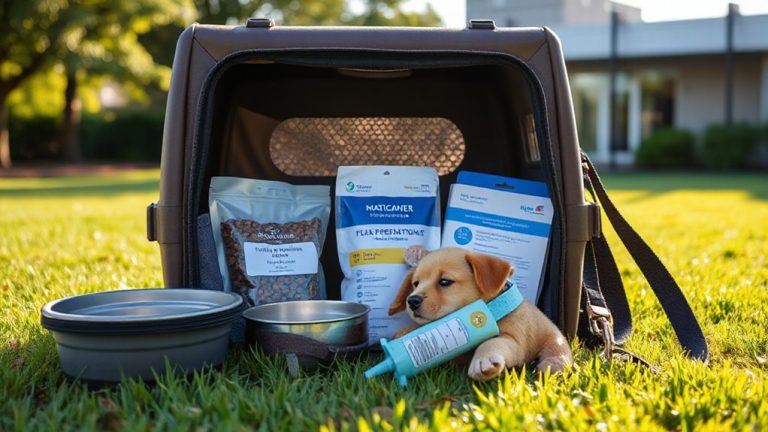
You’ve already built a foundation using a cotton jacket to introduce scent detection, and now it’s time to expand your toolkit with purpose-specific supplies. Scent containers standardize training by isolating odor in a controlled, reusable format. They allow consistent exposure without fabric contamination. Pair them with tracking vests to carry gear and reinforce work behavior. Choose durable, non-porous metal or plastic containers with permeable lids for ideal odor dispersion. For added motivation and behavioral feedback during training sessions, consider incorporating a pet behavior tracker to monitor your dog’s focus and activity patterns.
| Item | Material | Function |
|---|---|---|
| Scent container | Stainless steel | Holds cloth swabs, prevents cross-contamination |
| Tracking vest | Ripstop nylon | Distributes weight, includes scent pouch |
| Cotton swabs | 100% organic | Absorbs scent, fits in containers |
| Nylon lead | 4mm braided | Controls dog during focused searches |
| Treat pouch | Polyester | Holds rewards, attaches to vest |
Add Distractions and New Locations Gradually
Once your dog reliably identifies the target scent in controlled settings, it’s time to test that focus in evolving environments. Begin by introducing mild distractions-like background noises or unfamiliar objects-while keeping visual cues consistent. Gradually shift training to new locations, such as parks or quiet streets, ensuring scent placement remains predictable. Use standardized verbal cues like “find it” to maintain clarity. Increase difficulty incrementally: extend search areas from 10×10 feet to 30×30 feet, and reduce proximity of source to entry point. Limit each session to 5–7 minutes to preserve mental sharpness. Reinforce correct behavior immediately with a high-value treat. Avoid overloading your dog; a 20% increase in complexity per week maintains progression without confusion. Maintain consistent cue words and reward timing. This phased exposure solidifies scent discrimination under variable conditions.
Fix Common Scent Training Problems
If distractions or inconsistent performance arise during scent training, they’re often signs of underlying issues in reinforcement timing or environmental control. Weak motivation frequently stems from infrequent or poorly timed rewards. Deliver treats within two seconds of correct identification to strengthen association. Use high-value rewards like freeze-dried liver to increase drive. Improper storage of scent articles degrades odor integrity. Store jackets in glass containers at 4°C to minimize bacterial breakdown and volatile compound loss. Avoid plastic bags, which encourage mold and off-gassing. Guarantee only one scent source is present during drills-unsupervised exposure to other odors causes confusion. Limit training sessions to five minutes to maintain mental sharpness. If your dog hesitates or oversamples, recheck your reinforcement schedule and storage methods. Consistency in protocol directly impacts reliability. Adjust variables methodically-alter one element at a time to isolate causes.
How Dogs Recognize Human Scent Naturally
Dogs detect human scent through an olfactory system far more advanced than that of humans, with around 300 million olfactory receptors compared to our 5 million. Their ability to recognize individual scents begins with genetic inheritance, which shapes the sensitivity and structure of their nasal anatomy. You’ll find that scent recognition is hardwired-specific gene expressions determine receptor diversity and neural pathways to the olfactory bulb. Environmental exposure further refines this capability. Puppies exposed early to varied human scents develop sharper discrimination skills. Each person emits a unique odor print composed of volatile organic compounds, which dogs analyze like a chemical signature. Your dog doesn’t just smell you-it decodes your scent profile. This natural skill stems from both inherited traits and lifelong scent learning. Together, genetic inheritance and environmental exposure create a precision detection system unmatched in the animal kingdom.
On a final note
You’ve now built a reliable foundation in canine scent detection. Dogs identify human scent through volatile organic compounds on the jacket, primarily from skin cells and sweat. Training leverages their 300 million olfactory receptors. Use consistent cues, high-value rewards, and gradually increase difficulty. Performance peaks at 90% accuracy after 6–8 weeks of daily 10-minute sessions. Properly stored target scent articles remain viable for up to three months.