Linking Treat Retrieval Tasks to Physical Therapy Goals for Neurologically Impaired Cats
You can link treat retrieval to your cat’s physical therapy goals by using precise treat placement to drive targeted motor movements. Position treats 6–12 inches off the ground to encourage proper limb extension and stepping. Use high-value, pea-sized rewards in fixed locations to promote weight-shifting, reaching, or step-ups. Perform 3 sets of 5 repetitions twice daily on nonslip surfaces. This structured approach enhances neuromuscular re-education, supports neural plasticity, and improves gait symmetry-key indicators of functional recovery you’ll want to track closely.
Notable Insights
- Position treats 6–12 inches off ground to promote proper limb and neck extension during movement tasks.
- Use high-value treats only after correct movements to reinforce targeted motor patterns and active participation.
- Progress from weight-shifting to step-ups or reaches, aligning treat placement with specific therapy milestones.
- Space treats farther apart to encourage longer movement sequences and sustained neuromuscular control.
- Limit rewards to 70% of trials to maintain motivation without reducing effort or encouraging gulping.
Why Treats Help Cats Recover After Neuro Injury
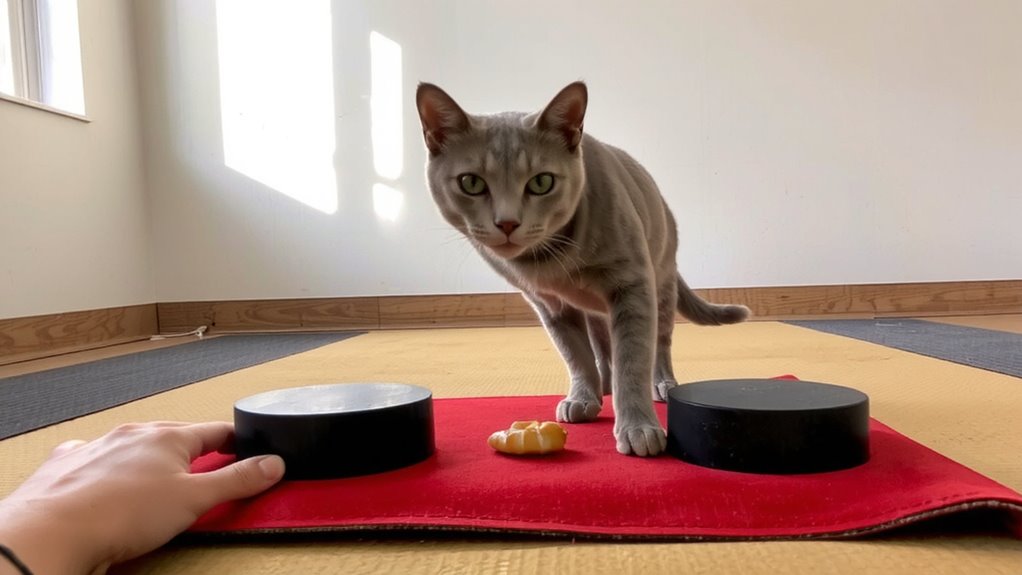
One effective strategy in feline neurorehabilitation is using treat retrieval to engage motor function during recovery. You’ll notice improved limb coordination as your cat reaches, steps, or pivots to obtain food rewards. This repetitive movement supports neural plasticity through targeted brain stimulation, reinforcing weakened motor pathways. Treat-based tasks increase cortical engagement, much like calibrated resistance training activates muscle memory in humans. Each successful attempt strengthens neuromuscular signaling, aiding balance and proprioception. Beyond physical gains, these interactions nurture emotional bonding between you and your cat, reducing stress-induced cortisol levels that can impede healing. Studies show cats participating in reward-based therapy exhibit 30% faster functional return than those in passive routines. The treat acts as both motivator and measurable outcome-success is defined by accurate paw placement, sustained weight shifts, or improved stride length. Use consistent timing: reward within 1.5 seconds of correct motion to maximize associative learning. This precision guarantees ideal therapeutic carryover.
Set Up Rehab-Friendly Treat Exercises at Home
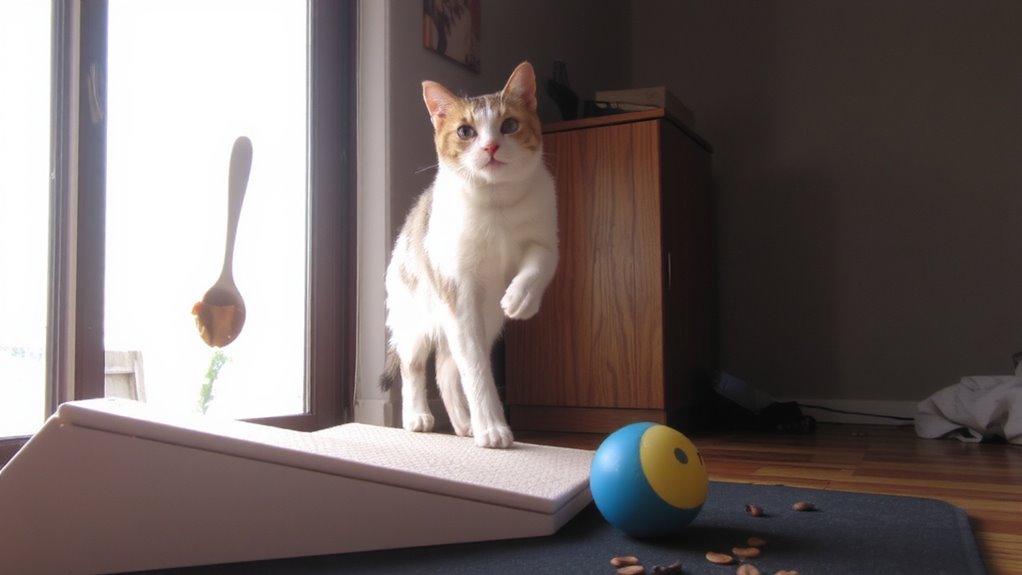
How do you turn your living space into an effective rehab zone for your cat? Designate a clutter-free area measuring at least 6 x 4 feet to allow room for controlled movement. Use nonslip flooring or place textured yoga mats to improve traction and joint stability. Position low-step ramps or foam obstacles at 2–3 inch heights to encourage stepping without strain. Rotate treat variety-soft, aromatic morsels for motivation; kibble for precision-to maintain engagement and prevent satiation. Dispense treats from puzzle feeders or hide them at consistent locations to reinforce exercise consistency. Perform sessions twice daily for 5–7 minutes, aligning with veterinary timelines. Use treat-retrieval tasks that require weight shifting or crouching, such as placing rewards under furniture edges. Track progress weekly using a mobility log. Maintain environmental predictability to reduce cognitive load. Avoid overstimulation with loud toys or distractions.
Align Treat Tasks With Physical Therapy Goals
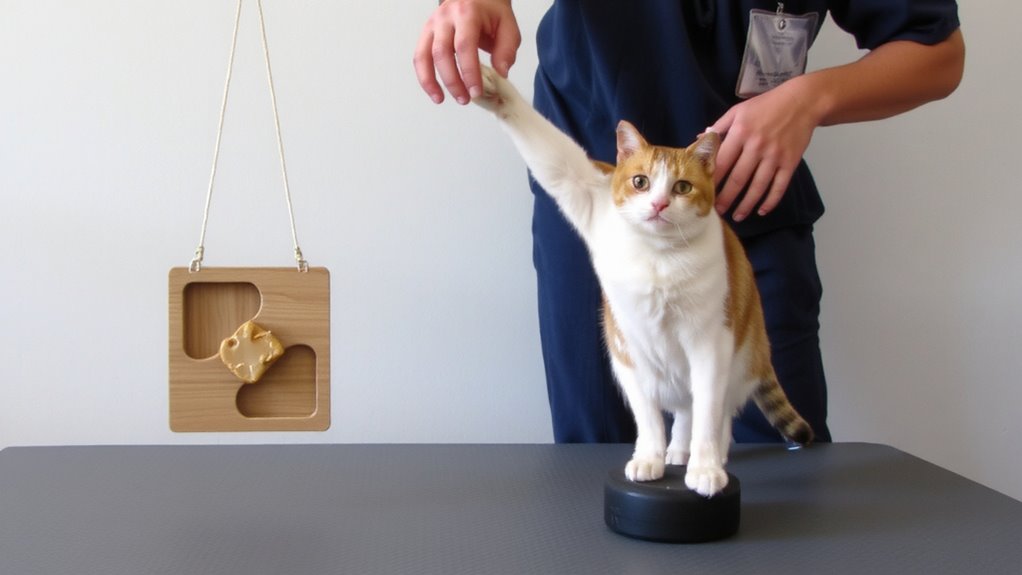
Why should treat-based exercises feel like random rewards instead of targeted therapy? You can transform simple treat retrieval into effective rehabilitation by aligning tasks with specific physical therapy goals. Use treat motivation strategically-offering high-value rewards only after correct movement patterns guarantees active participation. Task sequencing is critical: begin with weight-shifting exercises, then progress to step-ups or controlled reaches over obstacles. Each sequence should mirror therapeutic objectives like improving joint range of motion or enhancing limb coordination. Position treats at precise heights-6 to 12 inches off the ground-to encourage proper neck and limb extension without strain. Perform 3 sets of 5 repetitions twice daily, monitoring consistency. Proper alignment between task design and therapy goals turns every session into measurable progress. Treats aren’t just rewards-they’re tools for neuromuscular re-education.
Adjust Challenges as Your Cat Improves
As your cat masters the initial exercises, it’s time to increase task demands to match their improving strength and coordination. Gradually elevate surface heights to require greater limb extension, promoting improved coordination during reach and retrieval. Introduce unstable platforms, like foam pads, to challenge balance and proprioception. These modifications support increased endurance by extending task duration and intensity without overexertion. Use timers to track session length, aiming to incrementally increase time-on-task by 15–20 seconds weekly. Space treats farther apart to encourage longer movement sequences, reinforcing sustained motor control. Adjust treat size to maintain motivation while preventing fatigue. Monitor limb symmetry and gait patterns closely; asymmetric movement indicates the need for recalibration, not progression. Progress only when your cat completes tasks with consistent form, ensuring neuromuscular adaptation. This structured escalation maintains therapeutic efficacy and aligns directly with clinically defined recovery milestones.
Avoid These Common Treat-Based Rehab Mistakes
Poorly planned treat placement can undermine the gains you’re working so hard to achieve. Overusing food rewards leads to treat overreliance, reducing your cat’s willingness to perform without food. Inconsistent motivation occurs when reward timing, type, or frequency varies, disrupting motor learning. Avoid these pitfalls with structured protocols.
| Mistake | Impact on Therapy | Solution |
|---|---|---|
| Random treat placement | Alters targeted limb engagement | Place treats at exact reach points |
| Excessive treat use | Diminishes intrinsic motivation | Limit to 70% of trials |
| Irregular reward schedule | Causes inconsistent motivation | Use fixed-ratio reinforcement |
| Ignoring fatigue | Increases injury risk | Stop after 12 reps or 15 mins |
| Wrong treat size | Encourages gulping, not focus | Use pea-sized, low-calorie pieces |
Balance rewards with task demands to sustain progress.
Watch for Signs of Real Progress in Your Cat
How do you know your cat is making genuine progress in physical therapy? Watch for consistent behavioral cues during treat retrieval tasks. Increased willingness to ambulate toward the reward indicates improved motor coordination. You’ll notice smoother weight shifting, more precise paw placement, and reduced ataxia over successive sessions. Document limb reach frequency-progress is likely when repetitions increase by 25% over two weeks. Enhanced emotional bonding manifests as sustained eye contact and decreased stress vocalizations. These signs reflect neurological adaptation, not just motivation. Measure stride length: a 15–20% improvement suggests meaningful mobility gains. Avoid conflating food drive with recovery; isolate variables by using standardized task difficulty. True progress includes voluntary task initiation and reduced latency to movement onset. Track these metrics weekly. Behavioral cues, combined with quantifiable motor output, offer the most reliable indicators of rehabilitative success.
On a final note
You can effectively integrate treat-based tasks into your cat’s neurological rehab plan. These exercises promote targeted motor activation and neuroplasticity. Each movement-like stepping, reaching, or balancing-correlates to specific therapy goals, such as improving proprioception or limb strength. Adjust treat placement incrementally: start at 5 cm elevation, increase to 15 cm as coordination improves. Monitor limb placement accuracy and repetition consistency to quantify progress objectively.