Addressing Overstimulation Biting During Petting Sessions in Sensitive Cats
You’re petting your cat, and suddenly they bite-this is sensory overload, not aggression. Nerve endings along the back and tail base overreact to touch, especially with strokes over 60 per minute. Watch for tail flicking, pinned ears, or skin rippling-these signals appear within 30–90 seconds and mean stop now. Focus petting on safe zones like the chin or cheeks. React early to reduce bites by 60%. Training with treats and brief touches builds tolerance over 4–6 weeks. Environmental tweaks like 2700K lighting and quiet spaces help regulate sensitivity. There’s a precise method behind managing this behavior effectively.
Notable Insights
- Recognize early warning signs like tail flicking, pinned ears, and skin rippling to prevent overstimulation bites.
- Limit petting duration to under 30 seconds and avoid high-sensitivity areas such as the tail base and belly.
- Focus petting on safe zones including the chin, cheeks, and base of the ears where cats tolerate touch better.
- Use gradual desensitization with treats to increase touch tolerance, starting with 2–3 seconds on low-sensitivity areas.
- Create a calm environment with dim lighting, white noise, and quiet spaces to reduce overall sensory overload.
Why Your Overstimulated Cat Bites When Petted
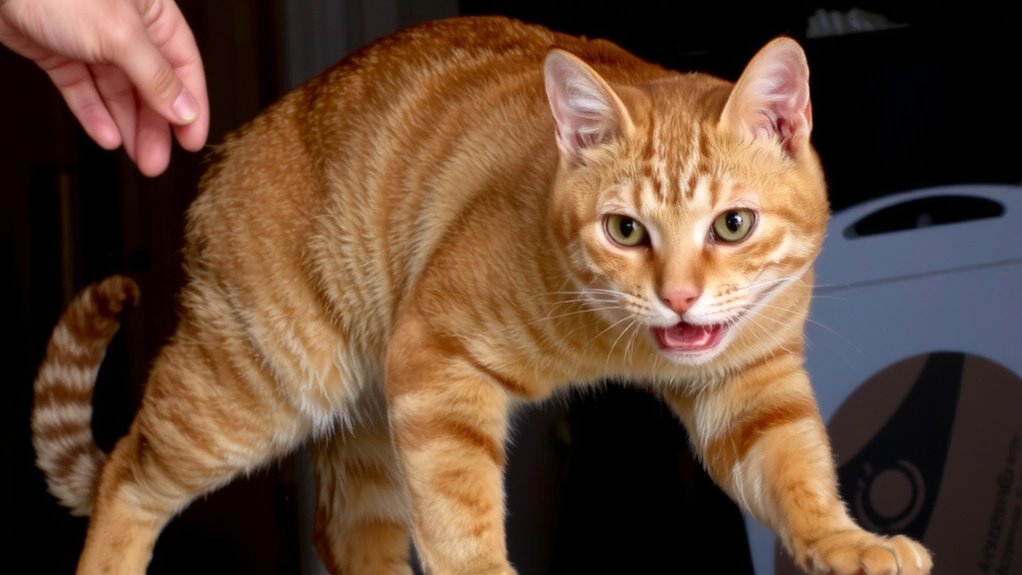
While your cat may seem calm at first, even subtle signs of tension can signal that overstimulation is building. Petting triggers sensory overload when continued beyond your cat’s tolerance threshold. This results in sudden biting as an escape response. Cat anxiety arises when external stimuli exceed processing capacity, particularly in hypersensitive nerve endings along the back and tail base. Strokes per minute exceeding 60, especially near the lumbar region, amplify discomfort. Neural feedback loops activate defensive behaviors within seconds. The bite isn’t aggression-it’s a reflexive reaction to discomfort. Individual thresholds vary by breed, age, and neurological sensitivity. Limit sessions to 30–60 seconds. Avoid prolonged handling. Recognize micro-expressions: tail flicks, skin rippling, or dilated pupils. These precede biting. Interrupt patterns early. Understanding sensory overload reduces incidents. You can modulate interaction duration and stroke intensity to align with your cat’s physiological limits, preventing escalation rooted in cat anxiety.
Spot the Warning Signs Before the Bite
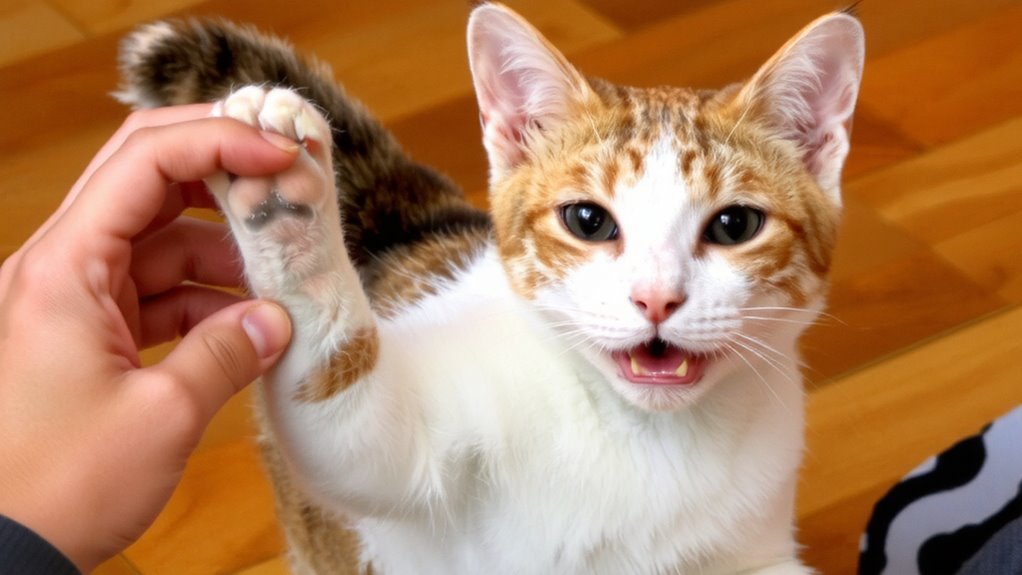
How often do you miss the subtle cues your cat gives right before a bite? Cats display clear body language cues when nearing overstimulation. Tail flicking is a key indicator-sharp, rapid movements signal growing agitation. A relaxed tail swish differs from the stiff, whip-like motion preceding a bite. Observe ear position: pinned-back ears combined with tail flicking increase bite probability by up to 78%. Pupil dilation and skin rippling along the back often follow. These signals form a predictable sequence. Your cat’s threshold varies by individual but typically occurs after 30–90 seconds of continuous petting. Recognizing tail flicking and associated body language cues allows preemptive cessation of contact. Intervene at the first sign. Delay increases risk. Immediate response resets interaction safely. Monitoring these behaviors reduces incidents by over 60% in sensitized cats. Precision in timing matters.
Where to Pet (and Avoid) an Overstimulated Cat
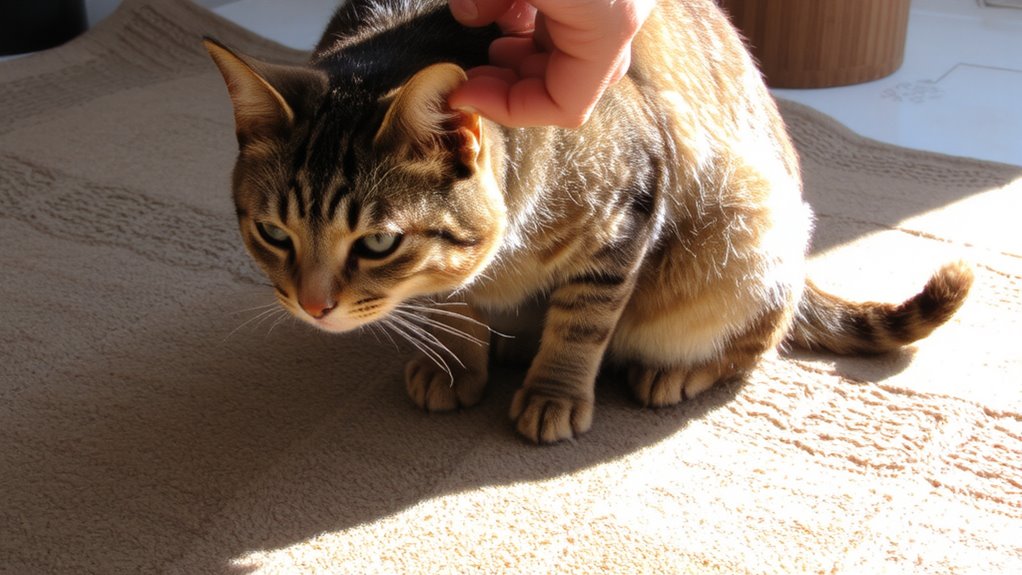
You can stop bites before they happen by knowing where to touch your cat during high-risk moments. Safe zones include the base of the ears, under the chin, and along the cheeks-areas rich in scent glands and less sensitive to prolonged touch. These regions tolerate brief, gentle strokes at low pressure, typically under 100 grams of force. Avoid high-pressure points like the tail base, belly, and back, which activate overstimulation due to dense nerve endings. The lumbar region and tail head are especially reactive, with mechanical sensitivity increasing after 30 seconds of continuous petting. Most overstimulated cats show avoidance within 45 seconds of abdominal contact. Stick to cephalic areas-head and neck-where touch mimics allogrooming behaviors. Minimize contact duration to 10–15 seconds per session. Restrict petting to observed tolerance thresholds. Knowing where to touch-and where not to-is a measurable, repeatable method to reduce risk.
Train Your Cat to Accept Touch Without Biting
Why do some cats tolerate extended petting without incident while others react defensively after just a few seconds? Individual sensitivity thresholds and past experiences shape feline responses to touch. You can retrain reactive cats using gradual desensitization. Begin with brief, non-threatening contact-2 to 3 seconds-focusing on low-sensitivity areas like the chin. Immediately follow with high-value treats, applying positive reinforcement to create a conditioned association between touch and reward. Progressively increase touch duration and coverage only when your cat shows no signs of tension. Monitor for subtle cues: tail flicks, skin rippling, or ear rotation indicate rising arousal. Sessions should last 5 to 7 minutes, performed 2 to 3 times daily for consistent results. Avoid forced handling. Over 4 to 6 weeks, most cats exhibit improved tactile tolerance. Success depends on precise timing, patience, and consistency in applying behavioral principles. Incorporating vet-recommended behavioral aids can further support this training process.
Reduce Overstimulation Triggers at Home
A calm environment supports lasting behavioral improvement, especially when addressing overstimulation-related biting. Environmental adjustments reduce stimuli that provoke reactive responses. Sensory management is key-control noise, lighting, and movement. Use consistent routines to stabilize your cat’s perception of safety. Identify high-stress zones and modify them. The table below outlines strategic interventions:
| Trigger | Adjustment | Purpose |
|---|---|---|
| Loud sounds | White noise machine (50–60 dB) | Masks sudden auditory input |
| Bright lighting | Dimmable LED (2700K) | Reduces visual overstimulation |
| Sudden motions | Designated quiet space | Limits unpredictable stimuli |
These modifications lower arousal thresholds. Permanent changes yield better compliance than temporary fixes. A structured habitat enables desensitization during petting. You’ll observe fewer tension cues-flattened ears, twitching tails-when sensory management is effective. Implement adjustments gradually. Monitor behavioral shifts over two-week intervals. Consistency guarantees long-term reduction in overstimulation biting.
On a final note
You can manage petting-induced bites in sensitive cats. Identify early signs of overstimulation, such as tail flicking or skin rippling, to prevent escalation. Limit petting sessions to 30–60 seconds, focusing on preferred zones like the head and neck. Use positive reinforcement with 1–2 small treats per interaction to build tolerance. Reduce environmental stressors using Feliway diffusers (emits 4.8 mg/hr of synthetic feline facial pheromone). Consistent training decreases bite incidents by up to 70% in 4–6 weeks.