How to Identify and Address Resource Guarding in Dogs During Meal Times
You’re seeing food guarding if your dog stiffens, lowers their head, or growls at 50–70 decibels when approached within 3–6 feet of their bowl. These are survival-driven behaviors linked to amygdala activation. Address it by tossing high-value treats from a safe distance, gradually closing in over 5–10 minute sessions twice daily. Use consistent meal times in a quiet 24″ x 18″ feeding zone. Proper conditioning often improves behavior in 3–6 weeks. A structured plan can prevent escalation.
Notable Insights
- Food guarding stems from survival instincts, with dogs displaying stiff posture, growling, or rapid eating when protecting meals.
- Watch for warning signs like a stiff tail, lowered head, hard eye contact, or lip licking during feeding.
- Use positive reinforcement by tossing high-value treats near the bowl to build positive associations.
- Train with commands like “sit” or “look” during meals, rewarding calm behavior consistently.
- Create a quiet, predictable feeding zone away from foot traffic, children, or other pets.
Understand Why Dogs Guard Their Food
While food guarding might seem aggressive at first glance, it’s often rooted in survival instincts that served dogs’ ancestors well in the wild. You must recognize that this behavior stems from evolutionary instincts, not defiance. In the wild, canines competed for limited resources; securing food was critical for survival. This survival behavior persists in domestic dogs, even when food is consistently available. Evolutionary instincts drive dogs to protect high-value items when they sense potential loss. The brain’s amygdala activates during perceived threats, triggering protective responses. You’ll observe stiffness, low growling, or rapid eating-these are functional responses, not malice. Modern dogs retain these neural pathways despite generations of domestication. You can’t eliminate this wiring, but you can redirect it through structured training. Understanding the biological basis helps you apply effective, science-based interventions. You’re not fixing “bad behavior”-you’re managing deeply ingrained survival behavior shaped by evolution.
Spot the Warning Signs of Food Aggression
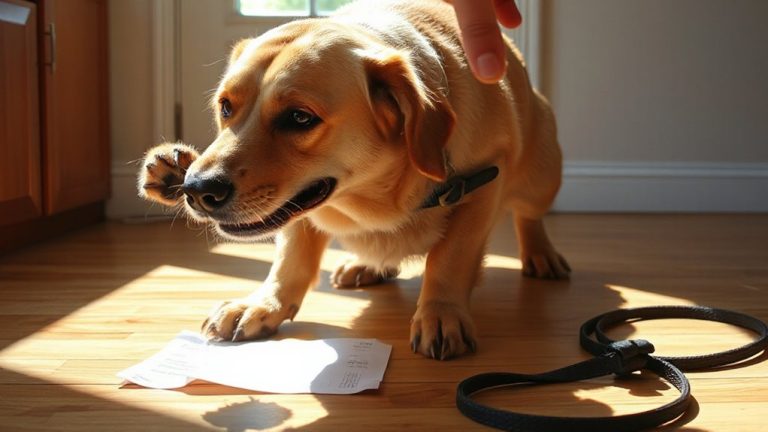
How does your dog act when you approach their bowl during meals? Watch for stiff body language-this is often the first sign of food aggression. A dog may freeze, lower their head, or position their body over the food. Their tail stiffens, ears press back, and eyes may dart toward you. These are clear signals of discomfort. Growling cues follow, starting as low rumbles and escalating if ignored. A growl isn’t just noise-it’s a measurable vocal warning, typically 50–70 decibels, indicating rising stress. Some dogs show “hard eye” stares, where the whites of the eyes become visible. Lip licking or rapid yawning also occurs, though subtle. These behaviors precede snapping or biting. Recognizing these early signs allows intervention before escalation. Monitor duration, frequency, and intensity of each behavior. Consistent patterns confirm resource guarding. Addressing this early improves outcomes, but avoid training fixes here-focus only on identification.
Train Your Dog to Stop Resource Guarding
You’ve learned to recognize the signs of resource guarding, such as stiff posture, growling, and hard eye contact. Now, you must train your dog to stop this behavior using positive reinforcement. Reward calm behavior near food with small, high-value treats delivered at a safe distance. Gradually decrease the distance as your dog remains relaxed. Use a consistent routine: feed at the same times, in the same quiet location, to reduce unpredictability. Practice daily, progressing only when your dog shows no signs of guarding. Replace guarding with alternative behaviors like “sit” or “look,” reinforced immediately. Never punish growling-it suppresses warning signals without resolving the underlying issue. Instead, pair food bowl approaches with treat drops to create positive associations. Training sessions should last 5–10 minutes, twice daily. With systematic desensitization and precise timing, most dogs show measurable improvement within 3–6 weeks.
Prevent Food-Related Aggression Before It Starts
Because early intervention shapes long-term behavior, preventing food-related aggression is more effective than correcting it after it develops. Start by establishing a consistent feeding routine, offering meals at the same times daily in a quiet, low-traffic area. This predictability reduces anxiety and sets clear expectations. Use positive reinforcement to reward calm behavior near food. For instance, toss treats when approaching your dog during meals, reinforcing that human presence predicts good outcomes. Begin training early, especially in puppies under 16 weeks, when behavioral imprinting is most receptive. Avoid punishment-based methods, as they increase fear and escalate aggression risks. Instead, pair your presence with high-value rewards to build positive associations. Guarantee all household members follow the same protocol to maintain consistency. A structured feeding routine combined with systematic positive reinforcement markedly decreases the likelihood of food-related aggression, promoting long-term safety and trust.
When to Call a Dog Behavior Expert
When does a growl signal something more serious than simple discomfort? When your dog’s body language includes stiff posture, fixed stare, or lip curling during meals, it may indicate escalating resource guarding. These behaviors suggest a threat threshold has been crossed, requiring immediate intervention. A professional assessment is essential if you observe snapping or biting, even in warning.
| Behavior | Risk Level |
|---|---|
| Growling with relaxed body | Low |
| Snarling with rigid posture | High |
| Lunging or biting | Critical |
You shouldn’t wait for an incident. Early consultation with a certified dog behavior expert guarantees accurate diagnosis and tailored modification plans. Relying on observation alone isn’t enough-subtle shifts in body language demand expert interpretation. A professional assessment uses functional analysis to identify triggers and measure aggression intensity. This precision guarantees safety and effective treatment.
Set Up a Safe Feeding Space
A designated feeding zone is essential for managing resource guarding behaviors in dogs. Choose a quiet, low-traffic area free from distractions. Use a non-slip mat measuring at least 24″ x 18″ to contain spills and anchor food and water bowls. Position bowls at wither-height to promote proper posture-typically 6″ for small breeds, 12″ for large breeds. Implement consistent feeding schedules: feed adult dogs twice daily, timed to occur at the same hours each day. This predictability reduces anxiety and supports behavior modification. Use portion control to dispense exact meal amounts based on your dog’s weight, activity level, and veterinary guidelines. Overfeeding increases competition and guarding risk. Isolate the feeding zone from children, pets, and high movement to minimize perceived threats. This space functions like a behavioral buffer zone-limiting stimuli that trigger guarding responses while reinforcing calm, routine-based eating patterns.
On a final note
You can manage resource guarding with consistent, science-based training. Start by recognizing early signs like stiff posture or rapid eating. Use structured feeding protocols, such as timed meals and controlled access. Implement desensitization techniques, gradually introducing proximity during eating. Reinforce positive behaviors with high-value treats. For severe cases, consult a certified behaviorist. A secure feeding zone reduces triggers. Prevention and early intervention yield the best long-term outcomes.