Teach Dogs to Fetch by Name: Clicker Training in 3-5 Min Sessions
You start by pairing the clicker with high-value treats, delivering a reward within 0.5 to 1 second of each click. Use consistent timing-click within 0.5 seconds of desired behavior-to mark moments like looking at or touching a named toy. Train one toy at a time in 3- to 5-minute sessions, repeating its name in a steady tone. Click and treat for each correct response. Shape retrieval step by step: interest, contact, grasp, and lift. Every click must mean a treat. Avoid distractions and cognitive overload from similar toys. Successive approximations build precise toy recognition. Mastery requires 95% accuracy over 20 trials, with retrieval in under 3 seconds. Further refinements can enhance reliability across environments.
Notable Insights
- Pair the clicker with treats by delivering a reward within 0.5 to 1 second after each click to build reliable association.
- Use the clicker to mark precise moments of interest in a named toy, followed immediately by a high-value treat.
- Train one toy name at a time in short 3–5 minute sessions to strengthen name recognition and prevent confusion.
- Shape behavior gradually by clicking and rewarding steps like looking, touching, grasping, and lifting the correct toy.
- Avoid distractions and timing errors by training in quiet environments with consistent click-treat timing and clear toy names.
How Clicker Training Works for Fetch by Name
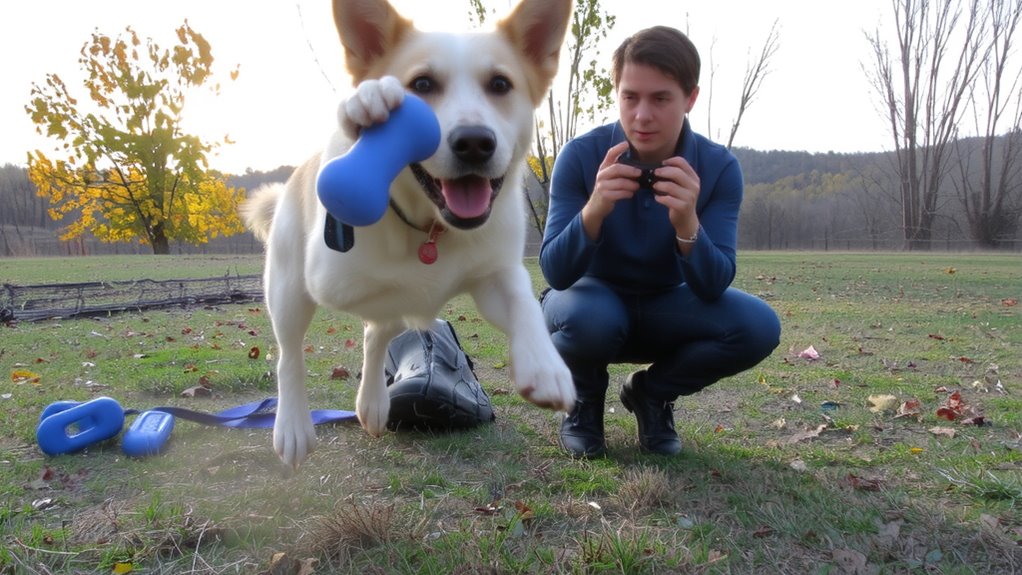
Start by charging your clicker to establish the association between the sound and a treat. You’ll use the click as a marker signal, indicating precise moments your dog performs the desired action. Accurate marker timing is critical-click within 0.5 seconds of the target behavior to guarantee clear communication. The sound bridges the gap between action and reward, helping your dog understand exactly what earns a treat. Use this method during target shaping, where you gradually refine your dog’s behavior toward retrieving a specific named object. Begin by reinforcing interest in the target toy, then shape successive approximations: touching, grasping, and finally lifting it. Each step is captured with the clicker. Maintain consistent criteria before advancing. Over sessions, pair the toy’s name with these shaped actions, reinforcing correct selection. This systematic, science-based process enhances discrimination and reliability.
How to Pair the Clicker With Rewards Correctly
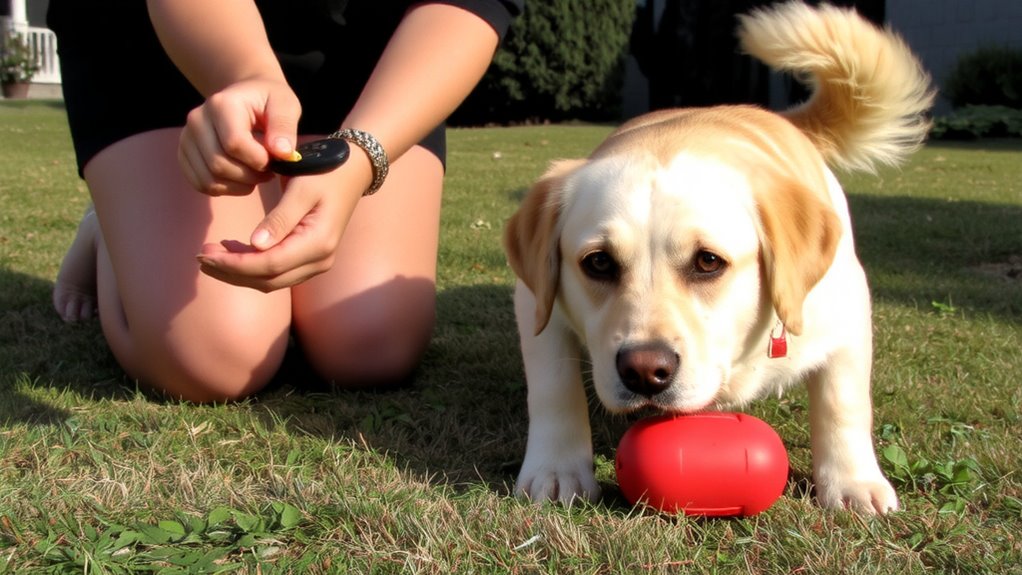
While your dog learns to connect actions with outcomes, proper pairing of the clicker and reward guarantees the signal remains meaningful. You must deliver the treat within 0.5 to 1 second after the click. This tight window secures accurate clicker timing, so your dog associates the sound with the correct behavior. Use high-value rewards consistently-small pieces of chicken or hot dog work best. Reward consistency strengthens learning by eliminating confusion. Each click must predict a reward; if you click, you must follow with a treat, every time. Breaks in this rule weaken the conditioned response. The clicker acts as a bridging stimulus, marking the exact moment of desired action. Think of it like a camera shutter capturing precise behavior. Misuse, such as delayed clicks or skipped rewards, degrades training accuracy. Maintain strict protocol to secure reliable communication with your dog. Top-rated models like the Best Cat Training Clickers ensure consistent clicking sound and ergonomic design for ease of use.
Step-by-Step: Teaching Your Dog to Recognize Toy Names
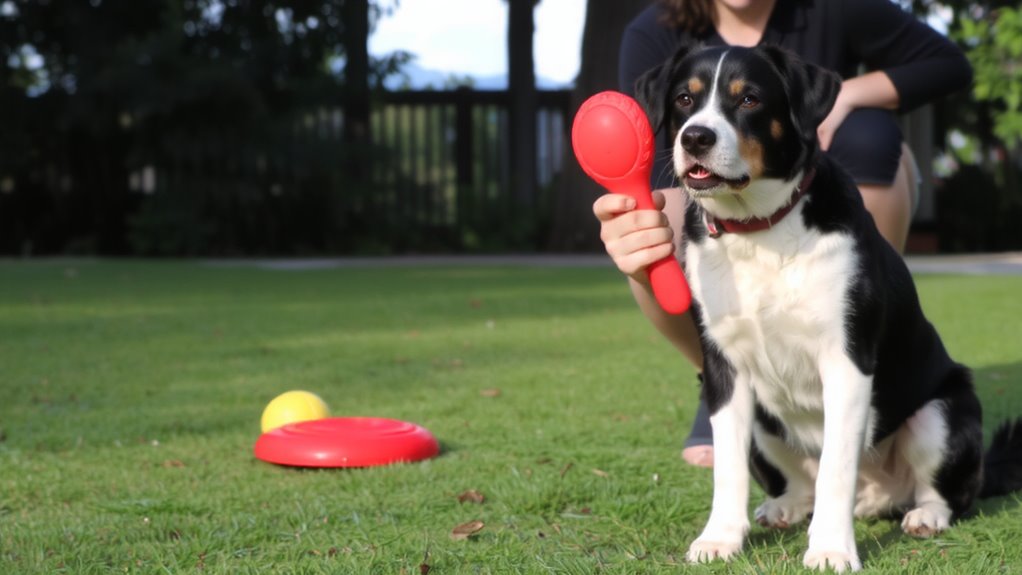
You can teach your dog to recognize specific toy names by using precise repetition and consistent reinforcement. Establish toy association by isolating one toy during training sessions. Use clear name repetition in a consistent tone. Present the toy, say its name, then click and treat when your dog shows interest. Repeat this sequence multiple times per session over several days.
| Training Phase | Action | Frequency |
|---|---|---|
| Introduction | Show toy, speak name | 5x per session |
| Association | Click for interaction | 10 reps daily |
| Recall Prompt | Say name without toy | 3–5x daily |
| Reinforcement | Reward correct response | Every correct cue |
Accurate name repetition strengthens memory encoding. Limit distractions to enhance focus. Use only one toy per name to prevent confusion. Training sessions should last 3–5 minutes, maximizing retention without fatigue. Consistency guarantees long-term auditory discrimination.
Common Mistakes to Avoid in Clicker Fetch Training
Why do some dogs struggle to learn fetch commands despite consistent clicker training? Inconsistent timing undermines the association between behavior and reward. The click must occur within 0.5 seconds of the correct action to effectively mark the behavior. Delayed clicks confuse your dog, weakening learning precision. Premature complexity is another critical error. Introducing multiple toy names before your dog masters one leads to cognitive overload. Limit initial training to a single toy with a distinct auditory and visual signature-such as a red squeaky ball (diameter: 7 cm)-to reduce confusion. Train in low-distraction environments with sessions under 5 minutes to maintain focus. Each repetition should reinforce one specific behavior, such as touching or retrieving that one object. Avoid layering commands or adding distractions too soon. Precision in timing and incremental progression guarantees reliable name recognition.
Advanced Tips to Level Up Fetch-by-Name Skills
How do top-performing dogs achieve flawless fetch-by-name accuracy? Distraction proofing is essential. Begin training in a quiet environment, then gradually introduce stimuli-low-distraction settings first, like a fenced yard, before progressing to parks or streets. Use high-value treats to maintain focus. Retrieval precision improves with consistent naming and repetition. Assign unique, one- or two-syllable names to each toy-avoid similar sounds to prevent confusion. Practice sessions should last 5–7 minutes, 3–4 times daily, ensuring mental sharpness. Reinforce correct picks with an immediate click and treat within 0.5 seconds. Rotate toys weekly to prevent habituation. Test recall under variable conditions: different rooms, surfaces, and lighting. Mastery occurs when your dog retrieves the correct item in under 3 seconds with 95% accuracy across 20 trials. Precision + consistency = reliability.
On a final note
You now have the tools to teach precise toy identification through clicker training. Each click marks the exact moment your dog interacts with the correct item, reinforcing accuracy. Pair verbal cues with immediate reinforcement to solidify name-to-object association. Use consistent, distinct toy names and limit training sessions to 5–7 minutes to maintain focus. Mastery requires 10–15 sessions depending on reinforcement timing and stimulus control.