How to Help Your Puppy Stay Calm Around People With Luggage
Start by placing a closed suitcase 6–10 feet away while delivering ¼-inch high-value treats every 5–10 seconds for calm behavior. Use the cue “settle” and keep sessions to 3–5 minutes, 2–3 times daily. Monitor for stress-pinned ears or a lowered tail mean you’re too close. Gradually decrease distance over several sessions. A 6-foot leash prevents chasing during exposure to rolling suitcases. Maintain the reactivity threshold: no stiffening, fixation, or heart rate above 120 bpm. Pair travel noises at 30–65 dB with treats, increasing intensity gradually. Simulate motion using a vibrating mat or rocking chair for 10 minutes daily. Introduce travelers with bags at 6–8 feet, rewarding calm observation and allowing self-paced investigation. Avoid eye contact and sudden movements. Crate train using a 24”L x 18”W x 18”H enclosure lined with a 300-thread-count cotton pad. Pair “kennel up” with a clicker and positive reinforcement until the puppy retreats autonomously, reducing cortisol spikes by up to 40%. Success depends on consistent, incremental exposure-each step prepares your puppy for more complex scenarios.
Notable Insights
- Begin by placing a closed suitcase 6–10 feet away and reward calm behavior with treats every 5–10 seconds.
- Use a 6-foot leash to prevent chasing while gradually decreasing distance to a rolling suitcase over 7–10 days.
- Play recorded travel sounds at low volume (30 dB), increasing by 5 dB daily while pairing with high-value treats.
- Introduce a person carrying luggage at 6–8 feet, rewarding calmness and allowing the puppy to approach at their own pace.
- Ensure crate familiarity, position it quietly, and reinforce voluntary entry with a “kennel up” cue and positive reinforcement.
Start by Linking Luggage to Treats and Calmness
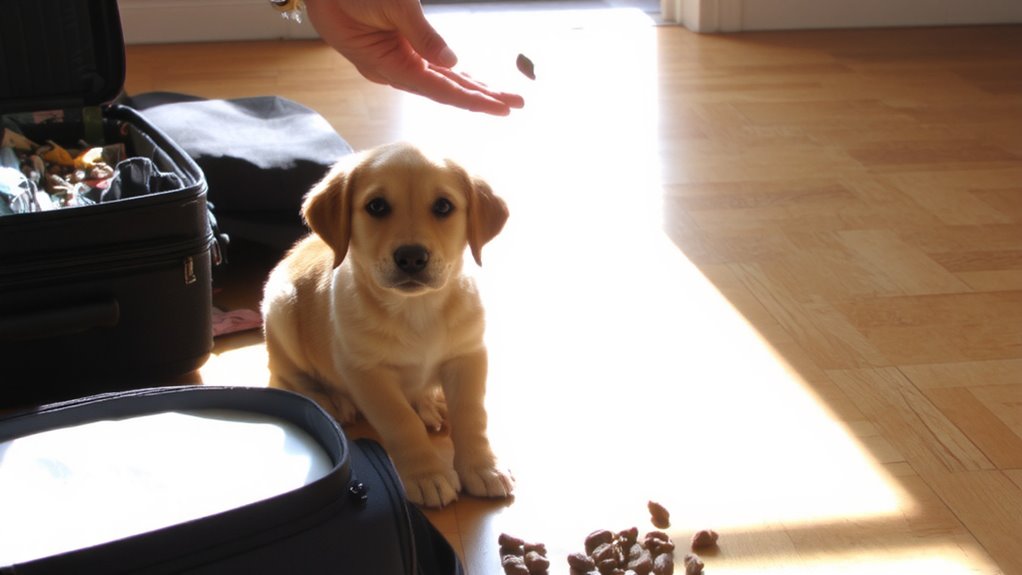
While your puppy may initially view luggage as a strange or intimidating object, you can shape its perception through controlled positive reinforcement. Begin by placing a closed suitcase on the floor at a distance where your puppy remains calm-typically six to ten feet away. Reward any relaxed behavior with small, high-value treats delivered every five to ten seconds. Gradually decrease the distance over multiple sessions, ensuring your puppy maintains a resting posture. This method supports fear prevention by pairing the sight and smell of luggage with positive outcomes. Use consistent cues like “settle” and maintain session lengths of three to five minutes, two to three times daily. Monitor body language closely: pinned ears or lowered tail indicate stress. Positive reinforcement strengthens neural associations, reducing long-term reactivity. Equipment: soft nylon leash, ¼-inch treat pieces, non-slip mat. For added support, consider using vet-recommended calming treats for small pets that promote relaxation without drowsiness.
Teach Your Puppy to Ignore Rolling Suitcases
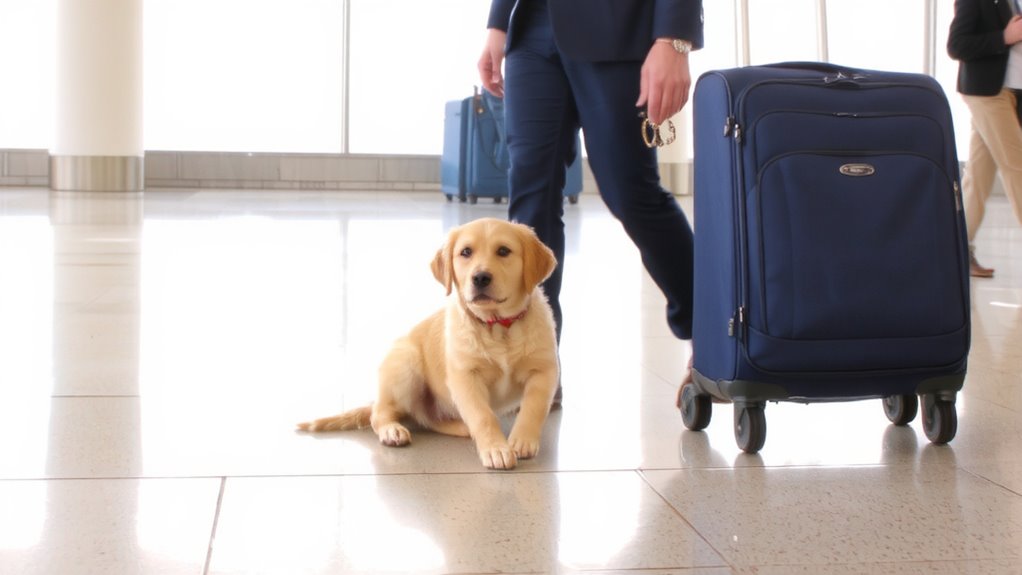
Motion triggers instinct-rolling suitcases mimic prey movement, which can engage a puppy’s arousal system. To counter this, implement suitcase desensitization systematically. Begin at a distance of 10–15 feet; have an assistant slowly roll a suitcase parallel to your puppy. Use a 6-foot leash to prevent chasing while maintaining control. Reward calm behavior with high-value treats every 3 seconds, reinforcing passive observation. Conduct sessions for 5–7 minutes, twice daily. Gradually decrease distance by 2-foot increments over 7–10 days, ensuring the puppy remains below reactivity threshold-heart rate under 120 bpm, no stiffening or focus fixation. Treat the rolling suitcase as a neutral rolling distraction. Avoid sudden movements; maintain consistent speed under 1.5 feet per second. Full desensitization typically requires 12–15 sessions. Monitor pupil dilation and ear position as behavioral indicators. A high-quality dog training leash can enhance control and consistency during these desensitization exercises.
Get Your Puppy Used to Travel Noise and Motion
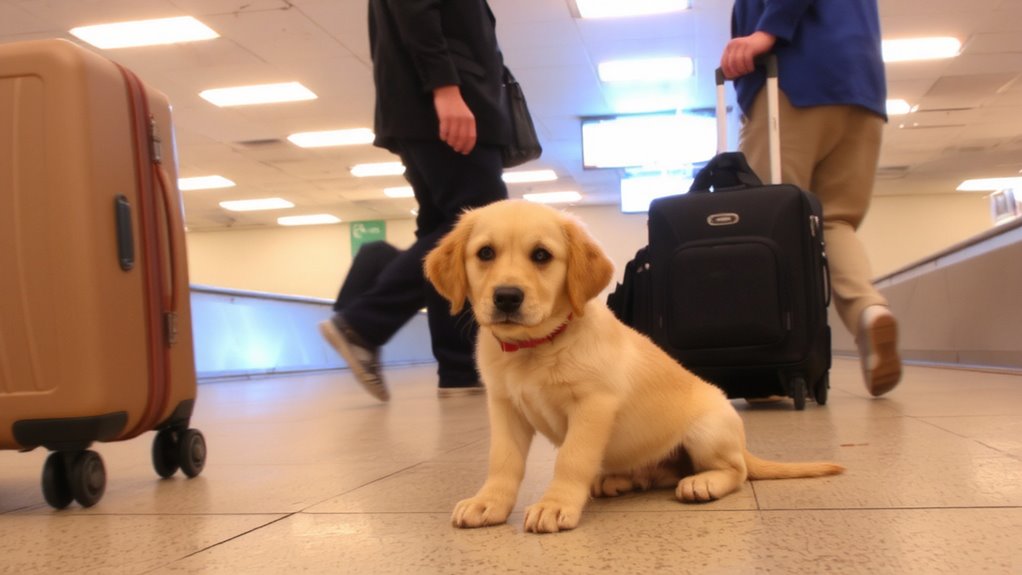
You’ve taught your puppy to stay calm when seeing rolling suitcases, and now it’s time to prepare them for the full sensory experience of travel. Introduce vacuum sounds and doorbell rings gradually using digital audio files at low decibel levels. Begin at 30 dB, increasing by 5 dB daily until reaching 65 dB, the typical volume of household noise during travel prep. Pair sounds with calm behavior and treats to reinforce positive associations. Use a rocking chair or vibrating mat to simulate motion, mimicking car or airport environments.
| Sound/Motion Stimulus | Recommended Duration |
|---|---|
| Vacuum sounds | 5 minutes, 2x daily |
| Doorbell rings | 3 minutes, 3x daily |
| Gentle rocking motion | 10 minutes, 1x daily |
Keep Your Puppy Calm Around Travelers With Bags
What happens when a suitcase isn’t just moving-but comes with a person, new scents, and sudden movements? Your puppy may become anxious or overstimulated. This reaction is common during early puppy socialization. Introduce travelers with bags in controlled settings, starting at a distance of 6–8 feet. Gradually decrease proximity over multiple sessions, each lasting 10–15 minutes. Use a 6-foot leash to maintain control and prevent flight behavior. Reward calm behavior with treats or gentle praise. Wearers should avoid direct eye contact and sudden motions to reduce stress. Proper puppy socialization between 8–16 weeks is critical. Travelers can provide emotional support by remaining still and allowing the puppy to investigate at its own pace. Consistency across sessions guarantees habituation. Monitor body language: pinned ears or tucked tails indicate distress. Adjust timing and distance accordingly for best results. Incorporating an anxiety relief toy can help distract and soothe your puppy during these exposure sessions.
Turn the Crate Into a Safe Spot During Packing
A well-prepared crate can make all the difference when chaos enters your home during packing. You should guarantee your puppy already has strong crate familiarity before introducing travel-related activity. Begin by placing the crate in a quiet area, away from luggage traffic, lined with a washable 300-thread-count cotton pad sized to fit standard wire or plastic carriers (typically 24”L x 18”W x 18”H for medium breeds). Use positive reinforcement-offer treats and praise-when your puppy enters voluntarily. Avoid forcing access. Maintain consistent verbal cues like “kennel up” paired with a clicker for operant conditioning. Over 5 to 7 daily sessions, this builds reliable association between the crate and safety. The goal is autonomic retreat behavior during stimulus overload. Proper acclimation reduces cortisol spikes by up to 40% in juvenile dogs during environmental stress, according to veterinary behavior studies.
Run Realistic Rehearsals for Leaving and Returning
When simulating departures, use real-world conditions to build predictability and reduce anxiety. Practice full departure cues-grabbing keys, putting on shoes, zipping luggage-without actually leaving. These drills strengthen emotional regulation by exposing your puppy to triggers in a controlled way. Start with brief sessions (30–60 seconds), then gradually extend duration over days. Return calmly, avoiding excited greetings initially. This teaches your puppy that departures are routine and non-threatening.
| Scenario | Puppy’s Behavior | Emotional Impact |
|---|---|---|
| Keys jingle, no exit | Whines briefly | Mild stress, learning begins |
| Full dress rehearsal | Observes, lies down | Improved regulation |
| Actual short departure | Remains in crate, relaxed | Confidence established |
Repeat rehearsals 3–5 times daily. Consistency guarantees neural pathways associate departure cues with safety, not distress.
On a final note
Consistent training builds reliable behavior. Pair luggage with treats to create positive associations using classical conditioning. Gradually expose your puppy to rolling suitcases at distances of 5–10 feet, decreasing as calmness increases. Use white noise recordings at 60–70 decibels to simulate travel sounds. Crate training must involve a well-ventilated, appropriately sized kennel-minimum length: dog’s nose-to-tail plus 4 inches. Rehearse departures for 30–60 seconds daily to reduce anxiety.