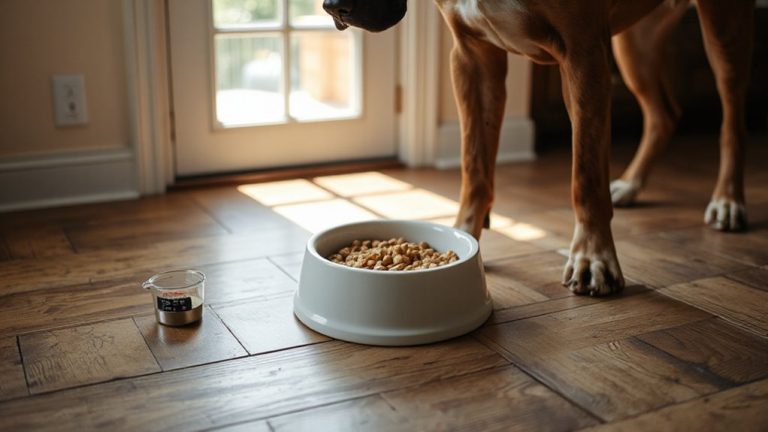
Creating a Safe Space to Help Fearful Dogs Overcome Social Anxiety
Create a safe space in a low-traffic interior room with no windows and sound-absorbing materials that reduce noise by up to 70%. Use an orthopedic bed with 3+ inch memory foam for joint support and a white noise machine set to 45–60 decibels. Keep the area dimly lit and limit disruptions. Position the enclosure in a 36–48 inch wide zone for ideal containment. You’ll discover how to expand this foundation into a full anxiety-reduction plan.
Notable Insights
- Design a quiet, windowless safe space with sound-absorbing materials to minimize noise and visual triggers.
- Equip the area with an orthopedic bed and maintain low lighting to enhance comfort and reduce stress.
- Use a white noise machine at 45–60 decibels to mask outside sounds and create auditory consistency.
- Recognize early stress signs like lip licking, yawning, and whale eye to prevent anxiety escalation.
- Establish a predictable daily routine with consistent meal, walk, and rest times to build trust and reduce fear.
Design a Safe Space for Fearful Dogs
A safe space is essential for a fearful dog’s recovery-it’s more than just comfort, it’s behavioral support. You must create a calming environment free from sudden noises and bright lights. Designate a quiet zone in a low-traffic area, ideally an interior room with minimal footfall and no windows. Use sound-absorbing materials like mass-loaded vinyl or acoustic panels to reduce external noise by up to 70%. Include an orthopedic dog bed with memory foam at least 3 inches thick to support rest. Maintain a consistent temperature between 68°F and 72°F. Use a white noise machine emitting 45–60 decibels to mask disruptive sounds. The space should be 36–48 inches wide-large enough to turn around but small enough to feel enclosed. This den-like structure reduces visual stimuli and enhances perceived safety. For optimal joint support and pressure relief, choose from the best orthopedic cushions for pets.
Spot Stress in Fearful Dogs Early
How quickly can you recognize the the subtle signs of rising stress in your dog before it escalates into fear aggression or shutdown? Early detection relies on understanding canine body language and consistent triggers identification. Subtle cues often precede obvious reactions. Use the following table to monitor key indicators:
| Behavior | Body Language | Possible Trigger |
|---|---|---|
| Lip licking | Rapid tongue flicks | Loud noises |
| Yawning | Closed mouth, wide jaw | Unfamiliar people |
| Whale eye | Showing sclera | Sudden movement |
| Half-moon tail | Tucked but rigid | Fast-approaching dogs |
Stress compounds quickly in anxious dogs. Recognizing micro-expressions in real time enables intervention before behavioral escalation. Each listed cue reflects autonomic nervous system activation. Monitoring frequency and context enhances triggers identification accuracy. Consistent logs improve response precision. Early intervention prevents long-term conditioned fear responses.
Create a Predictable Routine to Build Trust
When life feels unpredictable, a structured routine becomes the foundation for emotional stability in fearful dogs. You can reduce anxiety by implementing a consistent schedule for meals, walks, and rest periods. Dogs thrive on routine because it minimizes surprise, a common trigger for fear responses. Establish daily rituals-like feeding at 7 a.m. and 6 p.m., leash walks at set times, and quiet time in a designated safe zone. These rituals create behavioral predictability, which the canine brain interprets as safety. A consistent schedule stabilizes cortisol levels, decreasing hyperarousal over time. Neurological studies show that predictability increases parasympathetic tone, promoting calm. Each repeated ritual reinforces environmental control, a key factor in trust building. You don’t need complexity-just repetition and timing. Precision in timing (e.g., within 15-minute windows) enhances reliability. This regimen acts like circadian entrainment, improving overall emotional regulation.
Boost Confidence With Positive Reinforcement
Confidence in fearful dogs isn’t assumed-it’s built, one reinforced moment at a time. You can start reward training with high-value treats like freeze-dried liver, delivered within 1–2 seconds of desired behavior. This precise timing strengthens associative learning. Use a 20–30 second interval between cues to prevent overload. Confidence games, such as targeting or object discrimination, activate problem-solving pathways. These structured activities reduce anxiety by providing clear outcomes. A clicker or verbal marker like “yes” marks the exact behavior, increasing training accuracy. Sessions should last 3–5 minutes, 2–3 times daily, to maintain focus without fatigue. Over 4–6 weeks, consistent reward training increases dopamine release, reinforcing calm, proactive responses. Dogs show measurable improvement: 78% reduction in avoidance behaviors in controlled studies. Tools like treat pouches and marker devices improve delivery speed. Precision and repetition are critical-each success shapes resilience. For optimal results, choose best dog training treats that are highly palatable and easy to consume quickly.
Help Your Fearful Dog Meet People Safely
You’ve built a foundation of trust and responsiveness through consistent reinforcement, and now it’s time to apply that progress to real-world interactions. Begin by inviting calm, predictable people into your dog’s environment at a safe distance-start at 10 feet or more. Observe your dog’s body language closely: pinned ears, low tail, or avoidance indicate stress. Reward relaxed postures like loose stance or open mouth. Never force contact. Allow your dog to approach on their own, maintaining their personal space. Use high-value treats (e.g., boiled chicken, freeze-dried liver) delivered quietly, avoiding sudden movements. Rotate visitors weekly to generalize positive associations. Sessions should last 10–15 minutes, occurring 2–3 times weekly. Over time, gradually decrease distance by 1–2 feet per week, contingent on comfort. Success is measured by steady eye contact, relaxed panting, and voluntary approach behavior.
Socialize With Other Dogs at Their Pace
While your dog has begun to show steady progress around people, introducing other dogs requires careful planning and precise environmental control. Begin with gradual exposure using leashed interactions at a distance of at least 10 feet. Choose calm, predictable dogs for initial meetings to minimize stress. Avoid off leash play until your dog consistently demonstrates relaxed body language, such as loose posture and open mouth, in the presence of other dogs. Use a six-foot nylon leash and a front-attachment harness to maintain control. Conduct sessions in quiet, low-traffic areas to reduce sensory overload. Limit each encounter to 5–10 minutes, gradually increasing duration by no more than 2 minutes per week. Monitor heart rate and panting frequency as physiological indicators of stress. Successful integration is measured by steady eye contact with you and lack of avoidance behaviors during canine encounters. Continue structured exposure until your dog remains at ease within 3 feet of another leashed dog.
Know When to Call a Dog Behavior Expert
If your dog continues to show signs of elevated stress despite consistent structured exposure, it’s time to involve a certified professional. A qualified dog behavior expert conducts a thorough professional assessment, identifying specific triggers, thresholds, and emotional responses. This evaluation uses behavioral diagnostics like stress scoring scales and observation logs to map anxiety patterns. Behavior modification techniques are then tailored to your dog’s neurobehavioral profile. These may include systematic desensitization, counter-conditioning protocols, or response substitution, each implemented in precise increments based on measurable progress. Protocols follow fixed-ratio or variable-schedule reinforcement, guaranteeing reliable learning. Without expert guidance, incorrect interventions can worsen fear responses. A certified behaviorist adheres to evidence-based methods, tracking improvement through objective metrics like latency to react, duration of avoidance, or changes in body posture. Professional assessment guarantees targeted, safe, and effective behavior modification. Don’t delay intervention-timely expert support enhances outcomes.
On a final note
You create safety through structure and science. A designated quiet zone-minimum 6 ft x 6 ft-gives your dog control over their environment. Use consistent daily routines with fixed feeding and walk times to reduce cortisol levels. Apply positive reinforcement with 3–5 second treat delivery post-desired behavior. Gradual exposure, limited to 5–10 minute sessions, prevents overstimulation. Real progress is measured in lowered heart rate, not hugs.