Calming Sprays for Cats: an In-Depth Look Into the Mechanisms Behind Reducing Anxiety in Felines
You can reduce your cat’s anxiety with calming sprays that release synthetic F3 and F4 pheromones, mimicking natural facial gland secretions. These compounds, >95% identical to natural pheromones, are detected by the vomeronasal organ and help signal environmental safety. Apply 8–10 sprays 15 minutes before stress, covering a 10 sq ft area every 4–6 hours. Effects begin within 20–30 minutes and last up to 6 hours. Consistent use reduces vocalization, scratching, and hiding in 70–85% of cats. Devices emit 4.6–10 mg per day over 30 days, covering up to 500 sq ft. They work situationally, without sedation. Peak effectiveness occurs when applied to carriers, bedding, and furniture-but not directly on cats. Best results depend on timing, placement, and product formulation. You’ll discover how to match the right spray to your cat’s specific stress triggers and environment.
Notable Insights
- Calming sprays use synthetic F3 and F4 pheromones that mimic natural facial pheromones released by cats when marking safe spaces.
- These pheromones bind to the vomeronasal organ, influencing brain regions involved in emotional regulation and reducing anxiety responses.
- Sprays deliver pheromones as a fine mist over surfaces, creating a reassuring olfactory environment without sedating the cat.
- Effects typically begin within 20–30 minutes and last 4–6 hours, making them ideal for situational stress like travel or vet visits.
- Clinical studies show 70% of cats exhibit reduced stress behaviors, including less vocalization, hiding, and urine marking.
What Are Cat Calming Sprays?
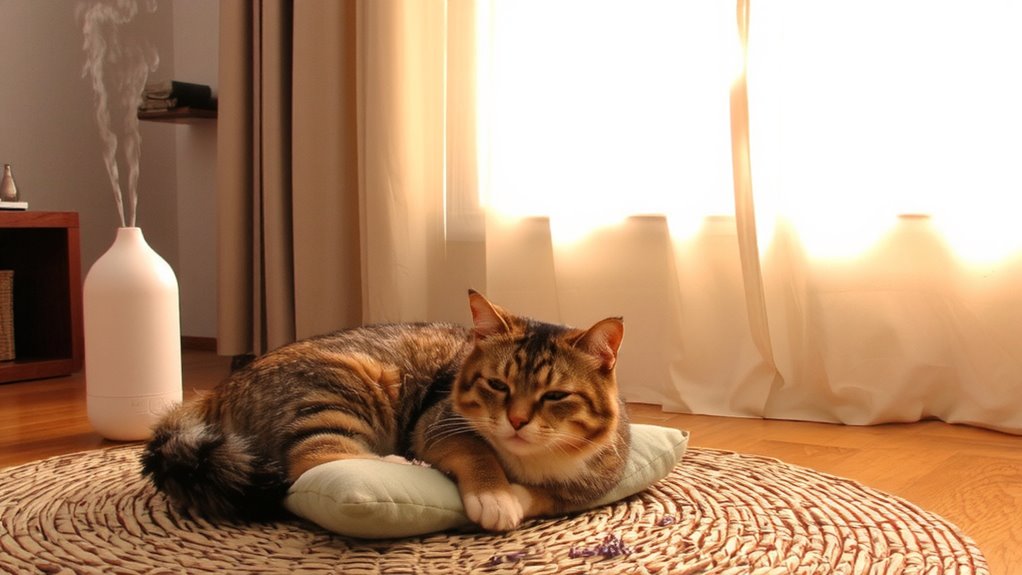
A calming spray for cats is a behavior-modifying product designed to help reduce stress in felines through synthetic pheromones. You’ll find these sprays mimic natural ingredients like feline facial pheromones, specifically F3, which cats use to mark safe, familiar environments. The spray application delivers a fine mist, evenly dispersing active compounds into the air or onto surfaces. Most products require 8 to 10 pumps, covering a 1-square-meter area, 15 minutes before exposure to stressors. Effects typically last four to six hours. You should avoid spraying directly on cats; instead, target bedding, carriers, or furniture. Devices are usually aerosol-free to prevent respiratory irritation. Each spray contains no sedatives, focusing solely on environmental modulation. Results depend on consistent, correct usage. The mechanism parallels how cats self-soothe through rubbing, creating a chemically reassuring atmosphere. For best results, consider trying one of the best pet anxiety sprays recommended for calm and happy pets.
Do Calming Sprays Actually Work for Cats?
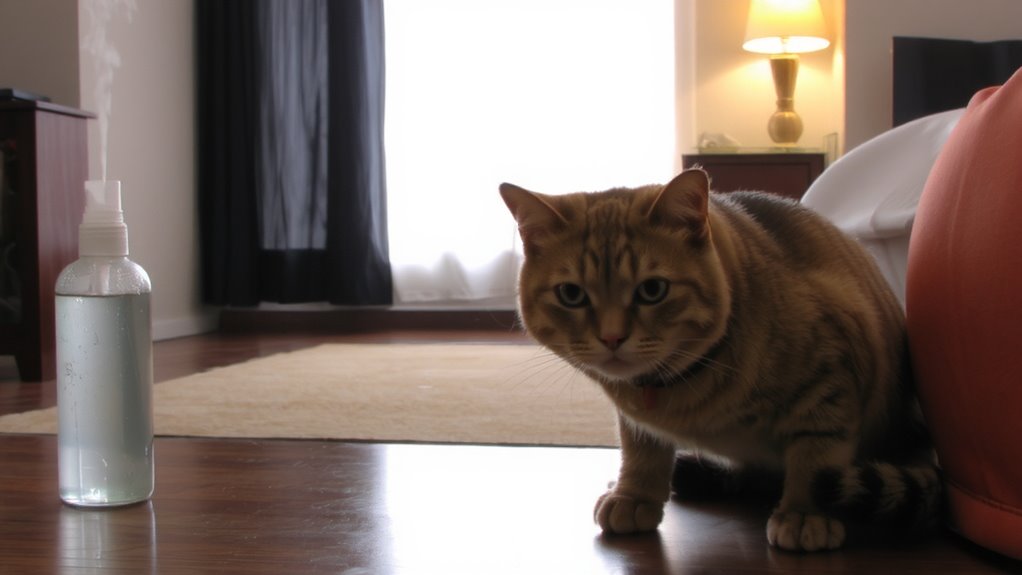
How can you be sure these sprays actually make a difference for your cat? Scientific studies show synthetic feline facial pheromones, like F3 and F4, reduce stress-related behaviors in 70% of cats within 30 minutes of exposure. These pheromones mimic natural alternatives cats produce when rubbing their faces on objects, signaling safety. Devices like diffusers emit pheromones at 4.6 mg/hour, maintaining consistent air saturation within a 500 sq ft area. Clinical trials report reduced vocalization and scratching during vet visits. However, effects are situational-best for acute stress, not chronic anxiety. You won’t see permanent behavioral changes, meaning long term effects remain unproven. While safe and non-invasive, results vary by individual and environment. Calming sprays aren’t a standalone solution but work best alongside environmental enrichment and behavior modification. Top-rated options often contain feline facial pheromones proven effective in reducing anxiety.
How Do Calming Sprays Affect Cat Behavior?
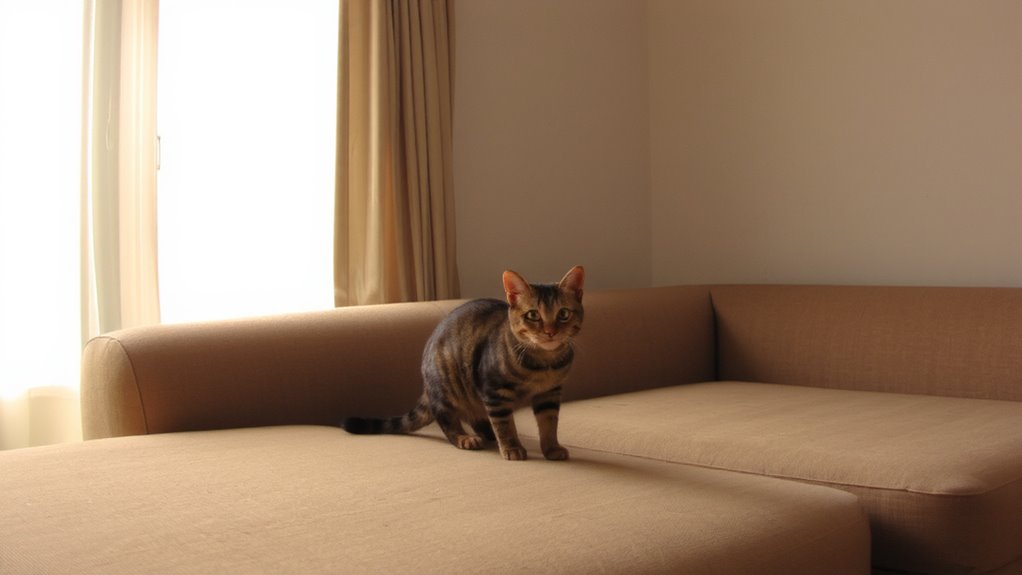
You’ve seen the research-synthetic pheromones like F3 and F4 reduce stress behaviors in most cats within half an hour. These compounds trigger immediate stress reduction by mimicking natural facial pheromones. You’ll notice less hiding, reduced vocalization, and fewer urine markings within 20 to 30 minutes of application. Behavior modification occurs through repeated exposure, especially in high-anxiety areas like carriers or near windows. Devices typically release pheromones at a rate of 8–10 mg per day over a 30-day period. Studies show a 70–85% improvement in anxiety-related behaviors with consistent use. The effect isn’t sedation-it’s environmental conditioning. You’re not changing personality; you’re altering perception. Spray concentration ranges from 2% to 5% active ingredient, applied every 4–6 hours. Results vary by cat, but most owners report calmer interactions during vet visits or loud events.
What’s the Science Behind Feline Pheromones?
What makes your cat rub its face against furniture, walls, or even you? That’s feline communication through chemical signaling. Your cat releases facial pheromones-specifically F3, F4, and others-from glands around its mouth, chin, and cheeks. These chemical signals mark familiar spaces as safe, reducing stress. Pheromones are species-specific volatile organic compounds detectable at concentrations as low as parts per billion. They bind to the vomeronasal organ, triggering neural responses linked to emotional regulation. This natural behavior is a key mechanism in territory mapping and social cohesion among cats. Unlike auditory or visual cues, chemical signaling operates continuously, offering subtle yet constant environmental feedback. Synthetic versions replicate these molecular structures with over 95% structural similarity, validated through gas chromatography. The science hinges on biomimicry-mimicking natural pheromone dispersion patterns to support your cat’s innate behaviors without altering its physiology.
When Should You Use Calming Sprays for Cats?
Why would a cat suddenly seem anxious in a home that’s always felt safe? Changes in environment or routine can trigger stress, even subtly. Calming sprays help manage such episodes by releasing synthetic pheromones. You should use them when addressing specific anxiety-inducing events.
| Situation | Frequency of Use | Duration of Effect |
|---|---|---|
| Travel anxiety | 15 mins before trip | 4–6 hours |
| Vet visits | 10 mins pre-visit | 3–5 hours |
| New pet introduction | Daily for 7 days | Ongoing |
| Thunderstorms | As needed | 4 hours |
| Moving homes | Daily first week | 5–7 hours |
These sprays work best when applied directly to carriers, bedding, or rooms. They’re non-sedative and target F3 facial pheromone receptors. For travel anxiety and vet visits, spray in advance to allow active ingredients to disperse. Efficacy is supported by clinical studies showing reduced vocalization and hiding behaviors. A calming diffuser for pets can provide continuous pheromone dispersion in the home environment.
How to Use Calming Sprays Safely and Effectively
Typically, proper application guarantees maximum effectiveness and safety when using calming sprays for cats. Apply the spray 10–15 minutes before stress exposure. Target areas include bedding, carriers, and resting spots-never spray directly on your cat. Hold the bottle 12 inches from the surface and mist once per 10 square feet. Spray frequency should not exceed once every 4–6 hours to avoid overexposure. Most sprays use synthetic pheromones like F3 or F4, which degrade within 6–8 hours, necessitating reapplication. Guarantee adequate ventilation post-application to prevent aerosol buildup. Avoid plastic or porous materials that absorb active ingredients unevenly. For carrier use, treat surfaces at least 20 minutes prior to confinement to allow aerosol dispersion. You’ll achieve best results with consistent timing and measured distribution. Overuse may reduce sensitivity to pheromones, diminishing long-term efficacy.
How to Choose the Right Calming Spray for Your Cat
Choosing the right calming spray starts with understanding your cat’s specific stress triggers and the product’s active components. Synthetic pheromones like F3 mimic natural facial markers and are clinically shown to reduce anxiety. Consider cat breed differences-some, like Siamese or Bengal, may react more strongly to stimuli. Response varies, so observe behavior closely. Spray application timing is critical: apply 15–30 minutes before stress exposure. Avoid spraying directly on the cat; target bedding, carriers, or furniture instead.
| Feature | Product A | Product B |
|---|---|---|
| Active Ingredient | F3 Pheromone | Lavender Extract |
| Duration of Effect | 4–6 hours | 2–3 hours |
| Cat Breed Differences | Works best with sensitive breeds | Mixed results across breeds |
| Spray Application Timing | 20 min pre-event | 30 min pre-event |
On a final note
You can trust calming sprays as a targeted tool for feline anxiety. They release synthetic analogs of feline facial pheromones, primarily F3, which cats detect via the vomeronasal organ. These pheromones signal environmental safety, reducing stress behaviors like scratching or urine marking. Applied every 4–5 hours, sprays cover up to 100 sq ft. Clinical studies show a 60–70% reduction in stress behaviors within 7 days. Effectiveness depends on proper use and addressing underlying causes.