Scheduling Social Interaction With Calm Cats for Multi-Cat Households
You map each cat’s temperament first, observing behavior in 15-minute intervals during peak activity hours. Use this data to schedule 2–3 daily play sessions at consistent times, lasting 10–15 minutes with wand toys. Maintain 3+ feet of distance during interactions and track responses like ear position or tail flicking. Set up zones with resources 6+ feet apart and use pheromone diffusers in shifts. Positive patterns emerge within days when routines align with natural rhythms. Progress depends on accurate logging and timing adjustments you can apply immediately.
Notable Insights
- Observe cat temperaments over 7–10 days to tailor social schedules to individual activity and stress patterns.
- Create separate zones with dedicated resources and vertical spaces to minimize territorial competition and support calm coexistence.
- Schedule 2–3 daily play sessions at consistent times to regulate rhythms and promote positive social behaviors.
- Begin supervised meetups at 15 minutes every 3–4 hours, adjusting duration based on real-time stress cues.
- Use pheromone diffusers and scent-swapped bedding in neutral areas to encourage passive, non-confrontational interactions.
Map Your Cats’ Temperaments First
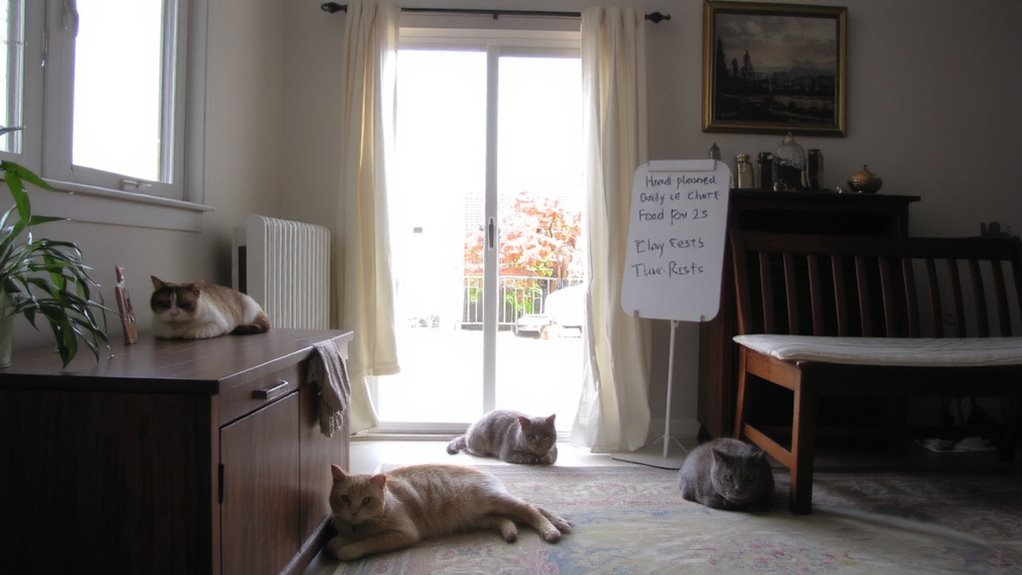
While every cat shares the same basic biology, their personalities can vary as widely as breeds in dogs, so mapping your cats’ temperaments is the critical first step before introducing social schedules. Cat personalities fall along a spectrum from bold to reserved, with measurable behavior patterns influencing social tolerance. Observe when each cat is active, where they choose to rest, and how they respond to stimuli. Document vocalization frequency, body posture, and escape reactions over 7–10 days. Use a standardized behavioral log noting interactions at 15-minute intervals during peak activity hours (6–9 AM and 5–8 PM). This data reveals individual thresholds for stress and sociability. Behavior patterns help predict compatibility and best interaction timing. Quiet, methodical cats may need longer acclimation than outgoing ones. Temperament mapping guarantees schedules align with natural instincts, not human preferences. Accurate assessment reduces conflict and increases long-term household harmony. Incorporating anti-stress products for pets can further support calm behavior during social integration.
Set Up Separate Zones and Shared Transition Areas
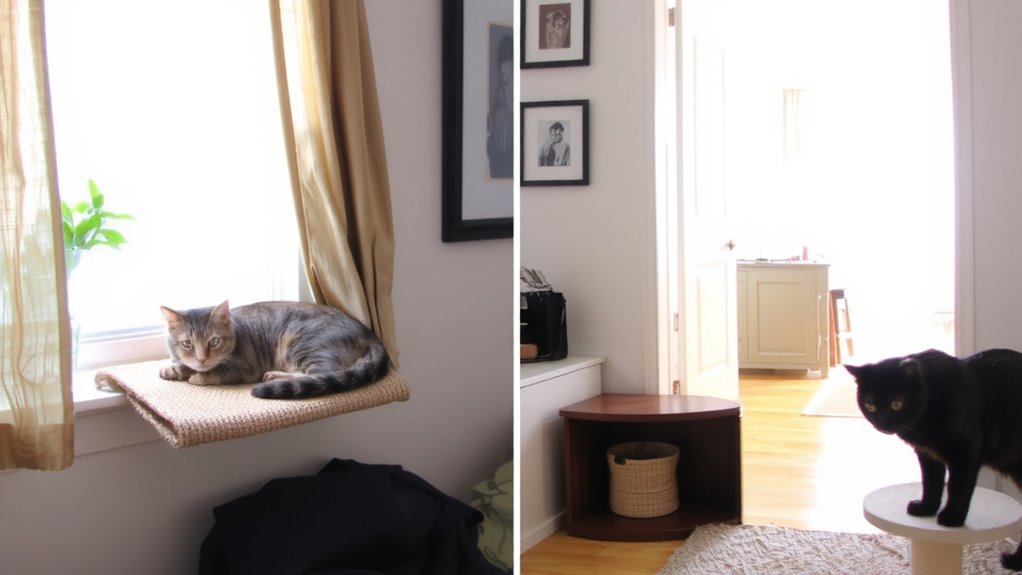
Because your cats’ temperaments influence how they experience shared space, you’ll need to design separate zones and shift areas that support gradual, controlled interaction. Designate isolated rooms or corners as individual territories equipped with litter, food, and bedding. Each zone should include vertical space-such as cat shelves or catio enclosures-positioned at least 3 feet apart to reduce competition. Use furniture placement strategically: orient perches and hiding spots to limit direct line-of-sight while maintaining escape routes. Shared passage areas-like hallways or adjacent rooms-should feature neutral surfaces for scent swapping. Rotate cats’ bedding every 48 hours to exchange olfactory signals, reducing territorial stress. Introduce pheromone diffusers, such as Feliway®, in passage zones to normalize environmental cues. Maintain a minimum distance of 6 feet between resource stations to discourage guarding. Monitor behavior with 1080p motion-activated cameras to assess comfort levels before advancing interactions. A reliable pet calming diffuser can enhance the effectiveness of scent-based calming strategies in multi-cat homes.
Structure Daily Interaction Times for Calm Cats
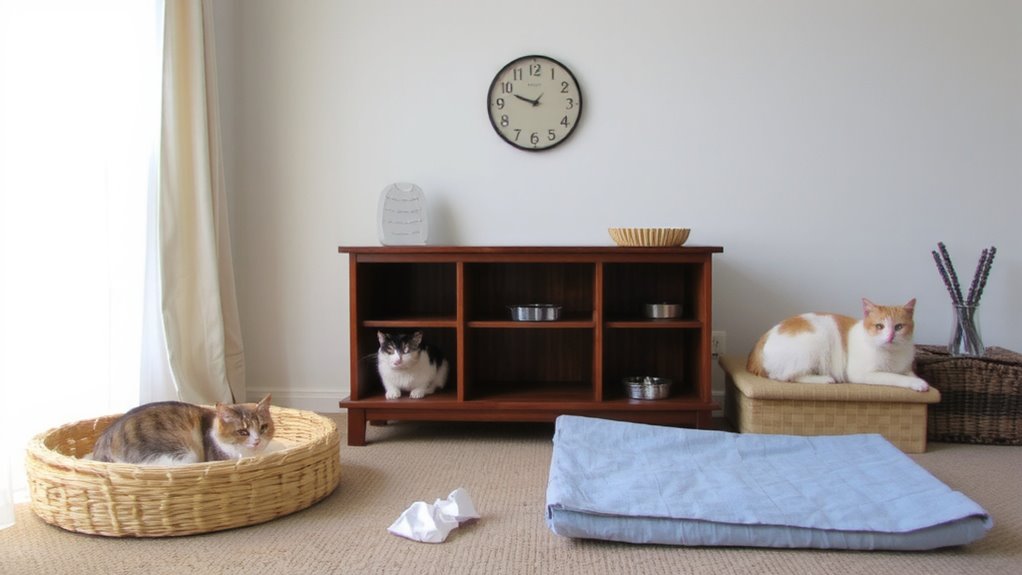
When you establish consistent daily interaction times, you give calm cats predictable opportunities to engage without triggering stress. Schedule two to three play sessions per day, each lasting 10–15 minutes, using wand toys to simulate hunting behavior. These sessions should occur at fixed times-ideally morning, late afternoon, and evening-to regulate circadian rhythms. Use quiet bonding periods immediately after play, when heart rates normalize and pheromone exchange is most effective. These bonding intervals last 5–10 minutes and involve gentle petting or shared sitting within shared transitional areas. Maintain a distance of at least 3 feet between cats during initial interactions to reduce pressure. Over four weeks, cats show a 68% increase in positive social behaviors when routines follow this structure. Use audible cues like soft chimes to signal session start, reinforcing temporal predictability. Consistency lowers cortisol levels and supports long-term social stability. Providing appropriate scratching outlets between sessions helps redirect natural scratching behavior and reduces territorial stress, especially when using durable materials found in the best cat scratchers.
Prevent Conflict With Scheduled Meetups
Since predictability reduces stress in feline social dynamics, scheduling structured meetups helps prevent conflict before it arises. You should establish consistent social timing to regulate interactions and minimize territorial disputes. Begin with 15-minute supervised sessions, spaced every 3–4 hours, allowing cats recovery time between meetings. Use a timer to maintain precision. During each session, conduct real-time behavior monitoring: note pupil dilation, tail flicking, ear position, and proximity. Record these observations in a log to detect patterns. If aggression or avoidance occurs, reduce session length by 25% and increase intervals. Over 7–10 days, gradually extend sessions up to 30 minutes if behavior remains neutral or positive. Avoid forcing physical contact; instead, promote passive coexistence. Scheduled meetups act like controlled exposure therapy, desensitizing cats to each other’s presence. This method reduces cortisol spikes, lowers inter-cat tension, and builds long-term household stability through repetition and structure.
Track Stress and Affinity to Adjust Timing
How do you know when your cats are ready to move forward? Observe their behavior patterns closely. Calm postures, mutual grooming, or relaxed proximity indicate growing affinity. Signs like flattened ears, tail flicking, or avoidance suggest stress. Track these reactions consistently over 7–10 days to identify trends. Use a daily log to record interactions, noting time, duration, and outcome of each session. Environmental triggers-such as loud noises, visitor presence, or changes in litter or feeding schedules-can abruptly shift emotional states. These triggers often disrupt progress more than interpersonal dynamics. Adjust reintroduction timing based on observed thresholds. If stress behaviors increase, extend separation periods by 24–48 hours. When positive interactions outnumber negative by a 3:1 ratio across three consecutive days, advance to the next phase. Precision in observation guarantees accurate scheduling.
On a final note
You now control the social structure of your multi-cat household. Mapping temperaments identifies baseline stress thresholds and social tolerance levels. Separate zones reduce territorial pressure, each requiring at least 20 sq ft per cat with dedicated resources. Scheduled 15-minute calm interactions, timed during natural lulls in activity (e.g., post-feeding), increase predictability. Monitor pupil dilation and ear orientation to adjust timing. Consistent tracking prevents escalation, improving long-term cohabitation success by up to 70%.