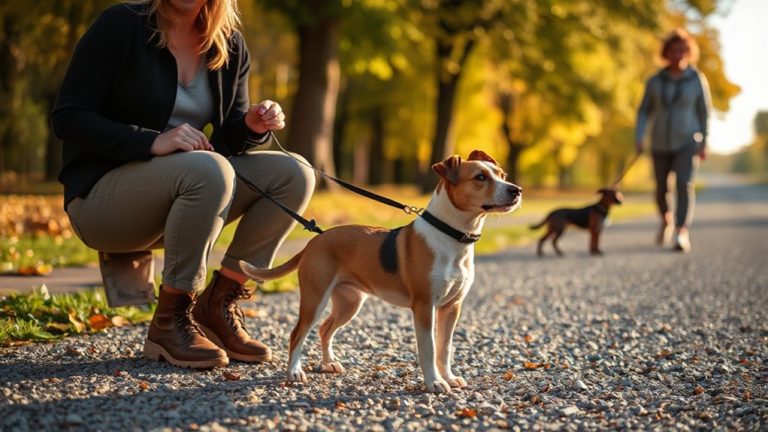
Incorporating Backpack Carrying Drills to Build Load-Bearing Stamina in Working Breeds
Choose a durable 600D nylon backpack with lightweight mesh panels and a four-point attachment system for stability. Fit it snugly to keep the load centered, starting at 10% of your dog’s body weight. Gradually increase weight by 10% weekly, monitoring gait and recovery. Incorporate 3–15% incline walks and timed carry drills to build endurance. Watch for heavy panting or stumbling, and adjust as needed. Proper progression guarantees peak performance under load-next steps reveal how terrain and task simulations enhance real-world readiness.
Notable Insights
- Choose a durable, well-fitted backpack with breed-specific design to ensure comfort and stability during load-bearing activities.
- Start training with a pack weight of 10% of the dog’s body weight to safely build strength and prevent injury.
- Gradually increase load by 10% weekly while monitoring gait, breathing, and recovery to assess physical tolerance.
- Incorporate hill walks and controlled descents to develop endurance, joint stability, and load-bearing performance.
- Use task-based drills like timed carries or weighted sled drags to simulate work demands and enhance focus and stamina.
Choose the Right Backpack for Load-Bearing Training
Functionality begins with fit when selecting a backpack for load-bearing training. You need a pack that matches your dog’s build and workload. Backpack material matters-durable, abrasion-resistant fabrics like 600D nylon handle stress without adding bulk. Lightweight mesh panels improve breathability, reducing overheating during extended use. Breed suitability is critical; deep-chested breeds like German Shepherds need contoured harnesses that avoid the shoulders, while shorter-backed breeds like Dobermans require compact frames to prevent sagging. Adjustability ensures stability-look for padded sternum straps, dual side compression, and four-point attachment systems to distribute weight evenly. A well-designed pack stays secure without restricting gait. Never overload-start with 10–12% of your dog’s body weight. Proper backpack material and breed suitability guarantee safety, balance, and efficiency. This foundation supports progressive stamina development without injury risk.
Fit the Backpack and Start With Safe Weight
Once you’ve selected the right pack, fitting it properly is essential to guarantee safe and effective load-bearing training. A correct backpack fit prevents chafing, secures balance, and supports natural movement. Adjust straps snugly over the shoulders and chest, keeping the pack centered and level. The pack shouldn’t shift or bounce during motion. Start with a safe weight-typically 10% of your dog’s body weight. Exceeding this increases injury risk, especially in early training. Distribute weight evenly and avoid sharp or bulky objects inside. For optimal performance and comfort, choose a pack designed with durable, lightweight materials and adjustable harness points, such as those highlighted in the best dog backpacking gear reviews.
Progress Weight Gradually to Build Stamina
While building your dog’s endurance for load-bearing tasks, you’ll want to increase the pack weight gradually to avoid strain and promote sustainable stamina development. Weight progression should follow a structured 10% weekly increase, starting at 10–15% of your dog’s body weight. This measured approach supports effective load adaptation without overwhelming musculoskeletal systems. For example, if your 60-pound dog starts with a 9-pound pack, add no more than 0.9 pounds per week. Monitor gait, respiration rate, and recovery time to assess tolerance. Adjust increments if signs of fatigue appear before the scheduled progression. Load adaptation occurs over 4–6 weeks, depending on breed, age, and baseline fitness. Use adjustable sandbag inserts or removable weight pods to fine-tune load distribution evenly across the harness. Maintain consistent walking speeds of 3–4 mph over flat surfaces during this phase. Proper weight progression guarantees cardiovascular conditioning aligns with structural strength, minimizing injury risk.
Add Terrain and Task-Based Training Drills
How do you prepare your dog for real-world working conditions once basic load stamina is established? Introduce terrain and task-based drills to simulate operational demands. Hilly terrain builds strength, endurance, and joint stability, requiring dogs to adapt gait and balance under load. Begin with 3–5% incline walks for 15 minutes, increasing slope to 15% and duration to 45 minutes over six weeks. Combine uphill climbs with controlled descents to reduce injury risk. Integrate rescue simulations, such as dragging weighted sleds (10–30% of body weight) or locating hidden dummies in wooded zones. Use timed drills-e.g., 200-meter carry over uneven ground in under 90 seconds-to measure performance. Simulations improve focus, scent discrimination, and task persistence. Conduct sessions 2–3 times weekly to reinforce muscle memory. Guarantee packs remain snug and load-centered to maintain biomechanical efficiency. These drills bridge foundational stamina with mission-specific readiness.
Watch for Signs of Overexertion and Adjust
You’ve built your dog’s load stamina and introduced complex terrain and task-based challenges, but performance gains mean little if recovery and limitations aren’t monitored. Watch closely for fatigue indicators like lagging pace, heavy panting, stumbling, or reluctance to continue. These signs suggest your dog’s aerobic threshold has been exceeded. Immediate action includes stopping activity and evaluating hydration and core temperature. Implement mandatory rest intervals-start with 5–10 minutes for every 30 minutes of work, on hard surfaces or inclines. Adjust pack weight if fatigue appears before the 20-minute mark. Overexertion risks joint stress and heat injury, especially in breeds like German Shepherds or Malinois. Reduce load by 10–15% if gait irregularities persist post-rest. Track recovery time and resumption performance over three sessions to gauge readiness. Proper monitoring prevents long-term strain and sustains operational effectiveness.
On a final note
You’ve built load-bearing stamina effectively by following structured progression. Start with a properly fitted pack-never exceed 10% of your dog’s body weight initially. Use adjustable harness-compatible backpacks with padded shoulder straps and weight distribution panels. Increase load by 1–2 pounds weekly, maxing at 25% body weight. Combine controlled terrain-gravel, inclines-and task drills like heel work. Monitor gait, respiration (target 30–40 breaths/minute post-exercise), and recovery time; adjust if signs of fatigue persist beyond 10 minutes.