Shaping Behavior Progressions in Reptiles: Step-by-Step Guide to Advanced Trick Teaching for Exotic Pets
You build trust first through consistent, calm handling 3–5 times weekly, using slow movements to reduce stress. Offer high-value food rewards like waxworms or crickets via tongs to create positive associations. Start with target training using a 6–10 inch stick and instant markers-click or cue within 0.5 seconds. Chain behaviors in sequence: touch, turn, enter, reinforcing each step before linking. You’ll discover how to shape advanced tricks by mastering these foundational stages.
Notable Insights
- Establish trust through consistent, calm handling and daily positive reinforcement to prepare reptiles for advanced training.
- Use high-value, varied food rewards delivered within seconds of desired behavior to maintain motivation and clear association.
- Begin with target training using a brightly colored stick and precise marker timing to build communication and accuracy.
- Chain simple trained behaviors into sequences using consistent cues, reinforcing only full completion to shape complex tricks.
- Monitor for stress signs and end sessions promptly to preserve learning efficacy and ensure a positive training experience.
Build Trust Before Training
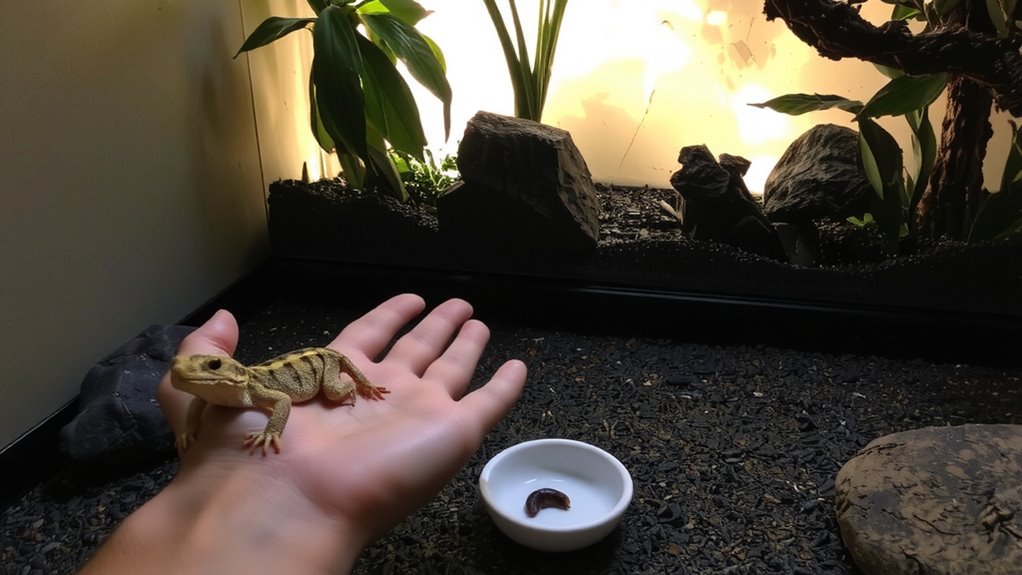
A strong foundation begins with trust-without it, training reptiles is ineffective. You must establish reliability before any behavioral shaping occurs. Hand feeding is a critical technique to build this trust, allowing the reptile to associate your presence with positive outcomes. Perform hand feeding daily, using tongs or gloved hands depending on species size and temperament. Consistent handling follows, ideally 3–5 sessions per week, each lasting 10–15 minutes. Begin with short durations and increase only if the animal shows no stress indicators-such as rapid breathing or tail whipping. Use slow, deliberate movements to minimize threat perception. Handling improves desensitization to human contact, a prerequisite for advanced training. These protocols are non-negotiable for species like bearded dragons or tortoises. Trust forms gradually through repetition, creating the behavioral stability needed for subsequent training phases.
Choose the Right Training Reward
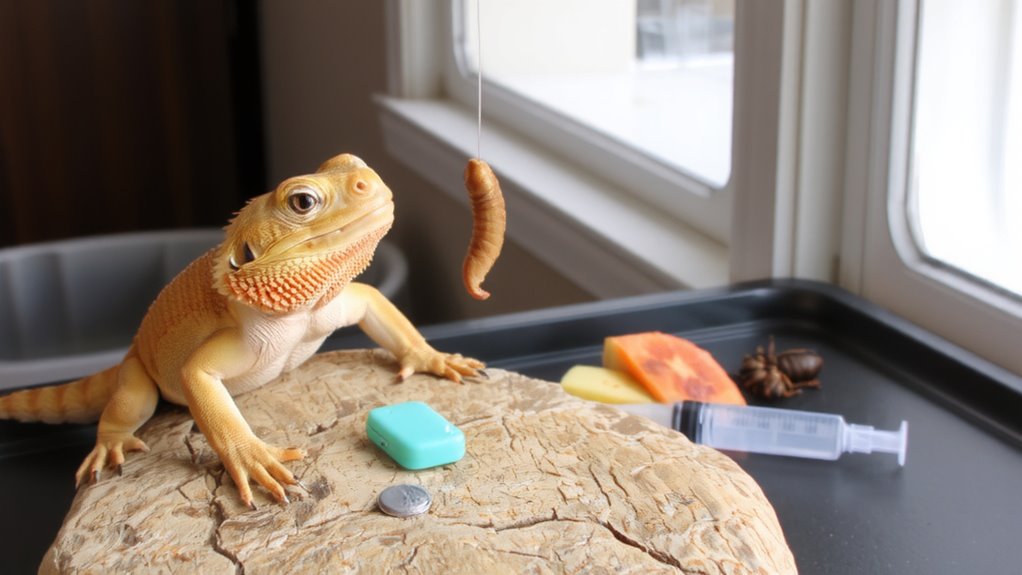
You’ve built trust through consistent handling and hand feeding, and now your reptile is ready to respond to structured cues. Food motivation is the cornerstone of effective training. Use high-value items like live crickets, waxworms, or pieces of shrimp, depending on your species’ diet. Offer rewards immediately after desired behavior-within 1–2 seconds-for clear association. Reward variety prevents satiation and sustains interest. Rotate between three to five approved food items, varying texture, movement, and scent. For example, use 3–5 mm silkworms for small lizards and 1-inch earthworm chunks for larger species. Limit each reward to a size your reptile can consume in under 15 seconds. Avoid overfeeding; total training portions should not exceed 10–15% of daily caloric intake. Consistent, precise rewards increase response reliability.
Start With Target Training
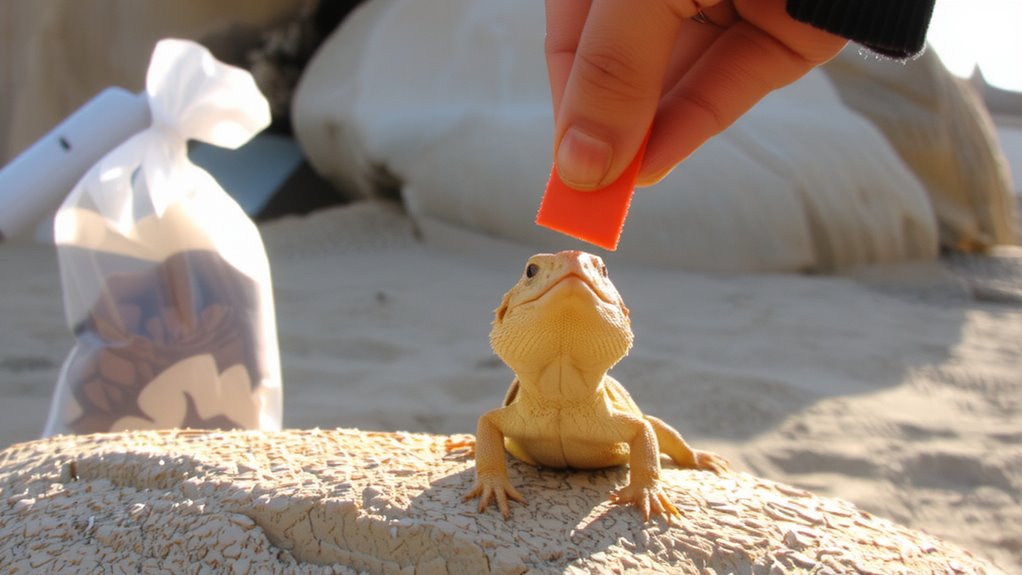
Why begin with something as simple as a target stick? It establishes precise communication between you and your reptile. Target selection is critical-choose a lightweight, brightly colored wand with a soft tip, typically 6–10 inches long, to guarantee visibility and safety. Present the target gently; when your reptile touches it, use immediate marker timing-click or verbally mark the moment of contact. This creates a clear association between action and reward. Marker timing must be accurate within 0.5 seconds to reinforce the correct behavior. Use consistent repetition across 5–10 minute sessions, two to three times daily. Start in a low-distraction environment to maximize focus. Target training builds behavioral momentum, laying the foundation for advanced cues. It’s non-invasive, relies on positive reinforcement, and adapts across species-from tegus to bearded dragons-making it the most effective first step in reptile training programs.
Chain Small Behaviors Into Tricks
Once target training is reliably established, you can build more complex actions by linking simple behaviors into sequences. This process, known as behavior chaining, combines individual actions into a single, fluid trick using sequential cues. Each behavior serves as the cue for the next, creating a predictable chain. Start by reinforcing each component separately, then link them in order. Use a consistent cue for each step to guarantee clarity.
| Step | Behavior | Cue Type |
|---|---|---|
| 1 | Touch target | Visual |
| 2 | Turn 90 degrees | Hand signal |
| 3 | Enter hide box | Verbal command |
Practice daily in 5–7 minute sessions. Reinforce only after the complete chain. Gradually phase out mid-chain rewards. Accuracy improves with repetition and precise timing. Behavior chaining increases cognitive engagement and allows advanced reptile training through structured, sequential cues.
Teach Obstacle Navigation
While reptiles may not navigate obstacles as instinctively as mammals, they can learn complex spatial tasks through systematic training and environmental conditioning. You’ll need to prioritize obstacle design to support effective reptile navigation. Start with low barriers-under 2 inches high for small species like leopard geckos-and gradually increase height as confidence builds. Use non-slip surfaces such as textured slate or rubber mats to prevent injury. Arrange obstacles in a linear sequence to minimize confusion. Reinforce correct pathing with immediate food rewards. Guarantee each obstacle allows clear visual cues; reptiles rely heavily on sight for spatial orientation. For species like bearded dragons, incorporate tunnels and ramps set at 30-degree inclines. Monitor movement speed and accuracy across trials. Over time, reptile navigation improves through repetition, with success rates exceeding 80% in controlled setups. A properly sized and secured Best Ball Python Enclosures ensures a controlled environment ideal for consistent training sessions.
Fix Common Training Stalls
If progress slows during reptile training, it’s usually due to environmental inconsistencies or improper reinforcement timing. Adjust your schedule so rewards follow target behaviors within 1–2 seconds, ensuring precise reinforcement timing. Delays weaken association, reducing learning efficiency. Use a clicker or distinct verbal cue to mark the exact moment the behavior occurs. Control environmental distractions by training in a quiet, temperature-regulated space between 75–85°F, depending on species-specific thermal preferences. Remove visual stimuli like moving shadows or other pets. Limit session length to 5–10 minutes to maintain focus. Re-evaluate your reinforcement-live prey, food treats, or tactile rewards must be sufficiently motivating. If the reptile hesitates, simplify the task and re-sequence shaping steps. Consistent conditions and accurate timing increase response reliability. Avoid overtraining; reptiles process tasks slower than mammals.
Know When to Stop: Respect Limits
Though reptiles can learn through repetition and reinforcement, you’ll get the best results by recognizing when a session has reached its limit. Recognize stress: signs include rapid breathing, color darkening, hiding, or aggressive posturing. These behaviors indicate elevated corticosterone levels, which impair learning and increase avoidance. Session duration should not exceed 10–15 minutes for most species; extended exposure increases physiological strain. Respect boundaries by ending training immediately if stress indicators appear. For example, a bearded dragon that flattens its body or a ball python that coils tightly is communicating discomfort. Respond promptly to prevent learned helplessness or trauma. Training efficacy drops markedly after two consecutive incorrect responses-this is a behavioral marker to stop. Always prioritize welfare over progress. Brief, positive sessions enhance long-term retention. Overtraining leads to habituation failure and reduced responsiveness. You maintain control not through persistence, but through timing, precision, and restraint. A well-designed environment supports emotional regulation, making compact lizard terrariums essential for minimizing stress during training.
On a final note
You’ve laid the foundation for advanced reptile training. Trust and consistent reinforcement enable reliable behavior. Target training establishes stimulus control, essential for shaping complex actions. Chains of conditioned responses must be reinforced individually before sequencing. Obstacle navigation improves spatial cognition and motor skills. If progress stalls, reassess reward value or reduce task complexity. Always terminate sessions before stress indicators appear. Training success depends on timing, precision, and species-specific biological constraints.