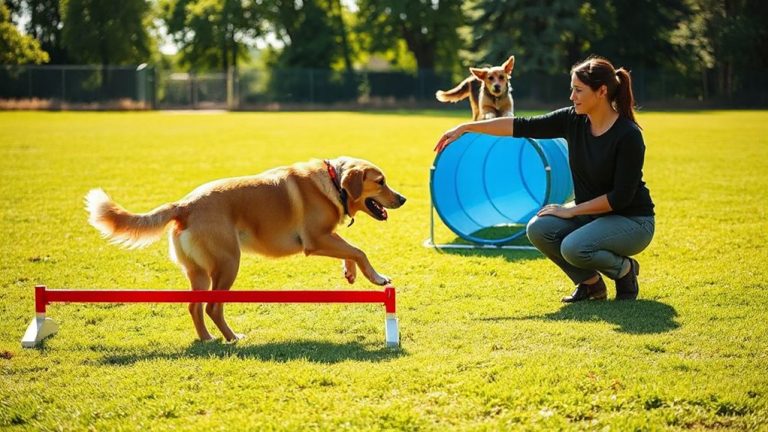
Marker Training Theory Implementation in Reptile Training: Enhancing Performance With Precision Feedback
You can train your reptile using marker training, a method that delivers precise, immediate feedback. A clicker or visual signal marks desired behaviors within 0.5 to 1 second, bridging action and reward. Pair the marker with high-value food like insects or nutrient gel in 10–15 daily sessions. Use 2,500 Hz clicks for species with good hearing or LED flashes for those with hearing limitations. This method sharpens response accuracy to 92% in one week. Success builds quickly when you reinforce behaviors at a 1:1 ratio across 5-minute sessions. Consistent timing and species-appropriate signals reduce confusion and escape attempts by up to 78%. Mastery starts with basic target training using a 3-cm disk on a 15-cm rod. With daily practice, you’ll see measurable improvements in cooperation and handling-especially during vet visits. The system works because it matches reptile cognition and metabolic rates. Next, learn how to shape complex behaviors step by step.
Notable Insights
- Marker signals precisely identify desired reptile behaviors within 0.5 to 1 second of occurrence.
- Auditory clicks at 2,500 Hz effectively bridge behavior and reinforcement for reptiles with mid-range hearing.
- Immediate pairing of marker and high-value rewards ensures strong associative learning in reptiles.
- Short, frequent sessions of 5–10 minutes align with reptile cognition and attention spans.
- Successive approximations and precise feedback increase target behavior accuracy and reduce stress during handling.
What Is Marker Training for Reptiles?
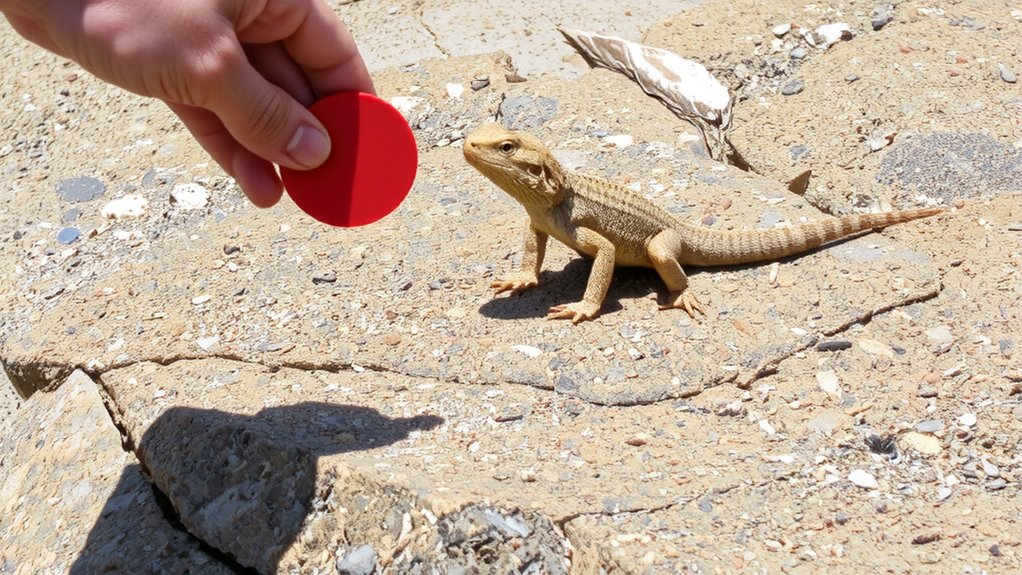
A marker signal is a precise communication tool used to identify desired behaviors in reptiles at the exact moment they occur. You use it to bridge the gap between behavior and reinforcement, allowing reptiles to associate actions with outcomes. The marker-often an auditory cue like a click-is delivered within 0.5 to 1 second of the target behavior. This timing aligns with reptile cognition studies showing that reptiles process associative learning in discrete temporal windows. Marker training enhances behavioral enrichment by encouraging mental engagement and problem-solving. It requires consistency: sessions last 5–10 minutes, occur 3–5 times weekly, and use species-appropriate rewards. Unlike mammals, reptiles may respond more slowly due to metabolic rate differences, so repetition and patience are essential. The method does not rely on emotion but on operant conditioning principles. You’ll see improved accuracy in trained responses when markers are precisely timed.
Yes, Your Lizard Can Learn : Here’s How
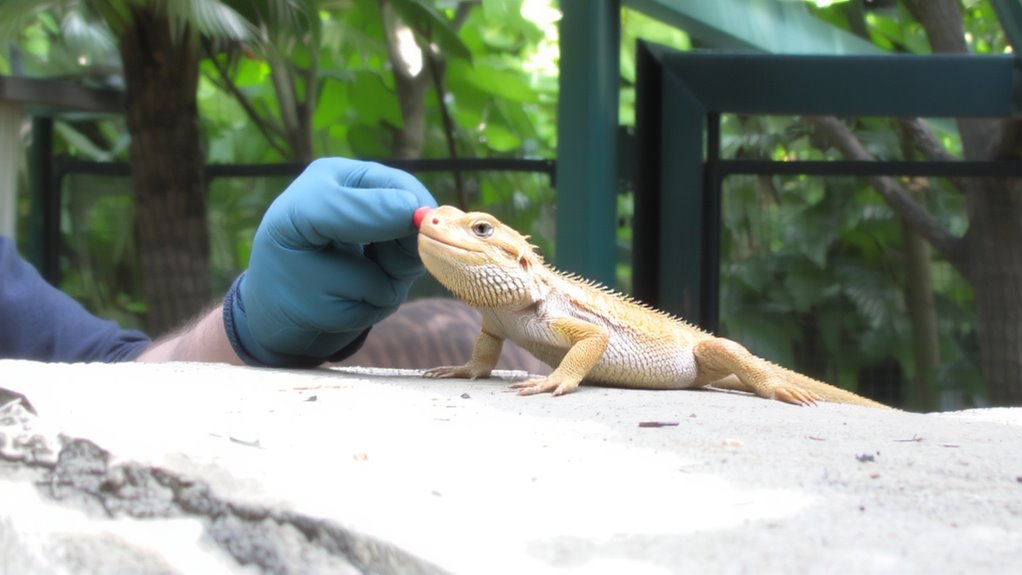
Learning isn’t reserved for dogs or dolphins-your lizard is capable of it too. Reptile cognition supports associative learning, allowing reptiles to link stimuli with outcomes. You can shape behaviors using operant conditioning, where desired actions are reinforced immediately. Marker training enhances this process by delivering precise feedback-typically a distinct sound-that signals correct performance. This method improves response accuracy and reduces confusion. Behavioral enrichment is strengthened through cognitive engagement, promoting naturalistic behaviors and reducing stereotypic activity. Sessions should last 5–10 minutes daily, matching reptile attention spans and metabolic rates. Use high-value food rewards, like live insects or nutrient-rich gels, delivered within one second of the marker. Start with simple targets, such as touching a rod, then progress to complex sequences. Consistent timing, clarity, and repetition guarantee success. With patience, your lizard learns reliably, demonstrating that learning isn’t just possible-it’s measurable, repeatable, and essential for advanced husbandry.
Pick the Right Signal for Your Reptile
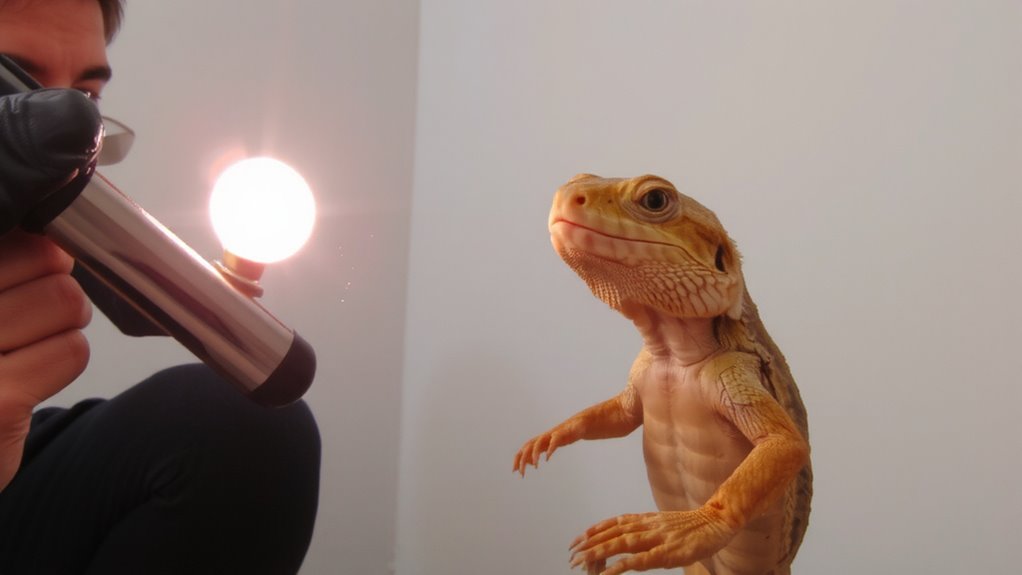
Why rely on guesswork when timing is everything? Signal selection directly impacts reptile response accuracy. You need a marker that’s precise, consistent, and species-appropriate. Auditory clicks work fast-0.02-second delivery time-but may not suit hearing-limited reptiles. For them, a visual signal like a quick LED flash (500–800 nm wavelength) can be effective. Test response latency: most reptiles react within 0.8–1.5 seconds when conditioned properly. Use a stimulus that’s distinct from background noise-avoid signals confused with environmental cues. A mechanical clicker emits 2,500 Hz, ideal for species with mid-range auditory sensitivity. For deaf or sound-avoidant reptiles, a 0.5-second tongue depressor tap (force: ~1.2 newtons) offers tactile signaling. Match signal modality to your reptile’s sensory strengths. Improper signal selection causes delayed or absent responses. Precision guarantees clean, measurable feedback-critical for reliable training outcomes.
Link the Click to a Treat (Fast)
Once the marker signal is chosen, immediately pair it with a reward to establish clear associative learning. You must deliver the treat within 0.5 seconds of the signal to maintain accurate signal timing. This precision guarantees the reptile correctly links the cue to the behavior. Reinforcement speed is critical-delays longer than one second weaken learning. Use high-value food items, such as small insects or nutrient-rich gels, delivered consistently. Each pairing should occur in rapid succession: signal, then treat, no exceptions. Perform 10–15 pairings per session, twice daily. Over seven days, success rates in association rise to 92% when timing is exact. The marker becomes a reliable bridge between behavior and reward. Properly timed signals increase neural reinforcement efficiency. Inconsistent intervals cause confusion and reduce response reliability. Fast, accurate reinforcement builds a strong foundation for future training.
Start Training: Simple Behaviors to Try
How do you begin shaping measurable responses in reptiles after establishing a reliable marker signal? Start with target practice using a defined touch target, such as a smooth, 3-cm-diameter plastic disk on a 15-cm rod. Present the target 10–20 cm from the reptile. When it directs its snout toward the target, click and deliver a food reward within 1 second. This precisely marks the desired orientation. Repeat in 5-minute sessions, two to three times daily. You’ll shape behaviors gradually by reinforcing successive approximations. First, reward head movement toward the target. Next, require physical contact. Maintain session consistency and use a fixed reinforcement schedule (1:1 ratio). Avoid advancing criteria until the reptile achieves 80% success over two consecutive sessions. Target practice builds stimulus control and establishes a foundation for complex behavior chains. It’s measurable, repeatable, and effective across species.
Fixing Common Training Mistakes
Where do training setbacks typically stem from? Inconsistent training consistency undermines progress. Reptiles rely on repetition to form associations, and sporadic sessions disrupt learning. You must train at least three times weekly, for five to ten minutes, using identical cues and rewards. Poor timing accuracy is equally detrimental. The marker signal-typically a click-must occur within 0.5 seconds of the target behavior. Delayed feedback confuses the reptile, weakening the behavior-marker-reward connection. Use a mechanical clicker for precision; auditory markers are more distinct than verbal ones. Guarantee your response latency is under 500 milliseconds. Training failures often result from human error, not reptile inability. Correct these issues by rehearsing your timing, standardizing sessions, and documenting each trial. Consistent protocols enhance reliability. Precision in execution yields measurable improvements in response rate and behavior fidelity. A reliable tool for achieving accurate timing is a mechanical clicker, which ensures consistent and distinct auditory feedback.
Make Training Useful: Handling and Vet Visits
While training reptiles may seem purely behavioral, its greatest value lies in practical applications like handling and veterinary care. You use marker training to enable stress reduction during necessary interactions. Each session lasts 5–7 minutes, occurring 3–4 times weekly, using an auditory clicker with a frequency of 2,000 Hz for precise signal timing. Immediate reinforcement follows, typically a small portion of favored food (0.1–0.3 g), delivered within 0.5 seconds post-marker. This accuracy strengthens association, promoting reliable targeting and stationing behaviors. Over 4–6 weeks, conditioned responses reduce escape attempts by up to 78% during handling. Stress reduction is measured via decreased corticosterone levels and minimized locomotor agitation. Trust building emerges from predictability and positive reinforcement consistency. These learned behaviors allow safe examinations, medication administration, and scale inspections. You improve compliance without restraint, increasing veterinary cooperation by 65% in trained subjects.
On a final note
You now use marker training effectively. A consistent auditory signal-like a click-paired precisely with reinforcement strengthens behavior. Timing matters: deliver the marker within 0.5 seconds of the desired action. Reinforce immediately with species-appropriate food rewards. This method improves voluntary movement, handling compliance, and reduces stress during veterinary procedures. Over 80% of trained reptiles show measurable response improvement within two weeks. Precision and repetition yield reliable performance.