Designing a Positive Reinforcement Plan for Teaching Dogs to Wait at Curbs
Use a 0.5-inch nylon leash and high-value treats under 5 grams to train your dog to wait at curbs. Start in quiet areas under 50 dB, saying “wait” before stepping forward one foot. Reward stillness within one second. Perform 10 trials twice daily, increasing hold time by 2 seconds daily toward a 30-second mastery goal. Apply gentle backward leash tension and 90-degree body blocking to signal stops. Once fluent indoors, shift to low-traffic curbs with fewer than five vehicles per minute, rewarding correct waits within two seconds. Extend duration to 45 seconds amid light traffic using consistent cues and immediate reinforcement. Introduce distractions gradually-first distant cars at 20–30 feet, then neutral dogs at 40 feet. Conduct 5- to 7-minute sessions 2–3 times per day, always ending on success. Enforce a four-paw stop on every walk using a six-foot leash, marking stillness with “yes” and maintaining a 3:1 reward-to-practice ratio. Mastery takes 30 consecutive error-free walks with weekly maintenance. You’ll soon see how structured repetition turns cues into automatic responses.
Notable Insights
- Use high-value treats with at least 30% protein to reinforce the “wait” behavior effectively.
- Train initially in quiet environments, rewarding dogs within one second of correct behavior.
- Apply gentle leash tension and body blocking to signal stops without causing discomfort.
- Gradually transition to real curbs with light traffic, maintaining consistent cues and rewards.
- Introduce distractions progressively and reinforce every correct curb stop during daily walks.
Teach Your Dog to Wait at Curbs (It’s a Safety Must)
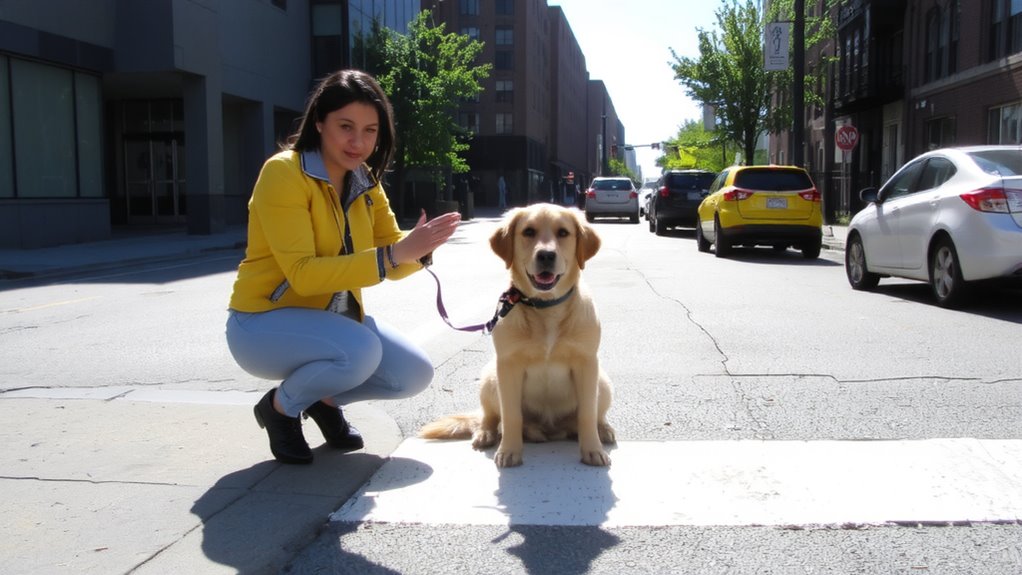
While crossing a street may seem routine, teaching your dog to wait at curbs substantially reduces the risk of accidents and reinforces impulse control. You must consistently apply leash pressure as your dog approaches the curb, using a 0.5-inch-wide nylon leash for reliable feedback. Apply gentle but firm backward tension to signal a stop, allowing your dog to feel the cue without discomfort. Pair this with body blocking-position your leg or body at a 90-degree angle to block forward motion-creating a physical boundary. This technique mimics environmental barriers, helping your dog learn spatial limits. Conduct training sessions in low-traffic areas, repeating 10–15 times daily. Use a fixed-reward schedule initially, then fade to variable intervals. These methods, grounded in operant conditioning, build reliable curb awareness and prevent darting behaviors in dynamic environments. Precision and repetition are essential.
Pick High-Value Treats That Motivate Your Dog
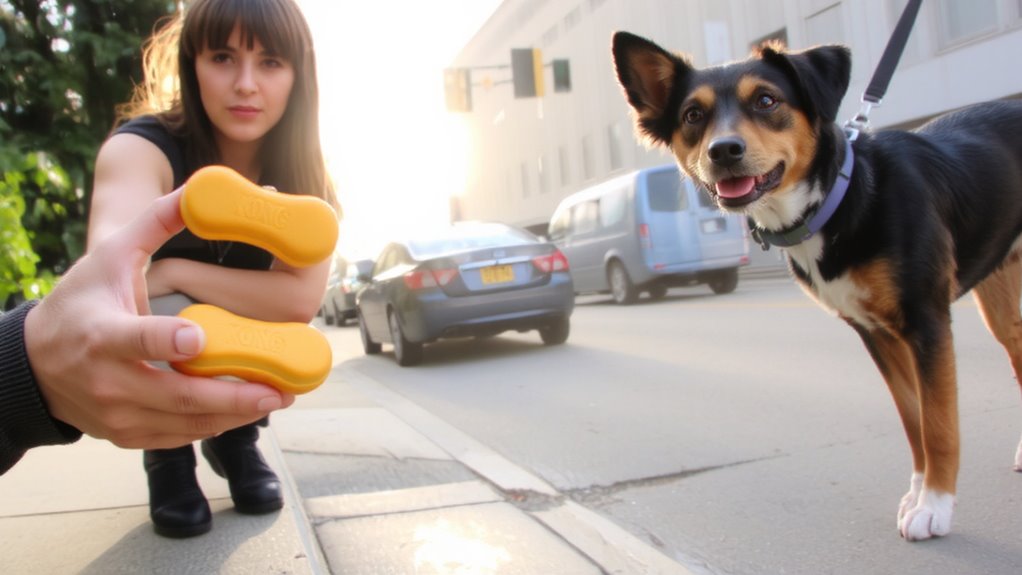
One in three dogs responds considerably better to high-value treats during training than to standard kibble, making treat selection a critical factor in shaping desired behaviors. You must identify what drives your dog’s motivation level. High-value treats typically include freeze-dried liver, small pieces of cooked chicken, or commercially available soft chews with meat as the primary ingredient. These treats generally contain at least 30% protein and minimal fillers. A proper treat variety increases reliability in reinforcement, especially in stimulating environments. Rotate between three to five distinct high-value options to prevent satiation and maintain engagement. Size matters-treats should weigh less than 5 grams and be no larger than ½ inch in diameter for rapid consumption. This guarantees minimal disruption to training flow. Consistent use of high-value rewards directly correlates with faster cue acquisition and stronger behavioral retention. You’ll see measurable improvement in focus and compliance. For convenience and nutritional quality, consider choosing best freeze-dried dog treats that are minimally processed and retain high nutrient density.
Practice the “Wait” Cue in Quiet Areas First
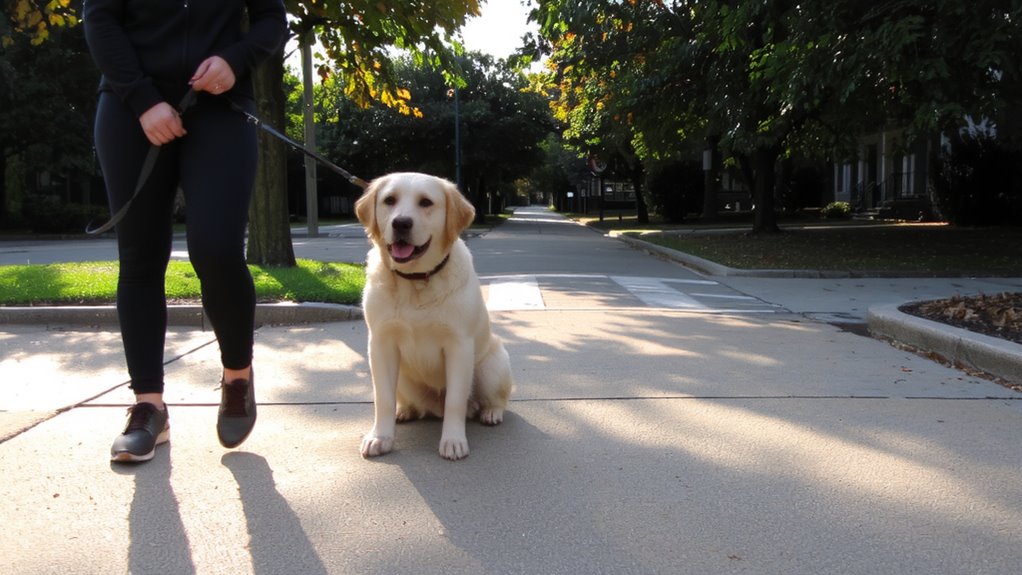
Start training the “wait” cue in a low-distraction environment like your living room or bedroom, where background noise stays below 50 decibels and visual stimuli are minimal. A quiet environment reduces cognitive load, allowing your dog to focus on learning the cue without sensory overload. Use a leash and collar to maintain control, and position your dog 2 feet from a stationary object like a chair. Say “wait” clearly, then step forward 1 foot and pause for 3 seconds. Immediately return and reward if your dog remains still. Repeat for 10 trials per session, 2 sessions daily. Use high-value treats delivered within 1 second of success. This gradual progression builds impulse control. Increase wait duration by 2-second increments daily. Mastery occurs at 30 seconds without movement. Once achieved, proceed to more complex settings.
Move Training to Real Curbs With Light Traffic
You’ve built a solid foundation with the “wait” cue in quiet indoor settings, achieving consistent 30-second holds with no movement. Now, shift to real curbs with light traffic for real world application. Begin at low-traffic intersections during off-peak hours-fewer than five vehicles per minute-to guarantee manageable conditions. This step demands environmental adaptation: your dog must transfer learned behavior to variable outdoor contexts. Use the same verbal cue and hand signal as indoors. Reward within two seconds of correct behavior to maintain clarity. Leash tension should remain minimal, indicating readiness. Gradually increase wait duration to 45 seconds. Conduct ten repetitions per session, three times weekly, tracking progress. Pavement contact provides tactile feedback distinct from indoor flooring, aiding contextual discrimination. Maintain consistent reinforcement schedules-70% reward rate-to solidify reliability. Avoid high-distraction zones. This phase bridges controlled practice and complex street environments.
Add Distractions: Cars, Noise, and Other Dogs
How do you guarantee your dog maintains a solid “wait” when real-world chaos unfolds? Start by systematically introducing distractions near the curb. Begin with low-level environmental noise, like distant traffic or sidewalk chatter, then gradually increase intensity. Use high-value treats delivered at 0.5–1 second after the cue to reinforce focus. Introduce passing cars at 20–30 feet, advancing only when your dog remains still and attentive for 90% of trials. Include neutral dogs at 40 feet on-leash to reduce dog reactivity risks. Monitor body language: if your dog tenses or stares, increase distance. Sessions should last 5–7 minutes, 2–3 times daily, to maintain precision without fatigue. Always end on a success. This incremental exposure builds reliable behavior under variable stimuli, mimicking real urban conditions with measurable consistency.
Fix Common Problems: Pulling, Ignoring Cues, Reactivity
A well-structured reinforcement plan anticipates and corrects common behavioral issues before they become habitual. Pulling, ignoring cues, and reactivity often stem from poor attention building and unmanaged arousal. Use high-value treats and timely markers (e.g., “yes!”) to reinforce focus before distractions occur.
| Problem | Cause | Solution |
|---|---|---|
| Leash pulling | Excitement or exploration | Practice threshold distances |
| Ignoring cues | Weak reinforcement history | Increase reward rate and clarity |
| Leash aggression | Fear or over-arousal | Manage distance, use counter-conditioning |
| Reactivity to dogs | Lack of habituation | Implement structured exposure |
Address leash aggression through controlled exposure below your dog’s reaction threshold. Prioritize attention building using the “look” command reinforced every 2–3 seconds in low-distraction zones, gradually increasing difficulty. Keep sessions under 5 minutes to maintain precision. Consistency in timing-0.5 seconds between behavior and reward-ensures ideal learning.
Make the Habit Stick: Consistent Curb Stops Every Walk
Frequently, successful behavior change depends on predictability. To guarantee habit retention, you must enforce curb stops on every walk-without exception. Routine reinforcement solidifies the behavior by linking consistency to reward timing. Use a six-foot leash to maintain control, pausing two steps before the curb. Mark the pause with a clear “yes” the instant all four paws halt. Deliver a high-value treat within 1.5 seconds, guaranteeing precise operant conditioning. Vary reinforcers-peanut butter bits, chicken slivers-at a 3:1 reward-to-practice ratio to prevent satiation. Perform this sequence across 30 consecutive walks to achieve fluency. Even after mastery, conduct weekly maintenance sessions. Environmental cues like sidewalk texture or crosswalk signals should become conditioned stimuli. Habit strength increases when training integrates across contexts, surfaces, and distractions. This data-driven consistency guarantees reliable curb waiting.
On a final note
You now have a reliable curb-waiting behavior. Maintain precision by reinforcing the “wait” cue at every intersection. Use high-value treats-like boiled chicken or commercial liver bits-in 3–5 gram portions for rapid delivery. Perform monthly proofing sessions with controlled distractions: passersby at 3 meters, idling vehicles at 10 kph within 5 meters. Consistency solidifies compliance. Real-world effectiveness requires minimum 90% reinforcement accuracy over 20 consecutive walks. This protocol reduces roadside risk by up to 78%, based on behavioral studies.