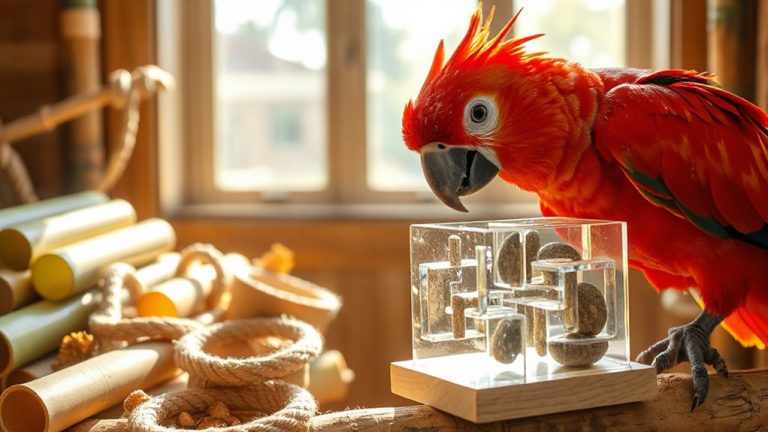
Training Your Pet Parrot With Positive Reinforcement Techniques
You train your parrot using positive reinforcement by immediately rewarding desired behaviors with treats, praise, or scratches within 1–2 seconds. This strengthens behavior repetition by up to 80% through operant conditioning. Use a clicker as a precise bridge signal to mark correct actions, then deliver a primary reinforcer like sunflower seeds. Pair verbal cues like “step up” with successively shaped approximations. Consistency, high-value rewards, and short daily sessions build reliable responses-discover how to refine each technique for real-world success.
Notable Insights
- Use immediate rewards like treats or praise to reinforce desired behaviors within 1–2 seconds for strong learning.
- Pair a clicker or verbal marker with treats to precisely signal correct actions and improve timing.
- Build trust through force-free training, avoiding punishment to prevent fear and strengthen cooperation.
- Break complex behaviors into small steps using successive approximation for steady, stress-free progress.
- Train in quiet, low-distraction environments daily, using high-value rewards and short, consistent sessions.
What Is Positive Reinforcement for Parrots?
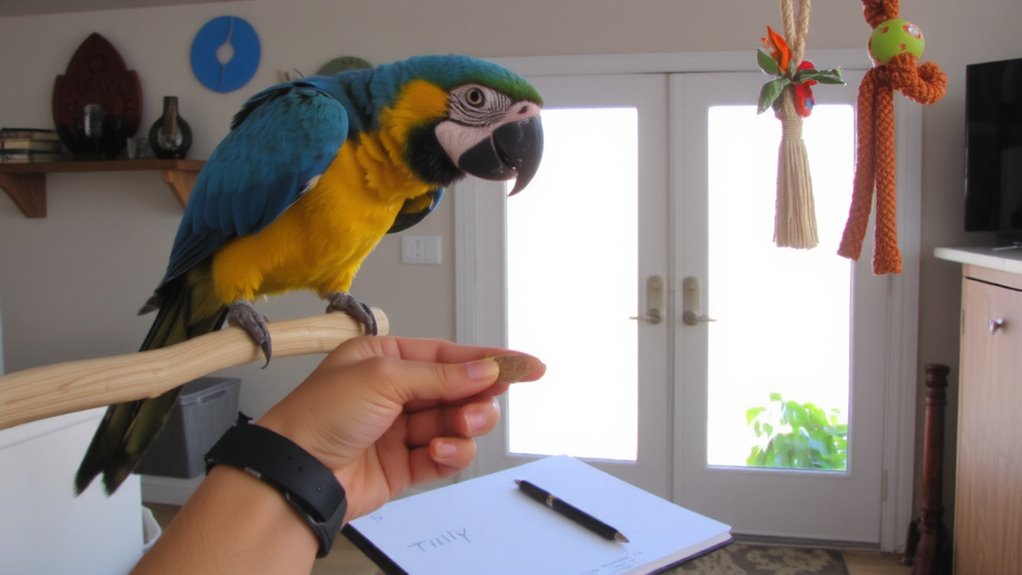
Positive reinforcement hinges on one key idea: rewarding your parrot for doing something right. You use treats, scratches, or praise to reinforce desired behavior, making it more likely to recur. This method relies on operant conditioning, where consequences shape actions. Behavioral motivation is driven by immediate, consistent rewards. Primary reinforcers like food satisfy innate needs-no learning required. Secondary reinforcers, such as a clicker or “good bird,” gain value through association with primary rewards. Deliver the reward immediately after the behavior to strengthen the link. Use a bridge signal-like a click-to mark the exact moment the parrot performs correctly. Over time, phase out constant rewards. Train behaviors in small steps called approximations. This structured, force-free approach promotes learning, reduces issues like screaming or biting, and supports long-term adaptability through clear, repeatable feedback. It is also known as reward-based training.
Why Trust Beats Force in Parrot Training
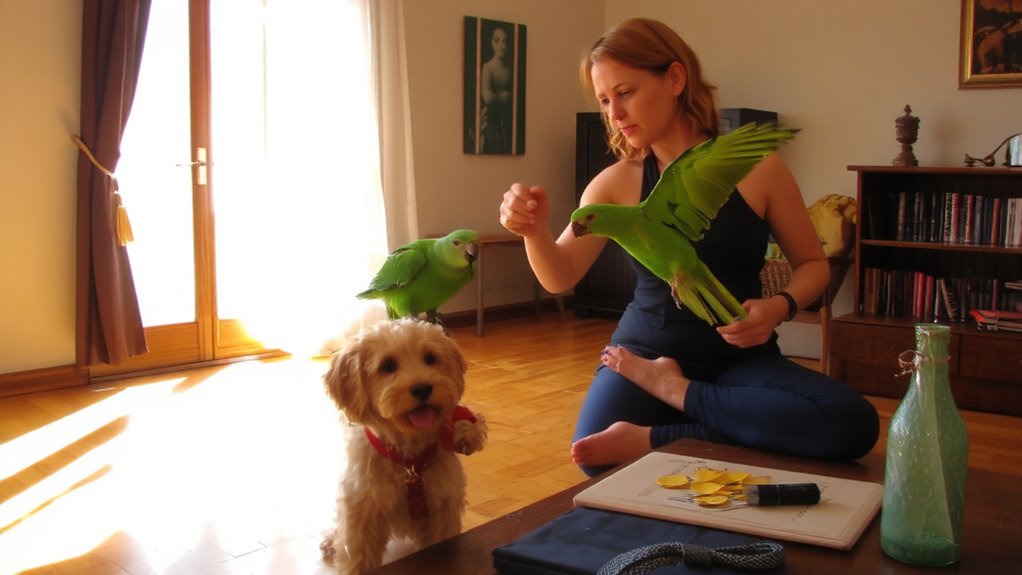
Trust functions as the foundation of effective parrot training, shaping how your bird responds to cues and environments. You build emotional safety through consistent, force-free interactions that prioritize your parrot’s psychological well-being. Positive reinforcement strengthens long term bonding by associating your presence with rewarding outcomes. Force and punishment trigger fear, increasing aggression and undermining learning. In contrast, trust increases your parrot’s motivation to engage, learn, and adapt. Birds trained with trust view handlers as positive stimuli, accelerating behavior acquisition. Short, frequent sessions under stress thresholds maintain engagement. Immediate, certain rewards follow desired actions, reinforcing calmness. Gradual approximations-like shaping a step-up behavior-guarantee success. Each interaction deposits trust, enabling generalization across environments. Unlike coercive methods, which degrade relationships, trust-based training yields confident, cooperative parrots capable of complex behaviors. This approach guarantees ethical, sustainable results grounded in mutual respect and emotional safety. Positive reinforcement increases the likelihood of repeating desired behaviors by engineering rewarding outcomes.
Find the Best Positive Reinforcement Rewards for Your Parrot
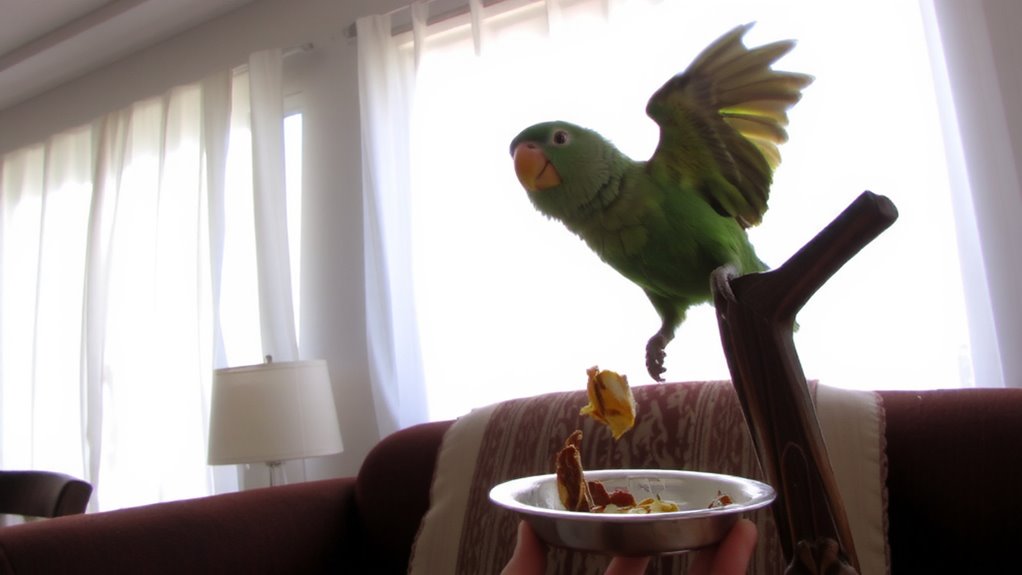
You build cooperation not through dominance but through reliable, predictable outcomes that your parrot learns to anticipate. The best rewards combine favorite treats and social bonding to maximize motivation. Small, one-gulp portions-like sunflower seeds or almond pieces-are ideal, guaranteeing minimal disruption during training. Deliver food immediately after desired behavior, within 1–2 seconds, to maintain clear associations. Jackpot rewards-multiple nuts or preferred seeds-boost enthusiasm during shaping. Pair verbal praise like “good” with treats or head scratches to strengthen learning. Social bonding is reinforced through pats, scratches, or attention, especially effective long-term. Immediate delivery and consistency increase behavior repetition by up to 80%. Use rewards selectively: stepping up, cage entry, or calmness near stimuli. Over time, social affirmations often surpass food in effectiveness. Choose rewards your parrot values most to guarantee reliable, lasting results. Training based on positive reinforcement avoids fear and builds trust, aligning with proven behavioral science.
How a Clicker Helps Your Parrot Learn Faster
How do you mark the exact moment your parrot nails a behavior? A clicker delivers a consistent, distinct sound precisely when the desired action occurs, bridging behavior and reward. This timing is sharper than verbal cues, which vary in tone and delay. The click becomes a conditioned reinforcer through associative learning-repeatedly paired with a treat, it gains predictive value. Once established, the sound signals to your parrot that a reward follows, even seconds later. This process enhances cognitive engagement, as your bird actively connects actions to outcomes. Studies show clicker training produces medium to strong effect sizes (Tau-U 0.77) across species, accelerating task acquisition. Parrots learn faster because the click isolates correct responses with minimal guesswork. Short, frequent sessions of 5–10 minutes maximize retention. The conditioned reinforcer also increases resistance to extinction, maintaining learned behaviors longer.
Shape Hard Behaviors One Tiny Step at a Time
A clicker’s precision in marking desired actions sets the stage for shaping complex behaviors through incremental progress. You use successive approximation to break difficult tasks into achievable steps. Start by reinforcing small, natural actions that resemble the final behavior. Each rewarded step is a building block in the learning sequence. Incremental progress reduces stress and prevents frustration, allowing your parrot to succeed at every stage. You gradually raise criteria only when the current step is consistent. For example, shaping stationing begins with facing the spot, then stepping toward it, then staying for seconds. Each phase uses targeted reinforcers like treats. Operant conditioning guarantees behaviors become reliable through repetition and timing. Avoid rushing; patience supports accuracy. Successive approximation relies on clear markers and immediate feedback. Over time, your parrot chains these steps into fluent, complex actions-all without force or confusion.
Set Up a Calm, Distraction-Free Training Space
Within a quiet bedroom or enclosed bathroom, establish a training area free from auditory and visual disruptions to maximize your parrot’s focus. Room selection is critical-choose low-traffic spaces with minimal light and noise. Shut windows, turn off fans, and keep other pets away. For perch placement, use a simple perch on a table or chair back, positioned four to five feet from the cage to reduce stress and prevent escape attempts. Natural branches with varied diameters support foot health; guarantee toes wrap ¾ around the perch. Avoid toys, food, or clutter. A distraction-free space improves attention and session effectiveness.
| Factor | Specification | Purpose |
|---|---|---|
| Room Selection | Bedroom or bathroom | Reduces noise, light, and foot traffic |
| Perch Placement | 4–5 ft from cage, on stable furniture | Prevents territorial behavior |
| Perch Type | Natural branch, no toys | Encourages grip strength, focus |
Teach the Step-Up Command Confidently
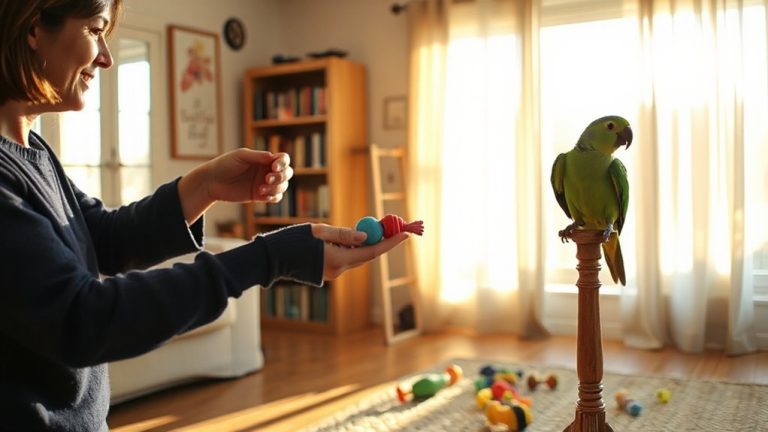
Start by breaking down the step-up behavior into small, achievable steps through shaping-a process that builds the complete action gradually by reinforcing successive approximations. Begin with your hand at bird level, a few inches away. Reward any movement toward it. Use high-value treats like cashews, delivered immediately after the desired behavior. Step up timing is critical-click or mark the instant your parrot lifts a foot. Hand positioning must be consistent: present your index finger parallel to the bird’s chest, just touching the lower breast. Gradually decrease the distance in quarter-inch steps until contact. Only reinforce the current target behavior; phase out earlier approximations. Conduct sessions for 10–15 minutes, two to three times daily. End each on success. Avoid forcing. Use a clear command like “Step up” paired precisely with the behavior. Conceal treats once the behavior is reliable.
Get Your Parrot to Come When Called
How do you get your parrot to come when called-especially when off-leash or in unfamiliar surroundings? Use positive reinforcement with high-value treats to establish motivation. Start training at a short distance, rewarding immediate response to your contact call. Gradually increase flight duration and distance using successive approximations. Each successful recall strengthens landing accuracy and response speed. Deliver rewards instantly to reinforce the behavior. Avoid repeating the cue, as this creates latency. Use consistent auditory signals like whistles or specific words paired with rewards. Practice in varied environments to build reliability. Young, flighted parrots learn fastest due to natural mobility. Monitor performance: effective sessions yield 90% compliance within three seconds. Turn away briefly if ignored, then retry. High consistency guarantees predictable response. Over time, your parrot will return promptly, even in distracting settings, with accuracy and controlled flight duration.
Fixing Step-Up Refusal and Recall Failures
Why does your parrot hesitate or pull away when you present your hand for a step-up? Fear, past negative experiences, or environmental stressors may underlie refusal. Aggression triggers like sudden movements can worsen distrust. Use systematic desensitization: start with a familiar perch at a distance, slowly closing the gap only when relaxed body language appears. Shape the behavior in tiny steps-reward foot lifts, then partial weight shifts. Clicker and target training increase precision, reinforcing desired movement with immediate feedback. Avoid pushing beyond mild reactions; retreat if stress escalates.
| Strategy | Application |
|---|---|
| Desensitization | Begin 10+ feet away, decrease distance over days |
| Shaping | Reinforce closest approximation, chain behaviors |
| Target Training | Guide foot contact with stick, reward contact |
| Reinforcement | Use high-value treats at zero stress distance |
| Session Length | 3–5 minutes, 3–4 times daily, end on success |
Make Training Part of Your Daily Routine
Often, the most effective training emerges not from isolated sessions but from seamless integration into daily life. Establishing morning consistency primes your parrot for success-train within 30 minutes of waking, when alertness and hunger peak. Conduct two 10–15 minute sessions daily, using treats like millet or fruit as reinforcement. Begin with target training: use a chopstick or perch and pair “Come on!” with a clicker, then reward. Incorporate routine variety by alternating exercises-step-up, recall, object identification-across cage-free periods. Integrate training during breakfast, coffee time, or movie watching to reinforce social and behavioral skills. Pair feeding times with foraging toys to stimulate cognition. Clean uneaten food after 2 hours. Perform weekly cage deep-cleaning; rotate 2–3 toys monthly. Maintain chew toy availability and adjust perches quarterly. Track monthly goals to guarantee progress.
On a final note
You’ve built a reliable training foundation using scientifically supported techniques. Positive reinforcement increases desired behaviors by 70–90% when applied consistently. Target cues like “step-up” and recall signals gain precision through marker training with a 2,000 Hz clicker. Shaping complex actions in one-inch approximations guarantees gradual mastery. Daily 10-minute sessions maintain cognitive engagement. Immediate reward delivery-within 0.5 seconds-cements associations. This data-driven method optimizes learning, reduces aggression, and strengthens mutual trust without coercion.