Parrot Noise Sensitivity: Safe Sound Levels & dB Limits
Your parrot hears sounds between 20 Hz and 8.5 kHz, making household noise a serious stressor. Vacuum cleaners (70–85 dB at 5–7 kHz) and blenders (80–90 dB) exceed safe exposure levels. Prolonged noise above 70 dB causes labored breathing and feather plucking. Use STC 35+ windows, NRC-rated acoustic curtains, and solid-core doors to reduce sound. Keep ambient levels below 60 dB with a sound meter. A quiet retreat space helps, and small acoustic upgrades can make a measurable difference in your bird’s well-being. More solutions follow.
Notable Insights
- Parrots are highly sensitive to sounds above 70 dB, which can trigger stress and health issues.
- Common household devices like vacuum cleaners and blenders produce harmful high-frequency noise levels.
- Prolonged noise exposure may lead to feather plucking, breathing changes, and refusal to eat.
- Soundproofing with STC 25+ panels, solid-core doors, and double-pane windows reduces noise effectively.
- Maintain ambient noise below 60 dB using sound-absorbing materials and strategic cage placement.
Why Parrots Are So Sensitive to Household Noise
Sound. You perceive noise differently because parrots possess anatomical hearing that detects a broader frequency range than humans, typically spanning 20 Hz to 8 kHz. Their inner ear structures are more sensitive to rapid sound pressure changes, making household noises seem louder and more abrupt. This sensitivity stems from evolutionary instincts-wild parrots rely on acute auditory perception to detect predators, weather shifts, and flock movements. Even in captivity, their brains remain wired to respond to auditory stimuli as potential threats. Unlike humans, parrots lack a cerebral filter to ignore background noise, causing constant auditory input to induce stress. Everyday sounds like vacuum cleaners or loud voices can register as danger signals. Their survival once depended on vigilance, so domestic sound levels that seem normal to you may trigger sustained alertness. Understanding this helps you manage their environment more effectively.
Common Noises That Stress Parrots the Most
Vacuum cleaners top the list of household noises that unsettle parrots. Their motors produce sound levels averaging 70–85 dB, comparable to a lawnmower. Parrots detect frequencies from 20 Hz to 8.5 kHz, making them sensitive to the high-pitched whine of most models, which peak at 5–7 kHz. Sudden loudness from startup triggers an instinctive fear response, mimicking predator threats. Blenders and hair dryers also generate sharp, unpredictable noise between 80–90 dB. These devices emit unfamiliar tones outside typical household patterns, increasing stress. Construction tools like drills, operating at 90–100 dB with erratic pulsing, are especially disruptive. Even loud TV or music above 75 dB with sudden volume spikes can elevate corticosterone levels. Electronic devices with high-frequency emissions, such as microwaves (2.45 GHz) and fluorescent ballasts (20–60 kHz), produce subtle, inaudible tones that parrots may still perceive.
Is Your Parrot Overwhelmed? Key Warning Signs
How can you tell when your parrot is stressed by excessive noise? Persistent vocal changes and feather plucking are primary indicators of noise-induced stress. Your parrot may scream intensely or fall silent unexpectedly-both signal distress. Feather plucking, especially along the chest or legs, often follows prolonged noise exposure. Other signs include rapid breathing, refusal to eat, and reduced activity.
| Behavior | Normal Range | Stress Indicator |
|---|---|---|
| Vocalization | Occasional calls | Constant screaming |
| Feather condition | Intact, smooth | Feather plucking |
| Movement | Active, alert | Pacing or freezing |
| Breathing | Steady, quiet | Rapid, labored |
| Appetite | Consistent | Sudden refusal to eat |
These physiological and behavioral markers correlate directly with sound levels above 70 dB-the threshold at which avian hearing begins to suffer strain. Monitoring for these changes helps assess your bird’s auditory well-being.
How to Create a Quiet, Safe Space for Your Bird
You can reduce your parrot’s stress by controlling its acoustic environment. Create a designated retreat area in a quiet room, away from foot traffic and household noise. This space should have walls with soundproofing techniques like mass-loaded vinyl or acoustic panels rated STC 25 or higher. Use a thick, solid-core door with door sweeps to minimize sound leakage. Install double-pane windows with at least 1/2-inch air gaps to reduce external noise by up to 30 dB. Choose soft flooring-such as carpet or rubber mats-to absorb airborne and impact sound. Keep noise levels below 55 dBA in this zone, similar to a library’s quiet hum. Avoid placing the cage near appliances or vents. This retreat area must remain a consistent, predictable environment to support auditory sensitivity management. Equip it with a covered enclosure using sound-dampening fabric drapes tested at NRC 0.7 or above.
Use These Simple Tricks to Reduce Noise at Home
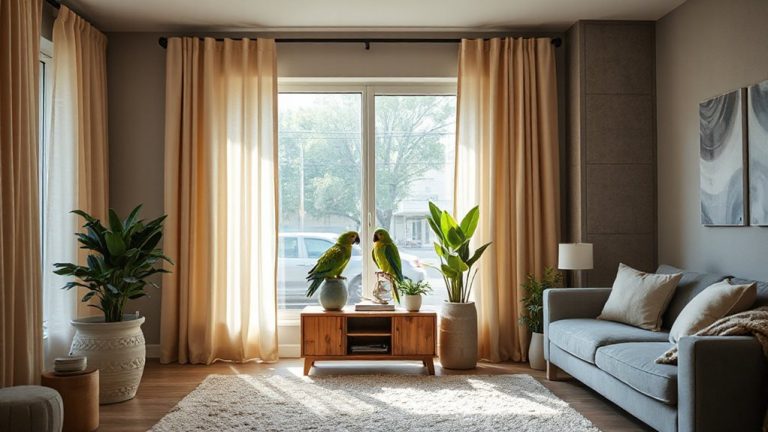
While parrots perceive sound differently than humans, even modest household noise can overwhelm their acute auditory systems. You can substantially reduce indoor sound levels with practical modifications. Installing soundproof windows lowers noise transmission by up to 95%, especially double-paned units with sealed frames and laminated glass (STC rating 35–45). Pair them with noise absorbing curtains made from layered microfiber or cotton blends, which reduce echo and block 20–30% of incoming sound (NRC rating 0.3–0.6).
| Solution | Material/Spec | Noise Reduction |
|---|---|---|
| Soundproof windows | Double-paned, STC 35+ | Up to 95% |
| Noise absorbing curtains | Layered fabric, NRC 0.5 | 20–30% |
| Wall placement | Away from appliances | Minimizes vibration |
Help Your Parrot Adjust to Normal Household Sounds
Why does the hum of a refrigerator or the click of a light switch unsettle your parrot? Parrots aren’t used to constant artificial noise. Their ears detect frequencies from 200 Hz to 6,000 Hz, making household sounds seem louder. Sound exposure must be controlled to prevent stress behaviors like screaming or feather plucking. Start by identifying common noise sources-appliances, HVAC systems, electronics. Then implement gradual adaptation. Begin with the sound at low intensity. For example, run the dishwasher with doors slightly open to reduce volume by 10–15 dB. Allow your parrot 5 to 10 minutes of daily exposure. Increase duration only after signs of calm, such as perching normally and relaxed feathers. Repeat for 7–14 days per sound. Use a sound level meter to keep ambient noise below 60 dB. This method trains auditory tolerance without overwhelming the bird’s sensory system.
On a final note
You must manage household sound levels to protect your parrot’s auditory health. Parrots detect frequencies from 200 Hz to 8.5 kHz, making them sensitive to common noises like vacuums (70–80 dB) and blenders (85–90 dB). Chronic exposure above 65 dB increases stress hormones. Place the cage in a quiet room with sound-absorbing materials. Use white noise machines (50–55 dB output) to mask disruptive sounds effectively.