Understanding the Sensory Changes With Age in Older Dogs and Cats
Your senior dog or cat likely faces age-related sensory decline. Nuclear sclerosis, common after age seven in dogs, clouds the lens with compressed fibers, reducing visual acuity to around 20/75. Cataracts further impair vision through protein clumping. Up to 70% of dogs show hearing loss by age ten, starting with high-frequency sounds. Olfactory receptor loss-critical in dogs with 300 million receptors-diminishes flavor perception. Joint pain from osteoarthritis alters touch response. Consider nonslip mats (2mm rubber backing) and 2700K nightlights for support. Further details on managing these changes follow.
Notable Insights
- Older dogs and cats commonly develop nuclear sclerosis, causing a bluish lens haze that may increase light sensitivity.
- Cataracts, distinct from nuclear sclerosis, involve protein clumping that impairs vision by scattering light in the lens.
- Age-related hearing loss often starts with high-frequency sounds and can affect up to 70% of dogs by age 10.
- Decline in smell and taste, especially umami and salt detection, reduces food interest in senior pets.
- Osteoarthritis and tactile hypersensitivity can cause pain or discomfort, altering response to touch in aging animals.
How Aging Affects Your Pet’s Vision
Vision in older pets often fades quietly, like a photograph left too long in the sun. You may notice your pet hesitating in dim light or startling at familiar objects. These signs often indicate vision impairment, commonly caused by nuclear sclerosis or cataracts. Nuclear sclerosis typically appears after age seven in dogs, causing a bluish haze in the lens due to fiber compression. Cataracts, in contrast, involve protein clumping that scatters light, reducing visual acuity. Both conditions can increase light sensitivity, making bright environments uncomfortable. Pets with impaired vision rely more on motion detection than detail, with canine visual acuity averaging 20/75 compared to human standards. You can help by maintaining consistent furniture placement and using auditory cues. Avoid sudden changes in lighting. While complete blindness isn’t inevitable, regular ocular exams are essential for early detection and management of degenerative changes affecting sight.
Is Your Older Dog or Cat Losing Hearing?
How often does your older pet not respond when called from another room? This could signal hearing decline, a common issue in senior dogs and cats. Hearing loss typically begins gradually, affecting high-frequency sounds first. By age 10, up to 70% of dogs show some degree of hearing decline. In cats, the onset often appears after age 12, particularly in white-coated or blue-eyed individuals predisposed to congenital deafness. Early signs include reduced sound recognition and failure to react to familiar noises like doorbells or food preparation. Brainstem auditory evoked response (BAER) testing objectively measures hearing ability, detecting both partial and complete deafness. While age-related changes are irreversible, environmental modifications-such as visual cues or vibrating collars-can compensate. Early detection improves quality of life.
Why Senior Pets Lose Interest in Food
Why has your older dog or cat suddenly turned away from meals they once devoured? The answer often lies in age-related sensory decline. Taste decline impairs your pet’s ability to detect flavors, particularly salty and umami notes, reducing meal appeal. This change stems from a loss of taste bud sensitivity and reduced saliva production, which limits food solubility and taste receptor activation. Simultaneously, smell reduction profoundly affects appetite. Dogs have up to 300 million olfactory receptors; cats have about 200 million-yet both experience neuronal loss in the olfactory bulb with age. As much as 80% of flavor perception depends on smell, so diminished olfactory function critically undermines interest in food. These physiological changes are progressive, not sudden. You may observe gradual disinterest, shorter eating periods, or selective feeding. Addressing these sensory deficits involves enhancing food aroma and texture. Warming meals to 100–104°F can amplify odor release, compensating for smell reduction and stimulating appetite.
Touch Sensitivity and Pain in Aging Pets
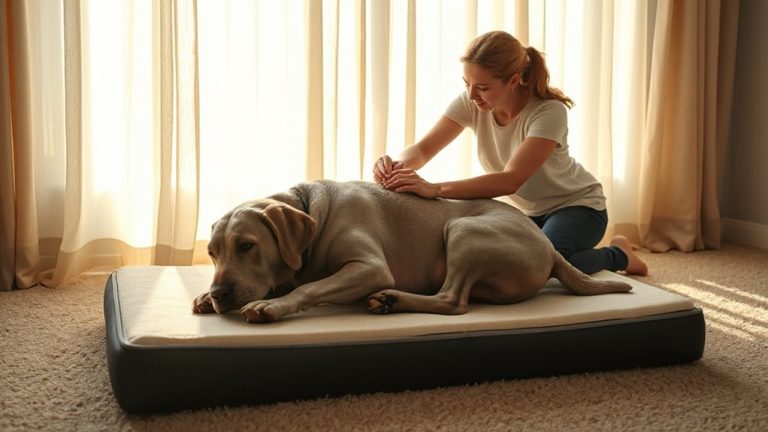
As your senior dog or cat grows older, changes in how they respond to touch may become more noticeable. Joint pain from osteoarthritis commonly develops, reducing mobility and causing discomfort during handling. This chronic condition affects synovial fluid viscosity and cartilage integrity, leading to decreased range of motion. Tactile hypersensitivity may also emerge, where light touch triggers avoidance or vocalization due to amplified neural signaling in degenerated peripheral nerves.
| Behavior | Possible Cause |
|---|---|
| Flinching when touched | Tactile hypersensitivity |
| Licking joints persistently | Joint pain |
| Aggression during petting | Nerve sensitivity |
| Reluctance to jump | Reduced joint mobility |
These responses are neurophysiological, not behavioral. Mechanoreceptor dysfunction alters pain perception. Regular low-impact exercise helps maintain joint flexibility. Analgesic therapy, like NSAIDs or gabapentin, may be prescribed based on clinical evaluation. Early intervention improves quality of life. Supportive devices such as pet back support braces can help stabilize the spine and improve mobility in aging animals with musculoskeletal decline.
Easy Home Fixes for Sensitive Senior Pets
Where can you start making meaningful changes for your aging pet’s comfort? Begin by creating a calm environment to reduce sensory overload. Older pets struggle with noise and activity, so isolate their space from high-traffic areas. Use sound-absorbing materials like thick rugs or curtains to minimize auditory stress. Install nightlights with a color temperature of 2700K to aid low-light vision without glare. Provide soft bedding made of memory foam, at least 3 inches thick, to relieve pressure on arthritic joints. Orthopedic beds with density ratings of 3.5–4.0 lbs/ft³ offer ideal support. Avoid slippery floors; place nonslip mats with rubber backing (minimum thickness 2mm) near resting zones. Restrict access to stairs and elevate food/water bowls by 6–9 inches, depending on shoulder height. These adjustments enhance mobility, reduce pain, and promote restorative sleep. For targeted joint support, consider one of the top-rated arthritis dog beds designed specifically for senior pets.
On a final note
You must monitor sensory decline in senior pets. Vision deteriorates due to nuclear sclerosis and retinal atrophy, reducing light adaptation. Hearing loss follows cochlear degeneration, especially at >15,000 Hz. Reduced olfaction and taste impair food interest-consider warming meals to 100°F to enhance aroma dispersion. Arthritis and peripheral neuropathy alter touch response. Modify environments: increase lighting to 250 lux, use non-slip flooring, and employ vibrating collars for deaf pets. Early intervention maintains function and quality of life.