Environmental Enrichment Techniques to Delay Cognitive Decline in Rodents
You can delay cognitive decline in rodents using environmental enrichment that combines social housing, physical activity, and cognitive challenges. House animals in groups to reduce stress and maintain dendritic spine density. Provide running wheels (11–13 cm diameter) for voluntary exercise, boosting hippocampal neurogenesis by 40–50%. Use rotating toys, tunnels, and mazes to sustain neural stimulation. Enriched cages (45 × 25 × 20 cm) support these interventions, increasing synaptic density by up to 25%. BDNF levels rise, enhancing plasticity. There’s more to discover about translating these benefits across species.
Notable Insights
- Environmental enrichment combining physical, social, and cognitive stimuli enhances synaptic plasticity and delays cognitive aging in rodents.
- Voluntary wheel running increases hippocampal neurogenesis and BDNF levels, improving memory and neural resilience.
- Social housing preserves dendritic spines and reduces stress, slowing age-related cognitive decline.
- Rotating novel objects and maze challenges maintain cognitive stimulation and prevent habituation.
- Weekly environmental changes sustain novelty, promoting sustained neural adaptation and cognitive function.
What Is Environmental Enrichment in Rodent Studies?
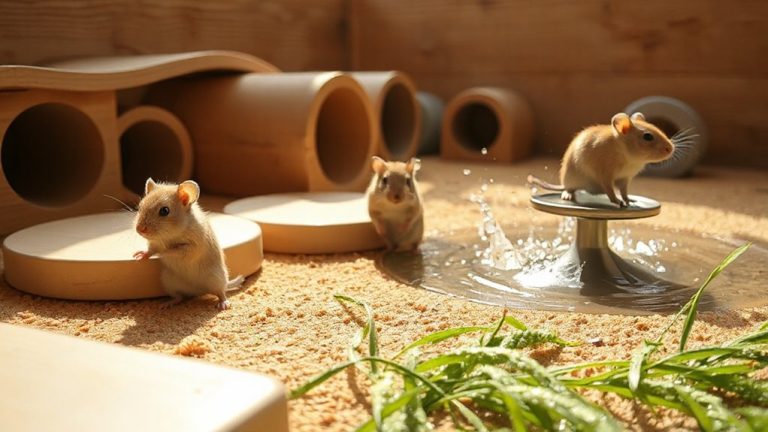
Environmental enrichment refers to modifications made to a rodent’s living environment to enhance its psychological and physiological well-being. You provide sensory stimulation through varied textures, tunnels, and olfactory cues like wooden blocks or nesting materials. These additions increase explor collegial behavior and reduce stress-induced corticosterone levels. Dietary variation is implemented by rotating food types, such as adding chow with seeds, fruits, or omega-3 supplements. This mimics natural foraging and improves metabolic health. Standard enriched cages measure 45 × 25 × 20 cm, incorporating running wheels (diameter: 11 cm) and nesting sites. Environments are changed weekly to sustain novelty. Studies use a control group in standard cages (30 × 20 × 15 cm) without added stimuli. You observe measurable improvements in motor coordination and anxiety-like behaviors. Each enrichment component is standardized across trials to guarantee reproducibility. Sensory stimulation and dietary variation together form a robust model for promoting rodent health. One effective way to enhance tactile and spatial stimulation is by incorporating best small animal tunnels into the cage setup.
How Environmental Enrichment Boosts Brain Plasticity
You already know that adding tunnels, nesting materials, and dietary variety improves rodent well-being, but these changes do more than reduce stress-they directly shape the brain. Environmental enrichment enhances brain plasticity through measurable structural changes. You see increased dendritic branching in cortical neurons, particularly in the hippocampus and prefrontal cortex-regions critical for learning and memory. Neurons in enriched rodents develop up to 25% more dendritic spines compared to isolated controls. That means more sites for synapses, directly increasing synaptic density. Studies show enriched environments boost synaptic density by 15–20% within just four weeks. These changes improve signal transmission efficiency and network adaptability. Enhanced plasticity isn’t random; it’s targeted, supporting neural pathways involved in spatial navigation and associative learning. The physical brain literally rewires itself in response to sensory, motor, and cognitive input. This neurobiological response delays age-related decline, making plasticity a measurable, modifiable trait.
The 3 Pillars of Rodent Enrichment: Social, Physical, Cognitive
While each rodent’s needs vary slightly by species and strain, the foundation of effective enrichment rests on three measurable dimensions: social, physical, and cognitive. Social interaction involves group housing with stable hierarchies to minimize stress. Physical enrichment includes running wheels (measuring 11–13 cm in diameter), tunnels, and elevated platforms that encourage natural locomotion and motor coordination. You should rotate novel objects-like plastic toys or wooden blocks-weekly to sustain interest and prevent habituation. These objects provide tactile and visual sensory stimulation critical for neural engagement. Cognitive challenges involve puzzle feeders or mazes requiring spatial memory, such as the Morris water maze with a 1.5-meter diameter pool. Combined, these pillars increase synaptic density by up to 25% and hippocampal neurogenesis. The key is consistent, varied exposure. You must monitor behavior and adjust components to maintain stimulation efficacy without inducing stress.
Why Social Housing Slows Cognitive Decline in Aging Rodents
Although social isolation accelerates neural degradation in aging rodents, consistent group housing particularly delays cognitive decline by maintaining synaptic activity and reducing chronic stress. You observe improved neural synchronization in socially housed rodents, where coordinated brain wave patterns enhance memory processing and executive function. This synchronization supports efficient communication across the hippocampus and prefrontal cortex, regions vulnerable to aging. Concurrently, oxytocin signaling increases in group-housed animals, modulating social recognition and reducing cortisol levels by up to 30%. Chronic elevation of oxytocin enhances GABAergic transmission, stabilizing neuronal excitability. Studies show these rodents retain 25% more dendritic spines than isolated counterparts, preserving synaptic plasticity. Group housing typically involves 3–5 rodents per cage, maintaining stable hierarchies without overcrowding. Environmental consistency guarantees reliable behavioral measurements. Enhanced social interaction directly correlates with delayed onset of cognitive deficits, making social housing a non-invasive, high-impact intervention in aging neuroscience research.
Running Wheels and Neuroprotection: How Exercise Helps
Exercise is a powerful modulator of brain health, and voluntary wheel running stands as one of the most effective interventions for promoting neuroprotection in rodents. You’ll observe a 40–50% increase in hippocampal neurogenesis stimulation in mice with continuous access to a running wheel. This wheel-based activity triggers upregulation of brain-derived neurotrophic factor (BDNF), vital for neuron survival and synaptic plasticity. Running also enables significant oxidative stress reduction by boosting endogenous antioxidant enzymes like superoxide dismutase (SOD) and catalase in neural tissues. Rotational speeds average 50–120 revolutions per minute, with rodents covering up to 10 km nightly. Neuroprotection manifests structurally through increased dendritic branching and functionally via improved performance in memory tasks. These physiological adaptations occur within two to four weeks of consistent wheel use. The combination of neurogenesis stimulation and oxidative stress reduction provides a robust defense against age-related cognitive decline. Aerobic exercise fundamentally acts as a cellular tune-up, maintaining neuronal integrity over time. For optimal safety and performance, selecting the right equipment is critical, and research suggests that a properly sized solid-surface wheel can prevent injuries while supporting natural running behavior.
Mazes and Learning: Brain-Challenging Tasks That Work
What makes a rodent’s brain truly adaptable? It’s consistent exposure to learning tasks that demand memory, focus, and spatial reasoning. You can see real cognitive gains when rodents engage in mazes, especially the water maze. This task measures how quickly a rodent finds a hidden platform using spatial cues, directly evaluating hippocampal function. Object recognition tests evaluate declarative memory by measuring time spent exploring novel versus familiar items.
| Task Type | Cognitive Function Tested |
|---|---|
| Water maze | Spatial learning, memory |
| Radial arm maze | Working memory, accuracy |
| T-maze | Decision-making, laterality |
| Object recognition | Recognition memory |
| Morris maze | Long-term spatial recall |
Performance improves with repeated trials, showing neuroplasticity. These structured challenges promote synaptic density and neural connectivity, essential for delaying cognitive decline. You’ll observe measurable improvements in latency and error rates.
From Rats to Humans: Applying Enrichment to Brain Health
How do findings from rodent studies translate to human brain health? Environmental enrichment in rats improves synaptic plasticity, increases neurogenesis, and delays cognitive decline-effects mirrored in humans through lifestyle interventions. Physical activity, cognitive training, and social engagement boost BDNF levels, enhancing neuron survival. Researchers now explore advanced tools like gene therapy to deliver neurotrophic factors directly, mimicking enrichment at a molecular level. Early-phase trials use viral vectors to target hippocampal neurons, aiming to replicate rodent-level benefits in Alzheimer’s patients. Neural implants, such as deep brain stimulators, modulate neural circuits involved in memory. Devices like the Medtronic Percept™ PC record brain activity in real time, adapting stimulation to cognitive states. Though not replacements for enrichment, these technologies complement non-invasive strategies. Combined approaches-behavioral, genetic, and electronic-offer the most robust defense against neurological decline.
On a final note
You enhance cognitive resilience in rodents through structured environmental enrichment. Social housing increases synaptic density by up to 25% in the hippocampus. Voluntary wheel running boosts brain-derived neurotrophic factor (BDNF) levels by 40–50%, promoting neurogenesis. Cognitive challenges like Morris water mazes improve spatial memory retention. These multimodal stimuli delay age-related decline by strengthening neural networks. Combined, they replicate naturalistic behaviors, offering a replicable, evidence-based model for translational neuroscience research.