Joint Care for Aging Pets: Understanding Mobility Issues in Elderly Animals
Your senior pet’s mobility issues often stem from arthritis, marked by cartilage thinning and reduced synovial fluid viscosity. You may notice stiffness, limping, or reluctance to jump. Vets diagnose joint disease through physical exams, gait analysis, and radiographs showing bone spurs or narrowed joint spaces. Synovial fluid volume drops up to 40%, impairing cushioning. Treatments like laser therapy (800–900 nm) and glucosamine (20 mg/lb daily) improve function. Further solutions follow.
Notable Insights
- Senior pets often show mild, intermittent limping due to joint pain and reduced cartilage cushioning.
- Hesitation to jump or rise may signal discomfort from decreased synov/vial fluid and joint inflammation.
- Stiffness after rest, especially morning stiffness, is a common sign of age-related joint degeneration.
- Joint health declines with aging due to cartilage thinning, reduced fluid volume, and loss of elasticity.
- Proven treatments include stem cell therapy, laser treatment, and supplements like glucos prescribing pet weight and needs.
Common Signs of Joint Pain in Senior Pets
With age, your pet’s joints undergo degenerative changes similar to osteoarthritis in humans, and recognizing early signs is critical for timely intervention. Limping episodes, often mild and intermittent, indicate joint discomfort or reduced cartilage cushioning. You may notice your pet hesitating before rising or showing reluctance to jump onto furniture or into vehicles. This behavior stems from decreased synovial fluid viscosity and joint capsule inflammation, reducing range of motion. Stiffness after rest, especially in the morning, is common. Muscle atrophy may develop secondary to reduced activity. Gait analysis shows shortened stride length and weight redistribution. Early detection allows for non-invasive management. Monitor frequency and duration of symptoms. Chronic pain alters biomechanics, increasing stress on adjacent joints. Radiographic changes often lag behind clinical signs, so functional observation is key. Documenting behavioral shifts provides valuable baseline data for veterinary assessment. Supportive tools like pet mobility aids can significantly improve daily function and quality of life.
How Your Vet Diagnoses Arthritis in Older Animals
How does your veterinarian determine if your pet has arthritis? Your vet starts with a thorough physical exam, focusing on joint palpation to detect swelling, heat, or pain in the joints. They’ll manipulate each joint through its normal range of motion, noting any stiffness or discomfort. Gait analysis follows, observing how your pet walks, turns, and rises from lying down. Subtle lameness, shortened stride, or limb favoring can signal joint dysfunction. Radiographs are often taken to confirm arthritis, revealing bone spurs, joint space narrowing, or cartilage loss. Blood work may rule out infections or immune-mediated conditions. In complex cases, advanced imaging like CT or MRI provides detailed views of soft tissues and joint structures. Together, joint palpation and gait analysis form the clinical foundation for diagnosing arthritis. Early, accurate detection guides effective treatment.
Why Joint Health Declines With Age
Arthritis isn’t just a result of old age-it’s the outcome of measurable biological changes that accumulate in your pet’s joints over time. Cartilage wear degrades the smooth tissue cushioning the ends of bones. Over years, repetitive stress thins this protective layer, increasing friction during movement. In healthy joints, cartilage is 2–4 mm thick; in aged pets, it can erode to less than 1 mm. Synovial fluid reduction further impairs joint function. This viscous lubricant normally has a viscosity of 50–150 mPa·s; with age, production slows and fluid volume drops up to 40%. Reduced lubrication heightens cartilage wear and limits shock absorption. Joint capsules lose elasticity, contributing to stiffness. These changes are progressive and irreversible, but measurable. Synovial fluid analysis shows decreased hyaluronic acid concentration-from 3–5 mg/mL to under 1.5 mg/mL in older animals-impairing fluid quality. These biological shifts collectively drive degenerative joint disease.
Proven Treatments for Pet Arthritis and Stiffness
Managing arthritis in aging pets requires a targeted, science-backed approach-because relief isn’t just about comfort, it’s about restoring measurable joint function. Stem cell therapy uses your pet’s own regenerative cells to reduce inflammation and repair damaged joint tissue. Veterinarians extract adipose tissue, isolate stem cells, and inject them directly into affected joints, with studies showing up to 75% improvement in mobility within eight weeks. Laser treatment, or photobiomodulation, delivers specific wavelengths (typically 800–900 nm) to penetrate deep into tissues. This boosts cellular energy (ATP) production, reduces pro-inflammatory cytokines, and accelerates healing. Clinical protocols use 5–10 minutes per joint, twice weekly for four weeks, yielding significant pain reduction. Both treatments are non-invasive and supported by veterinary research. When combined with prescribed joint supplements and weight management, they deliver measurable improvements in gait symmetry and range of motion. Always consult a certified veterinary rehabilitation specialist to determine candidacy and treatment frequency. High-quality arthritis supplements for senior pets can further support joint health by providing key ingredients like glucosamine, chondroitin, and omega-3 fatty acids.
Simple Home Changes to Support Pet Mobility
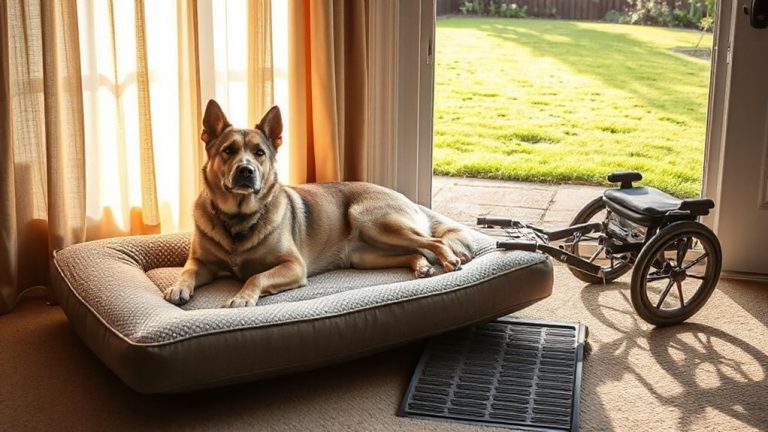
You can substantially improve your aging pet’s daily movement by modifying key areas of your home-changes that work alongside clinical treatments like stem cell therapy and laser sessions you’re already using. Install ramp access at least 12 inches wide with a maximum incline of 20 degrees for safe, low-impact entry and exit. Ramps should have textured surfaces and side rails to prevent slipping and disorientation. Replace smooth flooring with non slip flooring featuring a coefficient of friction ≥0.5; rubber or cork materials reduce fall risk by up to 70%. Place mats with raised grips near food, water, and litter stations. Use area rugs with non-slip backings, secured to subflooring. Avoid loose cables or clutter that obstruct pathways. These modifications reduce musculoskeletal strain, improve gait stability, and support joint integrity. Simple changes yield measurable improvement in daily ambulation and reduce compensatory injuries linked to poor traction and elevation shifts. For elevated furniture access, consider a dog ramp for beds with a non-slip surface and gentle incline.
Best Supplements for Senior Pet Joint Health
While age-related joint decline is inevitable, targeted nutritional support can markedly slow its progression and improve long-term mobility. You should consider glucosamine benefits: glucosamine sulfate, typically dosed at 20 mg per pound daily, helps maintain cartilage structure by stimulating glycosaminoglycan production. It’s most effective when combined with chondroitin, which inhibits degrading enzymes. You’ll also want to leverage omega advantages-specifically omega-3 fatty acids like EPA and DHA. These reduce joint inflammation; aim for 1,000 mg combined per 20 pounds of body weight daily. Fish oil supplements offer reliable concentrations, typically 18% EPA and 12% DHA. Always choose third-party tested brands to guarantee purity. Though results take 4–8 weeks, clinical studies show improved lameness scores in 70% of dogs. Consistent use supports synovial fluid viscosity and decreases pain mediators.
On a final note
You can manage your senior pet’s joint issues effectively with the right approach. Early detection improves outcomes markedly. Treatments like NSAIDs-such as carprofen at 2–4 mg/lb every 12 hours-reduce inflammation. Use glucosamine-chondroitin supplements at 20 mg/kg daily for cartilage support. Install non-slip flooring and raised feeders. Maintain weight; each excess pound increases joint stress by 3–4 times during movement. Consistency guarantees lasting mobility.