How to Safeguard Your Pet’s Natural Oil Production Without Over-Grooming
You maintain your pet’s natural oil balance by bathing only when necessary-every 4 to 8 weeks depending on breed and season. Use a pH-balanced shampoo (6.2–7.5) free of sulfates to preserve sebum, which contains 57% triglycerides and 12% squalene for hydration. Brush regularly to spread oils and support a healthy coat. Adjust routines with seasonal changes-minimize bathing in winter, lighten trims in summer. A proper routine sustains skin that retains 20–30% water in the stratum corneum. Ideal care follows next.
Notable Insights
- Bathe your pet only as often as breed-specific needs dictate to prevent stripping essential sebum.
- Use pH-balanced, sulfate-free shampoos that preserve natural oils and support skin hydration.
- Maintain proper brushing routines to distribute sebum without causing irritation or over-drying.
- Adjust grooming frequency seasonally, reducing baths in winter to conserve oils in dry air.
- Avoid shaving double-coated breeds, as it disrupts oil distribution and natural temperature regulation.
Signs Your Pet Is Losing Natural Oils
What does it mean when your pet’s coat looks dull or feels coarse to the touch? It’s a sign of diminished natural oil production. A dry coat lacks the glossy sheen typical of healthy fur and may feel brittle or rough. You’ll often notice excessive shedding or tangles, even with routine brushing. Flaky skin appears as white specks along the scalp or under fur, resembling dandruff. These flakes result from poor sebum distribution-sebaceous glands produce less lipid-rich sebum, disrupting the skin’s moisture barrier. Reduced oleic acid and triglyceride levels in the sebum compromise skin elasticity and lubrication. This condition is measurable via corneometer readings, which show decreased hydration. In canines, normal skin hydration ranges between 40–60%; dry skin falls below 30%. Address this early to prevent secondary irritations, but avoid over-cleansing, which strips essential oils. Monitor texture, luster, and flaking regularly. Choosing the right best dog shampoo for itchy skin can help restore moisture balance without disrupting natural oil production.
How Natural Oils Keep Your Pet’s Skin Healthy
Sebum-the body’s natural lipid secretion-acts as a protective shield for your pet’s skin and coat. It maintains oil balance by regulating sebum composition: approximately 57% triglycerides, 26% wax esters, and 12% squalene. These lipids form a hydrophobic barrier that prevents transdermal water loss, directly supporting skin hydration. A well-maintained lipid layer resists microbial invasion, reducing risks of dermatitis. Disruption in oil balance compromises barrier integrity, increasing transepidermal water loss (TEWL) by up to 40%. Proper sebum distribution occurs through natural shedding and movement across hair follicles. Essential fatty acids like linoleic acid stabilize cell membranes, preventing scaling. When oil production is sufficient, the stratum corneum retains 20–30% water content-optimal for elasticity and defense. Avoid interfering with this system unnecessarily. Preserving natural oils guarantees sustained skin hydration and functional epidermal performance without external intervention.
How Often Should You Bathe Your Dog?
Bathing too frequently strips away the natural oils that protect your dog’s skin and coat, disrupting the delicate balance needed for ideal barrier function. Your dog’s bathing frequency should align with breed, coat type, and activity level. Over-bathing leads to dryness, while infrequent cleaning risks oil buildup. Water temperature must be lukewarm (around 100°F) to avoid irritating skin or accelerating oil loss. Choosing the right best dog shampoo for itchy skin can help maintain skin health without compromising natural oil levels.
| Breed Type | Recommended Bathing Frequency | Notes |
|---|---|---|
| Labrador | Every 6–8 weeks | High oil production; avoid hot water |
| Poodle | Every 4–6 weeks | Curly coat traps debris; moderate water temperature |
| German Shepherd | Every 6–8 weeks | Double coat needs balanced oil retention |
| Beagle | Every 6 weeks | Sensitive skin; never cold water |
| Shih Tzu | Every 3–4 weeks | Long coat requires gentle routine |
Adjust bathing frequency based on seasonal activity and dermatological needs.
Pick Shampoos That Preserve Natural Oils
Your dog’s skin relies on a delicate lipid barrier to retain moisture and repel irritants, and the shampoo you choose plays a critical role in maintaining it. A proper canine shampoo matches your dog’s natural pH balance, typically between 6.2 and 7.5, unlike human shampoos, which are more acidic and can disrupt this barrier. You should always check labels for ingredient safety, avoiding harsh surfactants like sulfates that strip natural oils. Opt for formulations with moisturizing agents such as ceramides or fatty acids, which support lipid integrity. Choose products tested for dermatological compatibility. Medicated shampoos, while effective, must be used only when necessary and under veterinary guidance to prevent over-drying. Preservatives should be non-irritating, such as potassium sorbate. Never assume “natural” means safe-verify each component. Using pH-appropriate, vet-approved shampoos guarantees your dog’s skin stays balanced, protected, and resilient without excessive oil depletion. Some odor-fighting shampoos are specifically designed to eliminate smells without damaging the lipid barrier, like those with oatmeal and aloe vera.
Brush to Spread Natural Oils
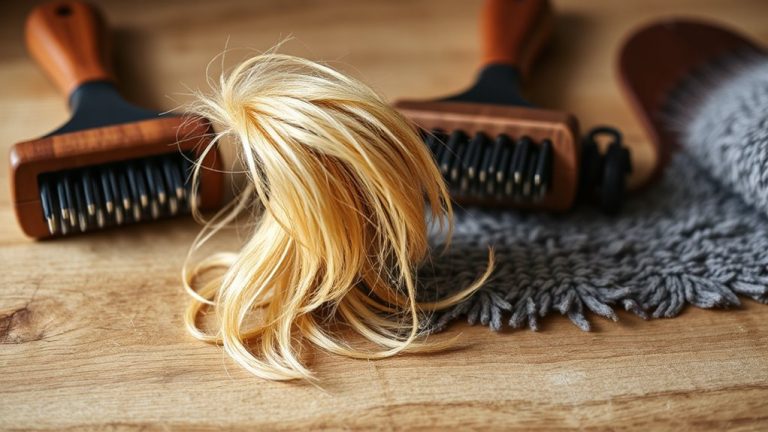
A consistent brushing routine helps distribute your dog’s natural oils from the skin to the fur, improving coat health and moisture retention. Proper oil distribution prevents dry skin and enhances coat shine. Use a slicker brush for long-haired breeds or a rubber curry brush for short coats; both effectively lift and spread sebum along the hair shaft. Brush in the direction of hair growth with moderate pressure-too light, and oils won’t move; too hard, and you risk irritating the skin. Aim for 3–5 minutes daily, adjusting frequency based on coat type. Dogs with double coats benefit from weekly undercoat rakes to support even oil distribution without disrupting insulation. This mechanical transfer mimics natural grooming behaviors seen in wild canids. Regular brushing also removes debris and loose hair, reducing matting and supporting a lustrous, resilient coat.
Adjust Grooming for Seasons to Protect Natural Oils
As temperatures shift with the seasons, so too must your approach to maintaining your pet’s natural oil balance. Adjusting grooming practices supports skin health through climate conditioning. Overbathing in winter strips essential oils; reduce frequency to every 6–8 weeks. In summer, increase to every 4 weeks to manage sweat and debris. Apply seasonal clipping selectively-avoid shaving double-coated breeds, as it disrupts thermal regulation and oil distribution. Use blade guards (0.8–1.2 mm) to preserve protective topcoats.
| Season | Bathing Frequency | Clipping Guidance |
|---|---|---|
| Winter | Every 6–8 weeks | Minimal trimming only |
| Spring | Every 5–6 weeks | Undercoat thinning |
| Summer | Every 4 weeks | Light seasonal clipping |
| Fall | Every 5–6 weeks | Remove summer debris |
| Year-Round | As needed | Climate conditioning care |
Build a Skin-Healthy Grooming Routine
Though skin health relies heavily on internal factors, consistent grooming plays a pivotal role in preserving your pet’s natural oil balance. Brushing 2–3 times weekly removes dead skin and distributes sebum evenly, supporting moisture balance. Use a slicker brush for fine coats or a bristle brush for short hair, applying light pressure to avoid irritation. Bathe no more than once monthly with a pH-balanced, sulfate-free shampoo diluted at a 10:1 water ratio. Over-bathing strips lipids, disrupting coat nutrition and increasing transepidermal water loss by up to 30%. Rinse thoroughly-residue alters skin acidity, inviting pathogens. Post-bath, towel-dry gently; never use high-heat blowers, as they desiccate the stratum corneum. For long-coated breeds, comb to the skin to prevent matting, which traps moisture and fosters microbial growth. A disciplined routine sustains hydration, supports barrier function, and preserves the cutaneous microbiome.
On a final note
You protect your pet’s natural oils by limiting baths to once every 4–6 weeks. Frequent washing strips essential sebum, disrupting the skin’s lipid barrier. Use pH-balanced shampoos (pH 6.2–7.4) to preserve epidermal integrity. Daily brushing distributes oils evenly, mimicking natural sebum dispersion. Adjust routines seasonally: reduce bathing in dry winter months. A consistent, minimal routine maintains coat health without over-grooming.