The Importance of Regular Nail Trimming for Maintaining Healthy Paws
Regular nail trimming keeps your pet’s paws healthy by preventing biomechanical damage. Overgrown nails alter weight distribution, forcing toe joints into unnatural positions and increasing loading forces on distal phalanges by up to 30%. This strains tendons, reduces circulation, and accelerates joint degeneration. Trimming every 3–4 weeks maintains proper gait alignment. Use scissor or guillotine trimmers with stainless steel blades, cutting 2–3 mm from the quick. A smooth finish with a fine-grit file prevents snags-there’s more to learn about optimizing paw health.
Notable Insights
- Overgrown nails alter your pet’s gait, forcing joints into unnatural positions and causing chronic pain.
- Long nails increase pressure on paw pads, reducing circulation and leading to tissue damage.
- Excessive nail length strains tendons and ligaments, raising the risk of joint degeneration.
- Uneven weight distribution from long nails contributes to early-onset osteoarthritis in weight-bearing joints.
- Regular trimming prevents infections, embedded nails, and discomfort during walking or standing.
Why Long Nails Hurt Your Pet’s Paws
When nails grow too long, they alter your pet’s natural gait, forcing toe joints into an unnatural position with each step. This misalignment creates excessive nail pressure on the toe pads and underlying structures. Over time, sustained pressure compresses soft tissues, reducing circulation and increasing discomfort. Joint strain develops as tendons and ligaments compensate for improper toe extension. The distal phalanges are pulled out of axial alignment, which can lead to chronic degenerative changes in the digit joints. Long nails also increase ground reaction forces during weight bearing, amplifying stress on metacarpophalangeal and metatarsophalangeal joints. These biomechanical disruptions contribute to early-onset osteoarthritis, particularly in older or arthritic pets. Regular trimming maintains ideal nail length-typically 2 mm above the surface when standing-minimizing pressure and preventing pathological joint strain. A consistent schedule supports structural integrity, ensuring healthy paw function across all weight-bearing phases.
How Long Nails Affect Your Pet’s Walk
Uneven strides begin the moment your pet’s nails exceed ideal length. When nails extend past the paw pad, they alter weight distribution with each step. This forces toes to splay and reduces traction, leading to gait abnormalities. These inconsistencies disrupt natural motion, especially on slick or uneven surfaces. Over time, the misalignment transfers stress up the limb, causing joint strain in wrists, elbows, and hips. Studies show pets with overgrown nails experience up to 30% more loading force on distal joints. The altered biomechanics mimic those seen in early osteoarthritis. Even mild overgrowth-just 2–3 mm past the pad-can trigger subtle shifts in stride length and timing. Chronic cases show measurable decreases in limb flexion and extension. Proper nail length-just above the surface when standing-maintains balanced posture and efficient locomotion. Consistent trimming every 3–4 weeks prevents structural fatigue and supports musculoskeletal health. Using a cat nail grinder ensures smooth, precise nail shortening without sharp edges.
How to Spot Pain From Overgrown Nails
How can you tell your pet is in pain from overgrown nails? Watch for limping behavior, especially on hard surfaces. Your pet may shift weight abnormally, reducing pressure on affected toes. Overgrown nails alter paw alignment, increasing strain on joints and ligaments. You might also notice toe swelling, caused by chronically curved nails embedding into the footpad. This condition, known as nail bed infection, can lead to inflammation and bacterial complications. Visually inspect each paw weekly. Swollen, red, or warm toes are clinical signs of distress. If your pet pulls a paw away when touched, pain is likely present. Limping behavior combined with toe swelling strongly indicates nail-related discomfort. Early detection prevents structural damage and reduces recovery time. Regular checks guarantee issues are caught before secondary problems arise, maintaining peak paw health and mobility. Don’t wait-act at the first sign.
Pick the Right Nail Trimming Tools
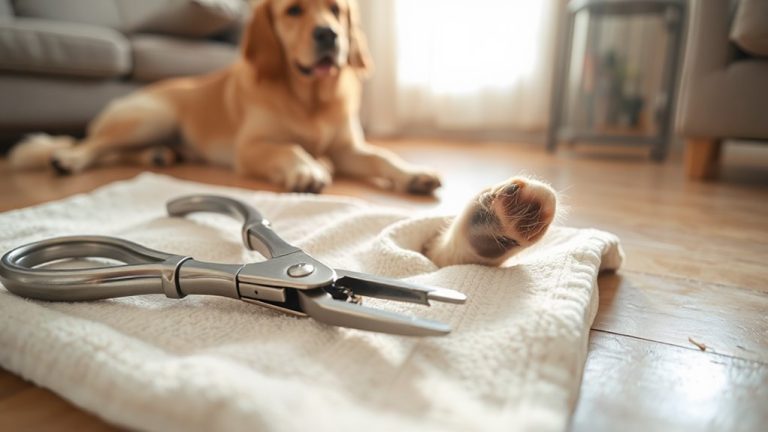
A quality nail trimmer is essential for maintaining your pet’s paw health and preventing injury. Choose tools based on your pet’s size, nail thickness, and temperament. Scissor vs. guillotine trimmers depends on control preference: scissor models offer precision and leverage, ideal for thick nails; guillotine types provide a clean, straight cut but require accurate nail placement. Scissor trimmers typically feature stainless steel blades and ergonomic handles for reduced hand fatigue. Guillotine clippers use a circular hole to guide the nail, with a sharp blade that slices downward-misalignment risks splitting the nail. Consider nail file options for smoothing rough edges post-trim. Manual files work well for small pets; electric grinders offer speed but demand noise tolerance. Select tools with safety stops to prevent over-cutting. Proper tool choice improves accuracy, reduces stress, and supports long-term paw wellness. For trusted options, check out the Best Cat Nail Trimmers.
Trim Pet Nails Safely: Step-by-Step
Why do so many pet owners struggle with nail trimming? Lack of technique and improper handling often lead to stress, injury, or incomplete cuts. Begin by securing your pet’s paw with firm paw position control-gently but firmly stabilize the foot to prevent slipping. Position the nail to avoid the quick, a blood-rich core inside the nail. Cut at a 45-degree angle, 2–3 mm from the quick’s visible end in light-colored nails. For dark nails, make small incremental cuts. Use a motorized tool with adjustable speed for precision. Always follow cutting with nail file safety-smooth sharp edges using a fine-grit rotary file at low RPM to prevent snags. File in one direction to avoid heat buildup. Maintain consistent pressure to avoid discomfort. Proper lighting and non-slipped tools increase accuracy. With steady hands and correct positioning, you guarantee a safe, effective trim every time. A high-quality dog nail file can make a significant difference in achieving smooth, safe results.
When to Trim Your Pet’s Nails
You’ve mastered the technique, but timing is just as important as method when it comes to keeping your pet’s nails at the right length. Nail growth patterns vary by species, breed, and activity level. Dogs typically need trimming every 3–4 weeks; cats every 2–3 weeks. Faster growth occurs in young and active animals due to increased blood flow. Watch for pet behavior changes-limping, skidding on floors, or reluctance to jump signal overgrowth. Overgrown nails alter paw alignment, leading to joint stress. For dogs, if nails touch the ground when standing, they’re too long. Most cats maintain rear nails shorter than front due to scratching behavior. Environmental factors like walking surfaces influence wear. Indoor pets need more frequent trims. Monitor weekly. Early intervention prevents complications. Regular assessment guarantees nails stay within functional length, promoting proper gait and paw health.
Stop Bleeding If You Cut the Quick
What happens if you nick the quick? You’ll see bleeding and your pet may flinch. The quick contains blood vessels and nerves, so cutting it causes pain and bleeding. Stay calm and apply first aid immediately. Use a styptic powder or other clotting agents like cornstarch or silver nitrate sticks. Styptic powders often contain ferric subsulfate or aluminum sulfate, which constrict blood vessels and accelerate clotting. Press the agent onto the nail tip for 30–60 seconds. Maintain firm pressure; most bleeds stop within two minutes. If bleeding persists beyond five minutes, contact your vet. Keep clotting agents on hand during every trim. These products are shelf-stable for up to three years when stored properly. Never wrap the paw tightly-this can cause swelling. Prevention is best, but knowing how to respond guarantees safety. Preparedness reduces stress for both you and your pet during accidents.
On a final note
Regular nail trimming prevents pain and maintains proper paw alignment. Overgrown nails alter your pet’s gait, increasing stress on joints and tendons. Use sharp, species-appropriate clippers: guillotine-style for small animals, rotary tools for thick nails. Trim every 3–4 weeks, cutting 2 mm from the quick to avoid bleeding. Apply styptic powder with benzoyl peroxide if bleeding occurs. Healthy nail length keeps the claw from touching the ground when standing.