Temperature Tolerance Ranges for Tropical Fish in Home Aquaria
Every degree outside the ideal range stresses tropical fish, so you need to maintain stable temperatures. Neon tetras thrive at 72–78°F, guppies at 74–82°F, angelfish at 78–84°F, discus at 82–88°F, and bettas at 76–81°F. Temperature shifts directly affect metabolism, oxygen levels, and immunity. Use a 3 to 5 watt-per-gallon heater, submersed fully and near the filter inlet. Pair a glass thermometer (±0.5°C accuracy) with a digital sensor (±0.1°C) placed away from the heater. Calibrate instruments every three months and use dual monitoring for reliability. Position new fish in sealed bags atop the tank for 20 minutes, then gradually mix tank water every 10 minutes for 30–60 minutes to match temperatures. When a heater fails or a power outage occurs, wrap the tank in towels and use warm water bottles-avoid sudden changes. Further details reveal how small errors cascade into systemic risks.
Notable Insights
- Tropical fish species have specific temperature ranges; for example, neon tetras thrive at 72–78°F, while discus require 82–88°F.
- Maintaining stable temperatures is critical, as fluctuations stress fish and compromise immune function.
- Water that is too warm reduces oxygen levels and increases metabolic demands, risking suffocation and exhaustion.
- Cold water slows digestion and metabolism, causing lethargy and appetite loss, especially in guppies below 72°F.
- Accurate monitoring with calibrated digital or glass thermometers ensures temperature remains within safe species-specific limits.
Why Temperature Matters for Tropical Fish
Every degree outside the ideal range can stress tropical fish, making temperature one of the most critical factors in aquarium management. You must maintain stable thermal conditions because fluctuations directly affect metabolic rate. When water’s too warm, oxygen levels drop while metabolic demands rise, forcing fish to burn energy faster. If it’s too cold, digestion slows and bodily functions lag. Both extremes compromise immune function, increasing susceptibility to pathogens like ich or fin rot. A stable temperature guarantees enzymes operate efficiently and cellular processes remain balanced. Even brief spikes or dips can impair gill function and oxygen transport. For most tropical species, sudden shifts beyond ±2°F (±1.1°C) from ideal trigger physiological distress. Reliable heaters with adjustable thermostats and accurate aquarium thermometers are essential. You’re not just regulating heat-you’re stabilizing biological systems. Proper thermal control supports long-term health by aligning environmental conditions with natural physiological needs. Selecting a high-quality saltwater aquarium heater ensures consistent and safe temperature regulation in marine environments.
Ideal Temperature Ranges by Common Species
Most tropical aquarium fish thrive within a narrow temperature band, and matching their specific needs is essential for long-term health. You should keep neon tetras between 72–78°F; outside this range, their immune function declines. Guppies do best at 74–82°F, a range that supports normal metabolic activity and encourages breeding seasons. Angelfish require 78–84°F to maintain ideal osmoregulation and reduce stress. For discus, set the thermometer to 82–88°F-this mimics Amazonian warm zones and aligns with natural seasonal behaviors. Betta splendens function well at 76–81°F, with temperatures below 74°F slowing digestion. Always research species-specific needs before stocking. Even slight variances can disrupt circadian rhythms, feeding patterns, and temperature-dependent enzyme activity. Stable conditions simulate natural habitats more accurately and sustain physiological balance over time.
How to Spot Temperature Stress in Fish
You can identify temperature stress in fish by observing changes in behavior and physical appearance that signal physiological imbalance. Fin clamping, where the fins remain tightly pressed to the body, is a common sign of distress. It often indicates the water is too cold or fluctuating beyond species-specific tolerance. Rapid gilling-excessively fast breathing movements-means oxygen exchange is impaired, usually due to high water temperatures reducing dissolved oxygen. Fish subjected to temperatures outside their ideal range experience compromised metabolism. For example, tetras exposed to temperatures above 86°F (30°C) show reduced activity within hours. Guppies below 72°F (22°C) display lethargy and appetite loss. These symptoms reflect systemic strain. Continuous exposure increases disease susceptibility. Monitor behavior daily. Act quickly if you observe fin clamping or rapid gilling. Early detection prevents mortality. Adjust temperature gradually, no more than 2°F (1.1°C) per hour, to avoid additional shock. Using a reliable inline aquarium heater helps maintain stable thermal conditions essential for tropical species.
Choose the Right Heater for Stability
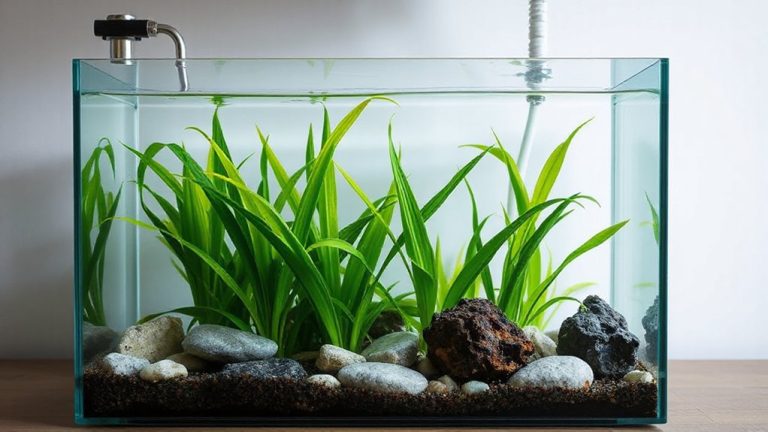
A reliable aquarium heater is essential for maintaining stable water temperature in tropical fish tanks. You need proper wattage selection to match your tank size-typically 3 to 5 watts per gallon. For a 20-gallon aquarium, a 75- to 100-watt heater suffices; larger tanks may require multiple units. This guarantees even heat distribution and prevents temperature swings. Heater placement affects efficiency. Install the unit near a filter inlet or water pump to circulate warm water evenly. Submersible heaters should remain fully immersed, positioned horizontally near the bottom for maximum convection flow. Avoid corners with poor water movement. Use heaters with built-in thermostats calibrated to ±0.5°F for precise control. Titanium heaters resist corrosion and suit saltwater and freshwater setups. Avoid glass units in tanks with large, active fish that may damage them. A consistent thermal environment supports metabolic function and reduces physiological stress in tropical species. Top-rated models offer advanced safety features and durability, making fish tank heater selection easier for long-term aquarium health.
How to Check Aquarium Temperature Accurately
Maintaining stable water temperature starts with precise measurement, not just proper heating. You need accurate tools to monitor conditions effectively. Glass thermometers are reliable and affordable, typically calibrated to ±0.5°C, offering consistent readings when mounted vertically on the tank’s exterior. They avoid electrical interference but require visual checks and can break. Digital sensors provide real-time data, often with external displays and alarms. Many connect to smart controllers, reporting temperatures to ±0.1°C accuracy. Submersible digital probes offer faster response times than adhesive strip thermometers. For best results, place sensors near the filter outlet, where water flow is constant. Avoid positioning near heaters or tank walls to prevent false highs. Use both glass thermometers and digital sensors together for cross-verification. This dual approach guarantees redundancy and improves long-term reliability in tracking your aquarium’s thermal stability. Calibration every three months is recommended.
Safely Acclimate New Fish to Tank Temperature
While transferring new fish directly into your main tank might seem convenient, doing so risks severe physiological stress due to abrupt temperature shifts. You must acclimate them slowly to prevent shock. Float the sealed transport bag on the tank’s surface for 15–20 minutes to equalize temperatures gradually. Then, every 5 minutes, add 1/4 cup of your tank water to the bag, repeating for 30–45 minutes. This method balances temperature and adjusts the fish to your water chemistry, including pH, hardness, and dissolved oxygen levels. Turn off tank lighting temporarily to reduce stress during transfer. Avoid pouring transport water into the aquarium to prevent contamination. Use a net to transfer the fish gently. The goal is thermal equilibrium-ideally within ±1°F (±0.5°C) of your established tank conditions-ensuring stability essential for sensitive tropical species.
Fix Sudden Temperature Fluctuations
What happens when your aquarium temperature swings more than 2°F (1.1°C) in a single hour? Sudden shifts stress fish, weaken immune systems, and can trigger disease outbreaks. To prevent harm, act quickly. If temperatures spike, use emergency cooling methods like turning off lights, opening the canopy, or floating sealed bags of ice (not directly adding ice). Replace 10–15% of water with cooler, dechlorinated water at tank pH. During heat, aim to reduce temperature no more than 2°F per hour. For drops, insulate the tank with blankets and use battery-operated heaters if needed. Power outage preparedness is critical-keep a thermometer, backup power supply, or generator ready. Monitor every 30 minutes. A stable thermal environment prevents shock. Prevention, through reliable equipment and planning, is more effective than intervention.
On a final note
You must maintain stable water temperatures to guarantee fish health. Tropical fish thrive within narrow thermal ranges, typically 75–82°F (24–28°C). Sudden shifts beyond ±2°F (±1.1°C) stress gills and immune function. Use a submersible heater with a +/- 0.5°F thermostat. Calibrate digital thermometers monthly. Acclimate new fish over 15–20 minutes using drip methods. Consistent monitoring prevents lethal fluctuations.