Space Requirements for Activity: Ensuring Adequate Room for All Your Pets
You need at least 60 minutes of daily exercise for large dogs, with a 4,000 sq ft fenced yard and 6 ft high barriers to prevent escapes. Cats require 18 sq ft each, vertical space up to 8 ft, and two scratching zones with sisal or cardboard. Rabbits need a 24×36×18 in cage plus 2 hours of daily exercise. Small mammals like guinea pigs need 7.5 sq ft each and 1–2 hours out daily. Secure zones, proper ventilation, and species-specific layouts guarantee safety and well-being-design details matter more than square footage alone.
Notable Insights
- Large dog breeds need at least 60 minutes of daily exercise and 40 sq ft of movement space indoors.
- Cats require vertical territory with shelves every 3–5 ft and a minimum of 18 sq ft per cat.
- Secure 6-ft-high fencing is essential for active or jump-prone dogs to safely access outdoor space.
- Small mammals like guinea pigs need 7.5 sq ft each and 1–2 hours of daily exercise outside their cage.
- Maximize space efficiency with multi-functional furniture and vertical landscaping for climbing and activity.
How Much Space Do Dogs Really Need?
How much space does your dog actually need to thrive? It depends on breed, size, and energy level. Large, active breeds require a minimum of 60 minutes of daily exercise and substantial outdoor access to meet their exercise needs. A fenced yard of at least 4,000 square feet is ideal for high-energy dogs like Border Collies or German Shepherds. Smaller or low-energy breeds may adapt to apartments if provided with two 20-minute walks daily. Without regular physical activity, dogs can develop behavioral issues. Outdoor access must be secure, with fencing at least 6 feet high for jump-prone breeds. Artificial turf spaces of 100–200 square feet can supplement outdoor needs in urban settings. Exercise needs correlate directly to mental and physical health. Proper space supports joint function, cardiovascular fitness, and behavioral stability. Access to safe, consistent outdoor areas guarantees adequate stimulus and eliminates reliance on indoor potty solutions.
How Much Space Do Cats Need to Stay Happy?
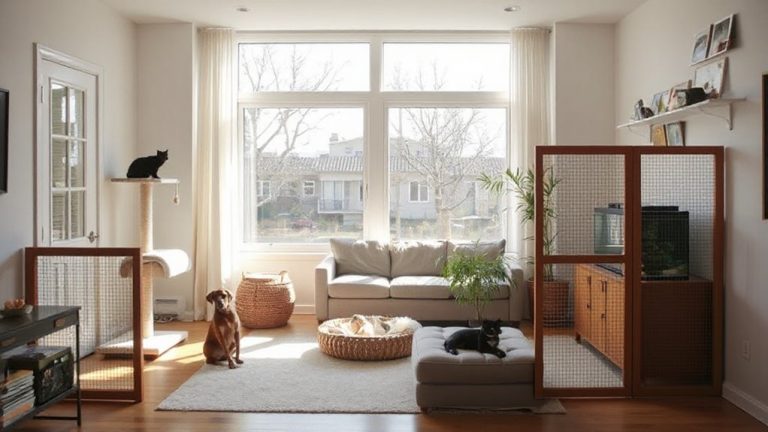
Where should your cat roam to stay both safe and mentally stimulated? Indoor environments must include vertical territory to meet feline spatial needs. Cats require access to elevated areas, ideally 6–8 feet above ground, such as cat shelves or multi-level towers, to observe their surroundings and retreat when stressed. Each cat needs at least 25 square feet of dedicated living space with clear pathways between zones. Include at least two scratching zones per cat-placed near resting and high-traffic areas. Scratching zones must offer both horizontal and vertical surfaces, using materials like sisal or corrugated cardboard, measuring a minimum of 18 inches in length. These zones maintain claw health and mark territory via pheromones. Proper air circulation, litter box separation, and visual barriers further enhance spatial functionality. Environmental enrichment within confined areas reduces stress-related behaviors. Space quality outweighs sheer square footage. Regular grooming with a best detangling dog brush can minimize loose fur that might otherwise accumulate in your cat’s environment, potentially reducing allergens and improving air quality.
Space Requirements for Rabbits and Rodents
While their small size might suggest otherwise, rabbits and rodents need surprisingly spacious and well-structured environments to thrive. Proper cage size directly impacts physical health and behavioral stability. You must provide enough room for movement, exploration, and instinctive behaviors like burrowing or hopping. Exercise frequency should be at least two hours daily outside the enclosure, under supervision. Inadequate space leads to stress, obesity, and skeletal issues. Stacking habitats can help maximize vertical space and meet these requirements efficiently using stackable small animal habitats.
| Species | Cage Size (L×W×H) | Exercise Frequency |
|---|---|---|
| Rabbit | 24×36×18 in | 2+ hours daily |
| Guinea Pig | 30×36 in | 1–2 hours daily |
| Hamster | 24×12×12 in | 1 hour nightly |
| Rat | 24×16×20 in | 1–2 hours daily |
| Gerbil | 20×10×12 in | 1 hour nightly |
Ensure enclosures allow for multi-level movement, bedding depth, and environmental enrichment.
Balancing Pet Space in Multi-Pet Homes
Why do some multi-pet households thrive while others descend into chaos? The answer lies in intentional space sharing and pet harmony. You must allocate distinct zones for each pet based on species-specific needs. For example, cats require vertical space-minimum 18 square feet per cat with shelves at 3- to 5-foot intervals. Dogs need defined floor areas; large breeds require at least 40 square feet for unrestricted movement. Small mammals like guinea pigs need 7.5 square feet each. Overlapping territories increase stress, leading to conflict. You can achieve balance by using barriers-gates should be 30 inches high for cats, 42 inches for dogs. Proper ventilation (minimum 10 air changes per hour) and noise reduction (under 60 dB) support cohabitation. Pet harmony depends not on closeness, but on well-planned separation and sufficient, species-appropriate space sharing.
Maximizing Room for Pets in Apartments
If you’re raising pets in an apartment, optimizing limited square footage is essential for their health and behavior. Vertical landscaping allows pets to engage with elevated spaces, improving air circulation and reducing floor clutter. These installations typically measure 12–24 in × 36–72 in and support climbing plants or cat-safe foliage. Compact litter solutions include self-cleaning units with odor-seal technology, measuring as small as 16 in × 18 in, ideal for studio layouts. Use multi-functional furniture with hidden pet zones to maintain spatial efficiency. Always prioritize non-toxic materials and load-rated stability in elevated designs. Maximize vertical territory, especially for cats, which instinctively use height for surveillance and stress reduction. Investing in the best pet furniture for apartments can further enhance comfort and functionality without sacrificing style or space.
On a final note
You must assess each pet’s species-specific needs to guarantee adequate space. Dogs require a minimum of 250 square feet per 50 pounds of body weight for healthy movement. Cats need vertical space-cat trees should be at least 6 feet tall. Rabbits need 12 square feet of floor space plus exercise runs. In apartments, multi-level enclosures save space. Always prioritize enrichment-compatible dimensions over minimum survival areas.