Optimal Water Quality Standards for Freshwater Fish Aquariums: A Guide
You must keep ammonia at 0 ppm to prevent gill damage and maintain nitrite at 0 ppm to avoid impaired oxygen transport. Nitrates should stay below 40 ppm through weekly 20–25% water changes. Temperature stability between 72–80°F (22–27°C) supports metabolic health, while pH remains stable between 6.5–7.8. Carbonate hardness (KH) of 3–10 dKH buffers pH swings. Biological filtration with ceramic media hosts *Nitrosomonas* and *Nitrobacter* to convert toxins efficiently. Consistent testing and maintenance prevent stress and disease, ensuring long-term aquarium success. Further details reveal even greater precision in system balance.
Notable Insights
- Maintain 0 ppm ammonia to prevent gill damage and ensure fish health.
- Keep nitrite at 0 ppm to avoid impaired oxygen transport in fish blood.
- Control nitrates below 40 ppm through weekly 20–25% water changes.
- Stabilize pH between 6.5 and 7.8, prioritizing consistency over exact values.
- Sustain carbonate hardness (KH) between 3–10 dKH to buffer pH effectively.
Test 5 Essential Water Parameters (And What Levels Are Safe)
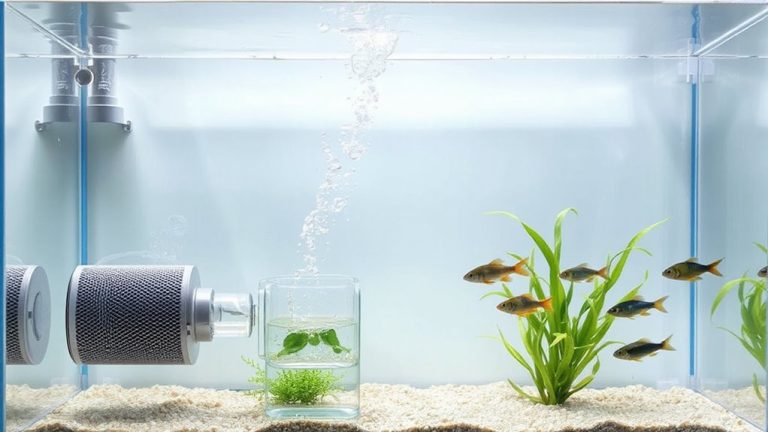
How do you know if your aquarium water is truly safe for fish? You test five essential parameters regularly. Ammonia must be 0 ppm-any detectable level risks gill damage. Nitrite should also read 0 ppm, as it disrupts oxygen transport in fish blood. Nitrates, less toxic, should stay under 40 ppm, ideally through weekly water changes. Temperature fluctuations stress fish; maintain a stable range specific to your species, usually 72–80°F (22–27°C), using a reliable heater and thermometer. Water hardness, measured in dGH (degrees General Hardness), affects osmoregulation. Most tropical fish thrive between 4–8 dGH. Sudden shifts in hardness or temperature weaken immune responses. Use a liquid test kit for accuracy-it’s more precise than strips. Test weekly. Stable, safe water isn’t accidental. It’s the result of consistent monitoring and adjustments tailored to your tank’s ecosystem. You control the environment. Make it count. A properly functioning aquarium filter ensures continuous removal of toxins and maintains optimal water quality.
Keep Your Freshwater Aquarium pH Stable
While your aquarium may appear calm, pH fluctuations can stress fish and destabilize the biological balance without visible signs. pH measures the acidity or alkalinity of water on a scale from 0 to 14, with 7.0 considered neutral. Most freshwater fish thrive between 6.5 and 7.8, but stability matters more than the exact number. Rapid shifts impair gill function and compromise immunity. You need consistent pH buffering to prevent swings. Carbonate hardness (KH) is the foundation of pH stability-it resists acidification by neutralizing hydrogen ions. Alkalinity monitoring lets you track KH levels, ideally between 3–10 dKH (50–180 ppm). Test weekly with a calibrated liquid reagent kit. If KH drops below 3 dKH, add crushed coral or a commercial buffer to restore capacity. Avoid sudden corrections; adjust pH gradually over 48 hours. Regular water changes with properly conditioned tap water maintain long-term stability.
Eliminate Ammonia, Nitrite, and Nitrate Safely
Toxic nitrogen compounds are invisible threats lurking in every freshwater aquarium. You must eliminate ammonia, nitrite, and nitrate to protect fish health. Biological filtration is your primary defense-it uses beneficial bacteria (like *Nitrosomonas* and *Nitrobacter*) to convert toxic ammonia into nitrite, then into less harmful nitrate. This process, called nitrification, occurs in media with high surface area, such as ceramic rings or bio-balls, housed in filters operating at 6.5–8.0 pH and 72–82°F. Even with efficient biological filtration, nitrate accumulates over time. That’s where chemical filtration helps. Use adsorbent resins or ion-exchange media like activated carbon or specialized nitrate-removing resins. These bind nitrogen compounds, reducing nitrate to safe levels below 20 ppm. Combine both filtration types to maintain ideal nitrogen control and guarantee long-term water stability. Top-performing systems often include a fish filter designed specifically for biological and chemical media stages.
Follow This Weekly Water Quality Routine
Regularly testing and adjusting key water parameters guarantees your aquarium remains stable and safe for aquatic life. Test pH, ammonia, nitrite, nitrate, and hardness weekly using a liquid test kit for accuracy. Perform 20–25% water changes every seven days to reduce toxin accumulation and replenish essential minerals. Use a gravel vacuum during water changes to remove detritus without disturbing beneficial bacteria. Conduct filter maintenance monthly-rinsing mechanical media in dechlorinated tank water preserves biofilm. Never replace all filter media at once; stagger replacements to maintain biological filtration. Check flow rate and pump performance during maintenance to guarantee efficient circulation. Keep a log to track parameter trends and detect deviations early. Proper water changes and filter maintenance prevent system crashes. These actions sustain nitrification efficiency and support long-term aquarium stability. Consistency in routine guarantees reliable water quality week after week. For precise results, choose a high-quality aquarium water test kit that covers all essential parameters.
Why Water Quality Determines Fish Health
When water conditions fall outside the ideal range, even hardy fish experience stress that weakens their immune systems and increases disease susceptibility. Poor water quality directly alters fish behavior, causing lethargy, rapid gilling, or erratic swimming. These signs indicate physiological distress from elevated ammonia, nitrite, or improper pH levels. Ammonia above 0.25 ppm damages gill tissues, reducing oxygen uptake. Nitrite concentrations over 0.5 ppm inhibit blood’s oxygen-carrying capacity. Stable pH between 6.5 and 7.8 suits most freshwater species. Maintaining these parameters supports natural fish behavior and aids disease prevention. Beneficial bacteria in mature filters convert ammonia to less toxic nitrates, which should remain under 40 ppm. Regular 25% water changes every seven days dilute accumulated toxins. Consistent monitoring with a liquid test kit-accuracy ±0.05 ppm for ammonia-ensures early problem detection. Best water quality isn’t just clean-it’s chemically balanced, biologically stable, and essential for long-term fish health.
On a final note
You maintain fish health by controlling key water parameters. Keep pH between 6.5 and 7.5, stable within 0.2 units daily. Ammonia and nitrite must read 0 ppm; even 0.25 ppm stresses gills. Limit nitrate to under 40 ppm, ideally 20 ppm with weekly 25% water changes. Test with liquid kits accurate to ±0.05 ppm. Reliable heaters and filters guarantee consistent conditions. Water quality directly impacts immune function. Monitor rigorously-it prevents 90% of common diseases.