Best Internal Filters for Aquariums That Keep Water Crystal Clear
You keep water crystal clear with internal filters that combine mechanical, biological, and chemical filtration. Models like the NICREW Magi 200 deliver 53 GPH for 5–10 gallon tanks, using fine foam and activated carbon. The Fluval U3 supports tanks up to 40 gallons with a media trap and replaceable cartridge. High-flow options like the 320 GPH submersible filter handle 50–150 gallon systems. All operate under 35dB and use multi-stage filtration to remove debris, ammonia, and discoloration. Each includes adjustable flow and suction cup mounting. You maintain ideal circulation and clarity across diverse tank sizes. Discover how specific models match your tank’s bioload and filtration needs.
We are supported by our audience. When you purchase through links on our site, we may earn an affiliate commission, at no extra cost for you. Learn more. Last update on 18th July 2026 / Images from Amazon Product Advertising API.
Notable Insights
- Choose internal filters with multi-stage filtration to effectively remove debris, toxins, and impurities for crystal-clear water.
- Opt for models with adjustable flow control to customize circulation without overwhelming small or sensitive tanks.
- Select filters with fine mechanical media like sponges or mesh to trap tiny particles and enhance water clarity.
- Prioritize quiet operation below 35dB to maintain a peaceful environment while ensuring continuous filtration performance.
- Match filter flow rate to tank size, aiming for 4–5x hourly turnover to sustain optimal water quality and clarity.
NICREW Aquarium Internal Filter 5-10 Gallon

If you own a small aquarium between 5 and 10 gallons, the NICREW Aquarium Internal Filter (Magi 200) is an efficient choice for maintaining clean, well-oxygenated water. I rely on its 5W motor to deliver 53 GPH, ensuring steady circulation. It supports biological and chemical filtration using activated carbon and fine filter foam to trap debris and absorb odors. An adjustable air regulator lets me fine-tune flow, creating a gentle current ideal for shrimp and small fish. The submersible design measures 6.3 x 4.02 x 1.81 inches, weighs 9.5 oz, and mounts securely with four suction cups. It works in both freshwater and saltwater setups.
Best For: Small aquarium owners with 5-10 gallon freshwater or saltwater tanks seeking reliable, adjustable filtration and oxygenation for delicate fish and shrimp.
Pros:
- Provides efficient biological and chemical filtration with activated carbon and fine foam to trap debris and control odors
- Adjustable air regulator allows customizable flow for gentle water movement ideal for sensitive aquatic life
- Easy to install and maintain with secure suction cup mounting and submersible compact design
Cons:
- Flow rate may be too low for heavily stocked tanks or larger aquariums beyond 10 gallons
- Plastic construction may be less durable compared to higher-end models over extended use
- Some users report noise from bubbles or airflow when regulator is set to maximum
Fluval U3 Underwater Filter for Aquariums

The Fluval U3 Underwater Filter stands out for hobbyists managing diverse aquatic environments, whether I’m maintaining a compact freshwater tank or a saltwater system under 40 gallons. It works as a primary filter in smaller setups or boosts filtration in larger systems. Its sleek housing fits tight spaces, and the easy-grip control panel lets me adjust flow without tools. I appreciate the flip-top lid-it gives instant access to the cartridge. The redesigned media trap captures more debris, extending maintenance intervals. I can mount it horizontally for shallow tanks or create a waterfall effect. Vertical placement drives currents along the tank wall, improving water circulation and surface agitation.
Best For: Aquarists with small to medium tanks who need a versatile, efficient, and space-saving filtration solution for freshwater, saltwater, or reptile habitats.
Pros:
- Suitable for a variety of environments including freshwater, saltwater, and reptile tanks up to 40 gallons
- Flexible mounting options allow for horizontal or vertical placement to optimize water flow and surface agitation
- Tool-free maintenance with flip-top lid and easy-grip control panel for quick cartridge access and flow adjustment
Cons:
- Limited to smaller tanks, making it unsuitable as a primary filter for large aquariums
- Cartridge-based filtration may require frequent replacements depending on bioload
- Higher initial cost compared to basic sponge or hang-on-back filters
Tetra Whisper Internal Power Filter 5-10 Gal
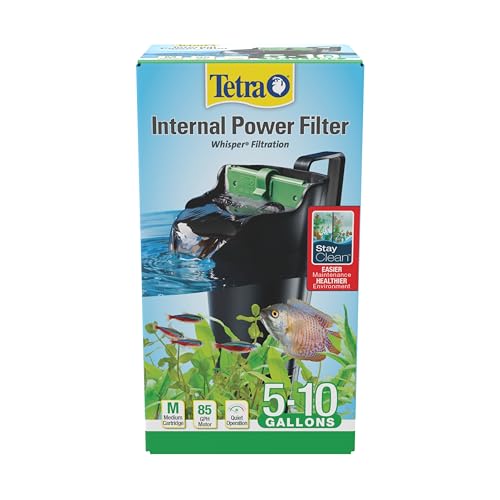
I rely on the Tetra Whisper Internal Power Filter 5 To 10 Gallons, Model 10i, when stocking small aquariums up to 10 gallons that need dependable, space-efficient filtration. It delivers 80 gallons per hour of flow, powered by an air-driven system that simultaneously filters and aerates. The dual-sided mesh traps debris and waste effectively. It uses a medium Bio-Bag cartridge for biological and mechanical filtration, which is easy to replace. The internal design mounts flush with the tank wall via a suction cup clip, saving space. Its compact form suits nano setups without sacrificing performance. I’ve found it runs quietly and maintains consistent water clarity.
Best For: Small aquarium owners with tanks between 5 to 10 gallons seeking a quiet, compact, and efficient filtration and aeration solution.
Pros:
- Delivers powerful 80 GPH flow with simultaneous filtration and aeration via air-driven system
- Space-saving internal design mounts flush to the tank wall, ideal for nano and small setups
- Easy maintenance with replaceable medium Bio-Bag cartridges and dual-sided debris-trapping mesh
Cons:
- Requires separate air pump purchase for operation, not included with filter
- Bio-Bag cartridges may need frequent replacement in heavily stocked tanks
- Not suitable for tanks larger than 10 gallons due to limited capacity
Submersible Fish Tank Filter 320 GPH
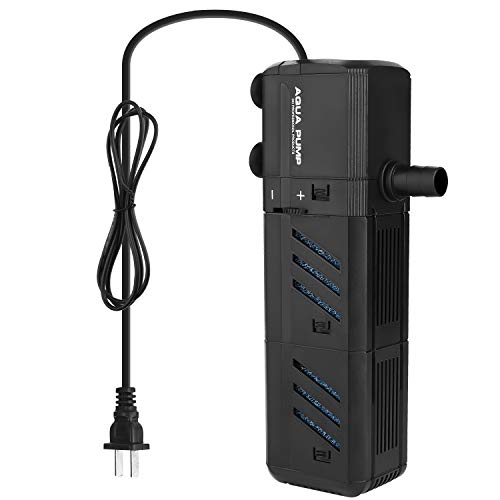
You’ll find the Submersible Fish Tank Filter 320 GPH ideal if your aquarium ranges from 50 to 150 gallons and you demand consistent, quiet performance. I rely on its 12W motor to deliver a maximum flow rate of 320 GPH (1200L/H). It lifts water up to 3.9 feet, with a 1.6-meter power cord for flexible setup. Its adjustable pump lets me fine-tune water flow. Four nozzles provide configuration options. I use mechanical, chemical, and biological media for complete filtration. It works well with fish and turtles. I appreciate the 180-day warranty covering repairs or maintenance for defects.
Best For: Aquarists with 50-150 gallon tanks seeking a quiet, adjustable, and multi-stage filtration system for fish or turtles.
Pros:
- Delivers strong 320 GPH flow with adjustable pump for customized water circulation
- Supports mechanical, chemical, and biological filtration with flexible nozzle configurations
- Ultra-quiet operation and 180-day warranty for reliable performance and peace of mind
Cons:
- Submersible design may require more frequent cleaning in heavily stocked tanks
- 3.9-foot maximum lift limits placement in taller or sump-style setups
- 1.6-meter power cord may be restrictive for certain aquarium arrangements
Tetra Whisper Internal Filter 20-40 Gal

Perfect for aquarium owners managing tanks between 20 and 40 gallons, the Tetra Whisper 40i stands out as a top-tier internal filter by combining filtration and aeration in one compact unit. It’s an all-in-one system with a built-in air pump that mounts inside your tank using a space-saving clip. Its air-driven design delivers up to 170 gallons per hour (GPH), ensuring strong circulation. Dual-sided mesh traps debris, waste, and fine particles effectively. The filter also oxygenates water, boosting gas exchange. I replace Bio-Bag cartridges easily, and its low profile lets me place the tank flush against walls.
Best For: Aquarists with 20- to 40-gallon tanks seeking a compact, all-in-one filtration and aeration solution.
Pros:
- Combines high-performance filtration and aeration in a single internal unit
- Delivers strong water flow with 170 GPH for excellent tank-wide circulation
- Easy maintenance with simple Bio-Bag cartridge replacements and a space-saving design
Cons:
- Limited to smaller tanks up to 40 gallons, not suitable for larger aquariums
- Air-driven design may require air pump maintenance or tubing adjustments
- Internal placement takes up in-tank space compared to external filters
Aquarium Filter 4-in-1 for 30-80 Gal

While compact enough for mid-sized setups, the Aquarium Filter 4-in-1 delivers robust performance suited for experienced hobbyists managing 30-80 gallon freshwater, saltwater, or turtle tanks. I rely on its 200 GPH flow rate to maintain strong water circulation and ideal dissolved oxygen levels. Its 2-stage dual-layer filtration removes debris, waste, and fine particles effectively. The modular design lets me customize filtration with single or dual-layer setups. An adjustable air inlet valve gives me precise oxygen control for diverse species. It runs below 35dB-quiet enough for any room. For larger tanks, I use two units to boost stability. Cleaning is simple: just rotate the base to replace media.
Best For: Experienced hobbyists with 30-80 gallon freshwater, saltwater, or turtle tanks seeking powerful, quiet, and customizable filtration.
Pros:
- Delivers 200 GPH flow rate with efficient 2-stage dual-layer filtration for clean, clear water
- Ultra-quiet operation below 35dB, ideal for home or office environments
- Modular design and adjustable oxygen control allow customization for diverse aquatic setups
Cons:
- May require a second unit for optimal performance in larger tanks (60-80 gallons)
- Replacement filter media not included in initial purchase
- Base rotation mechanism for cleaning may wear over extended use
NICREW Aquarium Internal Filter 40 GPH
The NICREW Aquarium Internal Filter 40 GPH stands out for compact tank enthusiasts seeking reliable, low-profile filtration in micro-aquariums. I use this submersible filter in tanks 2 to 5 gallons, and its 40 GPH flow rate keeps water moving efficiently. It draws just 3.5W, making it energy-efficient. The Magi mini model (ASIN B09DPHDF8Z) weighs 9.1 ounces and measures 6.26 x 3.94 x 1.93 inches. Its plastic body houses fine foam for biological filtration, trapping debris and absorbing odors. I’ve found it enhances oxygen levels by producing steady bubbles. An adjustable air regulator lets me control flow-ideal for shrimp and sensitive fish. I install it quickly using four suction cups. It works in both freshwater and saltwater. With over 5,000 reviews, its consistent ratings reflect dependable performance. I clean it easily during routine maintenance.
Best For: Small aquarium owners with 2 to 5 gallon tanks seeking a compact, energy-efficient internal filter that ensures gentle flow and reliable biological filtration.
Pros:
- Provides effective biological filtration and debris trapping with fine filter foam
- Adjustable air regulator allows customized flow and aeration, safe for shrimp and delicate fish
- Easy to install with suction cups and simple maintenance for routine cleaning
Cons:
- Limited to small tanks (2–5 gallons), not suitable for larger aquariums
- Plastic construction may be less durable compared to higher-end models
- 40 GPH flow rate may require careful adjustment to avoid strong currents in nano tanks
Aquarium Filter 4-in-1 for 10-30 Gal
You’ll find the Aquarium Filter 4-in-1 for 10-30 gallon tanks especially useful if you maintain compact aquatic environments needing efficient filtration, aeration, and circulation in one unit. I rely on the BlueYu πF-8808-EX to deliver 130 GPH of flow, ensuring strong water movement and ideal oxygen levels. Its submersible design saves space and operates below 35dB, making it nearly silent. The adjustable air inlet fine-tunes oxygenation, while the four-stage system filters debris, waste, and particles efficiently. It works in freshwater, saltwater, and turtle tanks. I recommend pairing two units for tanks over 30 gallons to maintain crystal-clear water and stable conditions.
Best For: Aquarists with 10–30 gallon freshwater, saltwater, or turtle tanks seeking a quiet, all-in-one filtration, aeration, and circulation solution.
Pros:
- Combines 4 functions-filtration, oxygenation, water circulation, and wave-making-for comprehensive aquarium maintenance
- Ultra-quiet operation below 35dB, ideal for home or office environments
- Adjustable air flow and submersible design offer flexible, space-saving installation
Cons:
- Maximum recommended for 30-gallon tanks; larger tanks require a second unit for optimal performance
- Plastic construction may be less durable compared to higher-end models
- Limited information on long-term reliability beyond the 1-year warranty period
Pawfly Aquarium Filter for 3-10 Gallon Tanks

I find the Pawfly Aquarium Filter ideal for small tank owners needing efficient, low-maintenance filtration in systems from 3 to 10 gallons. It’s a submers coordinate internal filter with a fine sponge that delivers mechanical and biological filtration. The sponge traps debris and protects shrimp or fry. A 55 GPH pump guarantees strong circulation. You can switch between drenching and spraying outlets. An adjustable knob controls flow intensity. Clear airline tubing pulls air to boost oxygen levels. Bubbles enhance gas exchange. It measures 1.4 W x 4.9 H inches. The 3 W motor is energy-efficient. You can detach the pump and filter easily. Remove the impeller and bottom covers for cleaning. Rinse the sponge every two weeks with aquarium water only.
Best For: Small aquarium owners seeking efficient, low-maintenance filtration for tanks between 3 and 10 gallons, especially those keeping shrimp or fry.
Pros:
- Combines mechanical and biological filtration with a fine sponge that protects delicate aquatic life
- Adjustable flow control and dual outlet options enhance water circulation and oxygenation
- Easy to disassemble and clean, with detachable pump and removable covers
Cons:
- Limited to small tanks up to 10 gallons, not suitable for larger aquariums
- Sponge requires rinsing every two weeks, which may be frequent for some users
- Plastic construction may be less durable over time compared to higher-end models
Aquarium Filter for 55-150 Gallon Tanks

A high-performance internal filter becomes essential when maintaining large aquariums between 55 and 150 gallons, where water quality directly impacts aquatic health. I rely on a 300 GPH water pump matched to this range, ideal for big fish tanks, turtle enclosures, or small ponds. It uses dual-stage black biochemical sponge filtration to trap debris and break down odors, ensuring crystal-clear water. An adjustable valve boosts oxygen intake, promoting lively, healthy fish. The unit creates strong water movement, enhancing surface agitation and circulation. Its body detaches and adjusts-you can lay it flat or remove the lower sponge for tanks under 15 inches.
Best For: Aquarists maintaining large aquariums (55-150 gallons), turtle tanks, or small ponds who need powerful filtration and efficient water circulation.
Pros:
- High 300 GPH pump capacity ensures effective filtration for large tanks
- Dual-stage biochemical sponge provides thorough mechanical and biological filtration
- Adjustable design allows installation flexibility, including laying flat or modifying height
Cons:
- May be too large or powerful for smaller aquariums under 55 gallons
- Requires regular maintenance to prevent clogging of the sponge media
- Adjustable valve and flow settings may need frequent tweaking for optimal performance
Factors to Consider When Choosing an Internal Filter for Aquarium
You need to match your internal filter to your tank size for effective water circulation and filtration. Look for models with adjustable flow rates-this lets you control water movement without overwhelming fish, especially in smaller or heavily stocked tanks. Also, check the decibel rating; many quality filters run under 30 dB, making them quiet enough for bedrooms or offices.
Tank Size Compatibility
Selecting the right internal filter begins with matching its flow rate to your aquarium’s water volume. You need a filter that turns over the entire tank volume 4–5 times per hour. For small tanks (5–10 gallons), pick a filter with a 40–80 GPH flow rate-this guarantees gentle yet effective circulation. If you have a medium tank (20–40 gallons), aim for around 170 GPH to maintain clarity and even water movement. Larger tanks (50–150 gallons) demand at least 200 GPH to manage waste and stabilize conditions. Filters rated below 200 GPH won’t handle heavy bio loads in big tanks. Oversized filters can create strong currents that stress fish. Matching capacity to tank size prevents under-filtration, which clouds water, and over-filtration, which disturbs aquatic life. Choose wisely to keep your system balanced and your water crystal clear.
Filtration Type Options
What kind of filtration does your aquarium truly need? Mechanical filtration captures debris, fish waste, and particulates using dense sponges or mesh as water flows through. This keeps your tank visibly clean. Biological filtration relies on porous media-like foam or sponge-where beneficial bacteria colonize and convert toxic ammonia into nitrites, then nitrates. It’s essential for a healthy nitrogen cycle. Chemical filtration uses activated carbon or similar media to absorb odors, discoloration, and dissolved pollutants, improving water clarity and quality. Many internal filters combine all three types into a multi-stage system, offering complete water purification. Modular designs let you customize filter media based on your tank’s needs. You can remove or add layers depending on bioload, stocking levels, or water conditions. Choosing a filter with all three filtration types guarantees balanced, efficient performance and long-term aquarium stability.
Flow Rate Adjustment
How much water movement does your aquarium actually require? Adjustable flow rate control lets you customize water circulation to match your tank’s needs. You can typically adjust the flow using a control knob or air regulator, giving you precise command over current intensity. Some internal filters offer multiple outlet nozzles or directional settings, letting you shape flow patterns effectively. This flexibility is essential if you keep delicate species like shrimp or fry, which thrive in low-current environments. At the same time, proper flow guarantees even oxygen distribution and prevents stagnant zones. Aim for a turnover rate of 5 to 10 times your tank’s volume per hour, adjusting downward for gentle circulation. Don’t overlook flow customization-it’s key to balancing biological efficiency with species-specific needs. A filter with fine-tuned control adapts easily as tank conditions change.
Noise Level Consideration
Why should you care about noise when setting up your aquarium filter? You want a peaceful space, and filters under 35dB are ultra-quiet, perfect for homes or offices. Submersible internal filters run quieter than externals because water dampens sound directly around the unit. You’ll benefit from high-efficiency pumps designed to minimize vibration, cutting down on operational noise. Look for models with adjustable flow controls-they reduce water turbulence, which lowers sound output. Proper placement matters too. You can stop rattling by securing the filter with suction cups to prevent movement against the tank wall. Even small vibrations can amplify noise if the unit isn’t stable. Quieter filters use engineering that prioritizes acoustic comfort without sacrificing performance. You get effective filtration without constant background hum. Choose wisely-your ears and fish will appreciate the calm.
Installation Ease
While you’re setting up your aquarium, choosing an internal filter that installs easily saves time and effort without compromising functionality. Most models use strong suction cups to mount securely on glass or acrylic, requiring no tools for attachment. You simply press the unit in place below the waterline for immediate operation. Their compact, submersible design allows flush positioning against the tank wall, saving space and reducing visual clutter. Placement near the bottom guarantees efficient water intake and even circulation. Many filters feature modular parts that snap together quickly, letting you assemble or service them without instructions or special tools. Since they run fully submerged, all you need is power and proper positioning. Installation typically takes under five minutes, making these units ideal for beginners and experienced aquarists alike. No drilling, plumbing, or complex setup is required.
Frequently Asked Questions
How Often Should I Replace the Filter Media?
You should replace mechanical filter media every 2–4 weeks, biological media every 6–12 months, and chemical media like activated carbon every 3–4 weeks. Mechanical sponges trap debris and clog quickly. Biological media, such as ceramic rings, harbor beneficial bacteria and last longer. Chemical media lose adsorption capacity over time. Always rinse biological media in old tank water to preserve bacteria. Never replace all media at once-stagger changes to maintain stable water conditions.
Can Internal Filters Work in Saltwater Aquariums?
Yes, you can use internal filters in saltwater aquariums, but you must choose models built for saltwater corrosion resistance. Look for filters with ceramic shafts, silicone seals, and non-corrosive plastics. They handle mechanical and biological filtration well in small to medium tanks under 30 gallons. However, they don’t replace protein skimmers. You still need chemical filtration and regular maintenance to manage nitrates and phosphates effectively in marine environments.
Do I Need an Air Pump With an Internal Filter?
No, you don’t need an air pump with an internal filter if your filter has a built-in air intake or creates sufficient surface agitation. Most internal filters, like the Eheim Pick Up or Tetra Tech, combine filtration and water movement, oxygenating the tank naturally. They draw water through sponge, carbon, and biomedia layers, then expel it with enough force to ripple the surface-this gas exchange maintains oxygen levels. Add an air pump only if your tank is overcrowded, heavily stocked, or in a warm environment where oxygen solubility drops.
Are Internal Filters Safe for Shrimp and Fry?
Yes, internal filters are safe for shrimp and fry if you use sponge pre-filters or intake guards. Without protection, strong suction can harm small organisms. Most modern internal filters draw water at 50–200 liters per hour, which poses risks to tiny fry. Attach a fine-pore sponge to the intake to reduce flow and prevent injury. This setup maintains effective filtration while protecting delicate inhabitants, much like a safety screen on a fan. Always check flow rate and intake design before use.
Can I Use Multiple Internal Filters in One Tank?
Yes, you can use multiple internal filters in one tank. Running more than one boosts filtration capacity and redundancy. Match flow rates to tank size-don’t exceed 5x turnover per hour. Position units to avoid dead zones and guarantee even water movement. Use filters with sponge pre-filters to protect fry and shrimp. Synchronize maintenance schedules to preserve beneficial bacteria. Multiple units increase reliability and support higher bio-loads effectively.