Lighting Needs and Photoperiods for Reptiles in Captivity: A Comprehensive Overview
You need proper lighting to maintain your reptile’s metabolism, digestion, and immune function. UVB exposure between 290–320 nm enables vitamin D3 synthesis for calcium absorption. Provide 10–14 hours of light daily using timers for consistency. Desert species like bearded dragons require UVI 3.0–4.0 and basking temps of 100–110°F; tropical species need UVI 1.0–2.0. Use T5 fluorescent tubes for even UVB coverage, replace bulbs every 6–12 months, and avoid glass or plastic barriers. Thermal gradients of 10–15°F support health. Adjust photoperiods seasonally to influence breeding or brumation behaviors. Optimizing these factors enhances long-term physiological balance. Further details reveal how precise setup choices impact overall wellness.
Notable Insights
- UVB lighting (290–320 nm) is critical for vitamin D3 synthesis, enabling calcium absorption and preventing metabolic bone disease.
- Desert reptiles need UVI 3.0–4.0 and basking temps of 95–110°F, while tropical species require lower UVI and temps.
- T5 fluorescent UVB tubes provide strong, even coverage for tall enclosures and should be replaced every 6–12 months.
- A consistent 10–14 hour daily photoperiod regulated by timers supports circadian rhythms and metabolic health.
- Seasonal light cycle adjustments can promote natural behaviors like breeding or brumation in species such as bearded dragons.
Why Reptile Lighting Affects Health
Light matters-especially when it’s for a reptile that depends on it to survive. Proper lighting directly influences metabolic function, enabling digestion and energy regulation. Without adequate full-spectrum lighting, your reptile can’t process food efficiently, leading to stagnation and malnutrition. UVB exposure between 290–320 nm wavelength is critical for vitamin D3 synthesis, which aids calcium absorption. This process supports bone health and boosts immune support by reducing infection susceptibility. Daily light cycles of 10–14 hours regulate circadian rhythms, maintaining hormonal balance. Chronic exposure to inadequate lighting suppresses immune response and slows metabolism. Reptiles like bearded dragons and leopard geckos require 5–7% UVB output for ideal physiological function. LEDs or fluorescent tubes with a color temperature of 5000–6500K simulate natural daylight, promoting alertness and activity. Consistent photoperiods and appropriate light intensity-measured in lux or lumens-ensure stable metabolic function and long-term immune support. For optimal UVB exposure, selecting the right bulb is essential, and the best UVB bulbs are specifically designed to meet the needs of reptiles like bearded dragons.
Match UVB and Heat to Your Reptile’s Habitat
While your reptile’s natural habitat sets the standard for its lighting needs, replicating those conditions in captivity means choosing UVB and heat sources that match its specific environment. Habitat mapping helps determine the UV index (UVI) and temperature range your species experiences in the wild. For instance, desert dwellers like bearded dragons require high UVB output (UVI 3.0–4.0) and basking temperatures of 95–110°F. Tropical species need lower UVB (UVI 1.0–2.0) and ambient temperatures around 75–85°F. Thermal gradients are essential-you must provide a temperature range from hot to cool zones. This allows thermoregulation, supporting digestion and immune function. A gradient typically spans 10–15°F, measured with digital probes. Pair UVB lighting with heat sources like ceramic emitters or halogen bulbs. Avoid over-lapping outputs to prevent hotspots. Accurate setup guarantees physiological needs are met without stress or injury. Heat lamps such as best heat lamps for corn snakes can provide effective basking spots for species requiring moderate thermal gradients.
Choose the Right Reptile UVB Bulb and Fixture
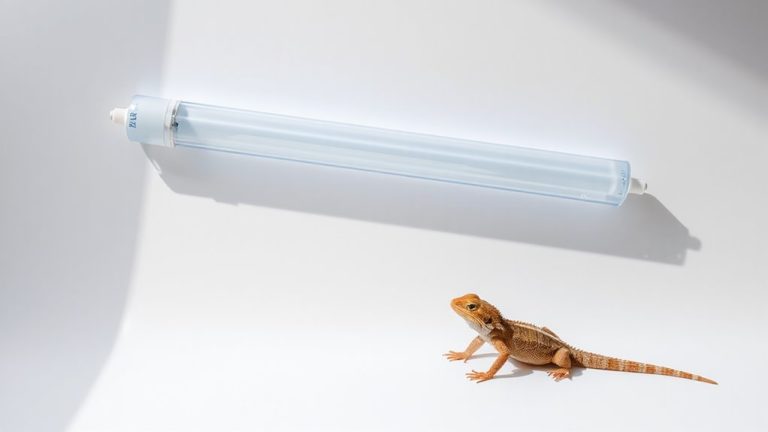
Since not all UVB bulbs deliver the same output, you need to match the bulb type and fixture to your reptile’s species-specific requirements and enclosure setup. T5 fluorescent tubes provide consistent UVB over 3–5 feet and suit tall enclosures; T8 bulbs are less intense and better for shorter distances. Compact coils fit small fixtures but often lack fixture compatibility and degrade faster. Always use a reflective hood to maximize output. Mercury vapor bulbs offer heat and UVB in one unit but require high ceilings and sturdy fixtures. Never use plastic or glass covers-they block UVB. Check manufacturer data for UV index (UVI) at specific distances; diurnal desert species often need UVI 4–6 at basking sites. Bulb lifespan averages 6–12 months; output declines before visible burnout, so replace proactively. Digital UV meters help monitor degradation. Mismatched components reduce effectiveness and risk hypovitaminosis D3.
Set Daily and Seasonal Light Schedules
How does your reptile know when to bask, feed, or rest? It relies on consistent light schedules to regulate its circadian rhythms. You must mimic natural daylight cycles using timers to guarantee 10–14 hours of light, depending on species-specific needs. Most diurnal reptiles require 12 hours of light and 12 hours of darkness daily to maintain proper metabolic and behavioral patterns. Sudden changes disrupt these rhythms, affecting digestion and activity. For seasonal breeding, gradually adjust photoperiods to simulate spring and fall. Reduce daylight by 30–60 minutes over 4–6 weeks to trigger breeding behavior or brumation in species like bearded dragons and leopard geckos. Use full-spectrum lights with UVB output during the day, turning off all lights at night. Avoid constant illumination. Consistent, gradual changes in photoperiod support health, reproduction, and natural behaviors essential to successful reptile husbandry.
Avoid These Common Reptile Lighting Mistakes
Getting the lighting schedule right sets the foundation, but even a perfect photoperiod won’t help if your setup has fundamental flaws. Improper wattage is a common error-it can cause overheating or insufficient basking temperatures. A 50-watt bulb may work for small enclosures, but larger habitats often require 100–150 watts, depending on distance and species needs. You must match wattage to your reptile’s thermal gradient requirements. Incorrect placement also undermines effectiveness. Basking lamps should be 6–8 inches above the perch for ideal heat, while UVB tubes must be within 12 inches of the basking zone. Mesh tops block up to 50% of UVB, so adjust placement accordingly. Fixtures without proper reflectors waste up to 40% of light output. Always use timers and digital thermometers to maintain consistency and accuracy. For bearded dragons, selecting the right heat bulb recommendations is crucial to maintaining proper basking temperatures and overall health.
Lighting Needs by Species: Bearded Dragons, Geckos, and More
While all reptiles require proper lighting, their specific needs vary considerably by species, and using a one-size-fits-all approach can lead to health problems. You must match lighting to your reptile’s natural behavior. Bearded dragons are diurnal and need bright UVA/UVB light-use a 10–12% UVB fluorescent tube for 12–14 hours daily to maintain their diurnal rhythms. Basking temps should reach 100–110°F under a 100W halogen bulb. In contrast, leopard geckos are crepuscular with nocturnal adaptations; they don’t require daytime UVB but still benefit from a low 2–5% UVB source. Provide a thermal gradient with a 70–80°F ambient and a 90°F basking spot. Monitor photoperiods consistently-12 hours light, 12 hours dark-using timers. Improper light cycles disrupt feeding and metabolism. Tailor setup specs precisely; small deviations impair long-term health.
On a final note
Your reptile’s health depends on proper lighting. UVB exposure between 2%–12% output, matched to species-specific needs, enables vitamin D3 synthesis. Maintain a 10–14 hour photoperiod with timers for consistency. Use mercury vapor bulbs for basking zones at 90–110°F or T5 UVB fixtures at 12–18 inches above the substrate. Replace UVB bulbs every 6–12 months. Avoid glass or plastic barriers that block UV transmission.