Best UVB Bulbs for Bearded Dragons That Keep Them Healthy
You need a 10.0 UVB bulb that delivers 4.0 to 6.0 UV Index at the basking site for ideal bearded dragon health. Choose a high-output 23W or 26W spiral CFL or LED, like the LUCKY HERP or MRREPTILE models, to guarantee strong UVB penetration. Place it 10–12 inches above the basking zone, using a reflective hood to boost output by up to 30%. Mesh screens block half the UVB, so adjust distance accordingly. Replace every 6–12 months due to UVB decay, even if the bulb still glows. Premium 5W LEDs offer energy efficiency, but higher wattages suit larger enclosures best. Pick E26-based, ETL-certified bulbs designed for desert reptiles. You’ll find the best results come from matching bulb output to enclosure size and species needs.
We are supported by our audience. When you purchase through links on our site, we may earn an affiliate commission, at no extra cost for you. Learn more. Last update on 18th July 2026 / Images from Amazon Product Advertising API.
Notable Insights
- Choose a UVB bulb with 10% UVB output to meet the high UV requirements of bearded dragons.
- Ensure the basking site receives a UV Index of 4.0 to 6.0 for optimal vitamin D3 synthesis.
- Replace UVB bulbs every 6 to 12 months, as UVB output degrades even if the bulb still lights up.
- Position the bulb 10–12 inches above the basking area, avoiding distances that cause overexposure or insufficient UV.
- Use a reflective hood and pair with a compatible fixture to maximize UVB output and ensure safety.
LUCKY HERP UVB Reptile Light 23W

If you’re shopping for a reliable UVB source tailored to high-demand reptiles like bearded dragons, the LUCKY HERP UVB Reptile Light 23W stands out as a top choice. It delivers 10% UVB output with minimal degradation, maintaining effectiveness for up to 12 months. I recommend replacing it every 6 to 12 months for peak performance. It emits 30% UVA, mimicking desert sunlight and supporting natural behaviors. UVB enables vitamin D3 synthesis, essential for calcium absorption and bone health. With a 90 CRI and full-spectrum light, it enhances color and visibility. It fits standard E26 sockets, runs on 120V, and works in most enclosures.
Best For: Reptile owners seeking a high-output, long-lasting UVB light tailored to species with intense UV requirements like bearded dragons, tortoises, and other desert reptiles.
Pros:
- Delivers stable 10% UVB output with low degradation, lasting up to 12 months for consistent reptile health
- Emits 30% UVA to promote natural behaviors and includes a 90 CRI for vibrant color rendering and visual clarity
- Compatible with standard E26 sockets and operates on 120V, making it easy to install in most enclosures
Cons:
- Requires replacement every 6 to 12 months to maintain optimal UVB output, adding to long-term maintenance costs
- Only available as a 23W compact fluorescent, which may not suit all fixture types or reptile setup sizes
- Limited voltage range (120V only), making it less suitable for international users without adapters
Reptile Heat & UVB Lamp Combo
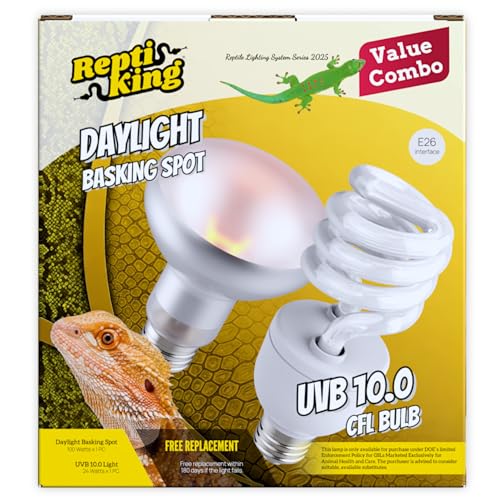
You’ll get the best results from this Reptile Heat & UVB Lamp Combo if your bearded dragon needs a high-output lighting solution that delivers both intense heat and strong UVB exposure. I rely on the 100W basking lamp to maintain proper thermoregulation and digestion. The 24W 10.0 UVB bulb provides essential UVB for vitamin D3 synthesis, preventing metabolic bone disease. It emits UVA to encourage natural feeding and activity. This combo mimics natural sunlight closely. I replace the UVB bulb every 6–12 months, as output declines after 3,500 hours. Both bulbs use E26 bases. ReptiKing guarantees consistent, professional-grade performance.
Best For: Reptile owners seeking a high-output lighting solution for desert species like bearded dragons, tortoises, and chameleons that require strong heat and UVB exposure for optimal health.
Pros:
- Provides both intense heat (100W basking lamp) and strong UVB (24W 10.0 bulb) to support thermoregulation, digestion, and vitamin D3 synthesis
- Mimics natural sunlight with UVA and UVB output while using low-harmful UVC technology to promote natural behaviors and prevent metabolic bone disease
- Reliable E26 base bulbs with professional-grade ReptiKing quality and consistent performance over a 3,500-hour UVB bulb lifespan
Cons:
- UVB bulb requires replacement every 6–12 months to maintain effectiveness, adding to long-term costs
- High wattage may generate excessive heat in smaller enclosures without proper ventilation or thermostats
- Limited suitability for tropical or low-light reptile species that don’t require intense UVB exposure
UVB Reptile Light 10.0 24W

The UVB Reptile Light 10.0 24W is ideal for bearded dragon owners who need strong, consistent UVB output in a compact design. It delivers a 10.0 UVB intensity, critical for desert reptiles like mine. The 24W spiral bulb fits E26 sockets and runs on 120V, making it compatible with standard fixtures. It supports calcium metabolism, preventing metabolic bone disease. I’ve seen improved activity and appetite in my dragon since using it. It’s 80% more efficient than older models and lasts up to 7,000 hours. ETL certified, it’s safe alongside ceramic heaters. Backed by ReptiKing’s warranty, it’s reliable and customer-focused.
Best For: Bearded dragon owners and keepers of desert reptiles seeking a reliable, high-output UVB light in a compact, energy-efficient design.
Pros:
- Delivers strong 10.0 UVB intensity essential for calcium metabolism and preventing metabolic bone disease
- Energy-efficient 80% over older models with a long lifespan of up to 7,000 hours
- ETL certified for safety and compatible with standard E26 fixtures and other reptile habitat lighting
Cons:
- Limited to 120V, making it less suitable for international use without adapters
- Requires replacement every 6–12 months to maintain optimal UVB output despite long lifespan
- Spiral design may not fit well in all reflector domes or tight enclosures
LUCKY HERP UVB Reptile Light Bulb

A compact fluorescent design makes the LUCKY HERP Desert UVA UVB Reptile Light Bulb 10.0 26W ideal for bearded dragons and other desert-dwelling reptiles requiring high-output UVB exposure. It delivers a precise 10.0 UVB output, mimicking midday desert sunlight. The bulb emits ideal UVA and UVB wavelengths, supporting natural behaviors like feeding and breeding. UVB exposure enables proper vitamin D3 synthesis, essential for calcium metabolism and preventing metabolic bone disease. I recommend placing it 10–12 inches above the basking area. Combine it with natural daylight or full-spectrum lighting for best physiological results. It fits most standard fixtures and lasts up to 6 months with daily use.
Best For: Reptile owners seeking a high-output UVB source for desert-dwelling species like bearded dragons that require strong UVB exposure to support health and natural behaviors.
Pros:
- Delivers a strong 10.0 UVB output, ideal for simulating midday desert sunlight
- Supports vital physiological functions including vitamin D3 synthesis and calcium metabolism
- Compact fluorescent design fits most standard fixtures and promotes natural feeding and breeding behaviors
Cons:
- Requires replacement every 6 months with daily use, increasing long-term costs
- Must be placed 10–12 inches from basking area for optimal effectiveness, limiting setup flexibility
- Does not replace natural sunlight entirely-best results require supplementation with daylight or full-spectrum lighting
UVB Reptile Light Bulb 10.0 (2 Pack)

Though many reptile UVB bulbs claim broad suitability, the UVB Reptile Light Bulb 10.0 (2 Pack) delivers targeted performance best suited for desert-dwelling reptiles like bearded dragons, where high-output UVB is non-negotiable. I rely on its 23W spiral compact fluorescent design with an E26 base, operating at 110–130V. It emits stable 10% UVB and 30% UVA-no harmful UVC. Quartz glass guarantees consistent transmission and minimal fading. The bulb supports calcium metabolism and natural behavior. Built with quality circuitry, it lasts up to 10,000 hours and cuts energy use by 80%. It’s ideal for bearded dragons, tortoises, and other sun-loving reptiles.
Best For: Reptile owners with desert-dwelling species like bearded dragons, tortoises, and iguanas that require high-output UVB lighting for optimal health and natural behavior.
Pros:
- Delivers stable 10% UVB and 30% UVA output with no harmful UVC, supporting calcium metabolism and natural activity
- Built with UVB-transmitting quartz glass and quality components for long-lasting performance and minimal UVB degradation
- Energy-efficient 23W spiral compact fluorescent design saves 80% energy and lasts up to 10,000 hours
Cons:
- May not be suitable for low-UVB-requiring or nocturnal species due to high 10.0 UVB output
- Compact fluorescent technology may experience reduced UVB output over time despite long lifespan claims
- Requires replacement every 6–12 months for optimal UVB performance, adding to long-term maintenance costs
REPTI ZOO UVB Light 2 Pack
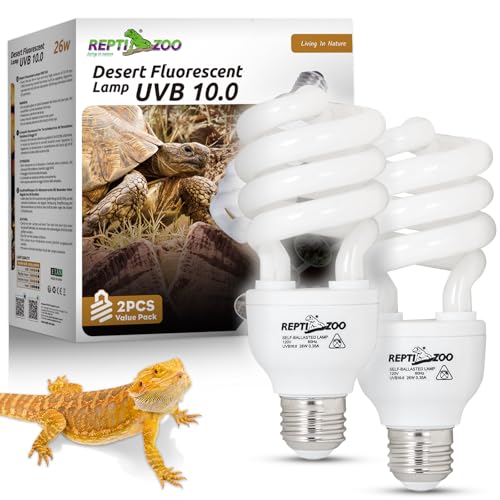
Looking for a reliable UVB solution that delivers consistent performance for tropical reptiles like bearded dragons, tortoises, and chameleons? I rely on the REPTI ZOO UVB Light 2 Pack for steady, high-output UVB. Each 26W spiral bulb emits 5% UVB and 30% UVA, mimicking tropical sunlight. This enables D3 synthesis for proper calcium absorption, preventing metabolic bone disease. The dual-pack design offers backup and extends coverage up to 10,000 hours. Advanced circuitry guarantees flicker-free operation. It fits any E26 socket, works across species, and runs efficiently. Customer support responds within 24 hours-no guesswork, just reliable performance.
Best For: Reptile owners seeking a reliable, long-lasting UVB solution for tropical species like bearded dragons, tortoises, and chameleons.
Pros:
- Dual-pack provides backup and extended lifespan up to 10,000 hours, reducing replacement frequency
- Emits 5% UVB and 30% UVA to support Vitamin D3 synthesis, calcium absorption, and natural behaviors
- Fits standard E26 fixtures, works with multiple reptile species, and features flicker-free, energy-efficient operation
Cons:
- Spiral compact design may not distribute UVB as evenly as linear fluorescent tubes
- Requires replacement after 10,000 hours despite continued visible light output
- May produce slight overheating in small enclosures if not properly ventilated
UVB Reptile Light Bulb 26W 10.0

This 26W 10.0 UVB reptile light bulb delivers high-intensity ultraviolet radiation essential for desert-dwelling reptiles like bearded dragons, making it the top choice for owners serious about preventing metabolic bone disease. It emits 10% UVB and 30% UVA, closely mimicking natural sunlight. The 26-watt fluorescent design guarantees deep UVB penetration across terrariums up to 18 inches. Premium quartz glass maintains stable UV output over time, while advanced circuitry improves efficiency and longevity. Its high brightness supports natural behaviors, including feeding and breeding. I recommend it for bearded dragons, tortoises, and sliders. It’s also gift-ready in decorative packaging.
Best For: Reptile owners seeking a high-output UVB light for desert species like bearded dragons, tortoises, and sliders to support optimal health and prevent metabolic bone disease.
Pros:
- High 10% UVB and 30% UVA output promotes vitamin D3 synthesis, calcium absorption, and natural behaviors
- Premium quartz glass and advanced circuitry ensure stable UV emission and extended lifespan
- Bright, natural-spectrum lighting enhances terrarium visibility and mimics sunlight effectively
Cons:
- Designed specifically for high-UVB-requiring reptiles, making it unsuitable for low-light species
- Effective only at distances up to 18 inches, requiring careful placement
- Higher wattage may necessitate compatible fixtures and increased energy use over time
2 Pack 13W Reptile UVB Bulb

The 2 Pack 13W Reptile UVB Bulb is ideal for bearded dragon owners who need reliable, high-output UVB lighting to support essential physiological functions. It provides critical UVB rays for vitamin D3 synthesis and calcium absorption, preventing metabolic bone disease. UVA output promotes natural behaviors like feeding and mating. The 13-watt CFL bulb has an E26 base for simple installation. It emits no harmful UVC. Each bulb delivers stable UVB/UVA output for up to 10,000 hours. Place it at least 15 cm from your pet. Use it in screened terrariums for desert reptiles. The dual-pack design guarantees backup availability or dual habitat use.
Best For: Reptile owners, especially those with bearded dragons, tortoises, and other desert-dwelling species, seeking reliable, high-output UVB lighting to support health and natural behaviors.
Pros:
- Provides essential UVB for vitamin D3 synthesis and calcium absorption, helping prevent metabolic bone disease
- Dual-pack design offers a spare bulb or allows use in two enclosures for continuous care
- Stable UVB and UVA output for up to 10,000 hours with no harmful UVC emissions
Cons:
- Requires minimum 15 cm distance from reptile, limiting placement flexibility in smaller enclosures
- CFL technology may have slower warm-up time compared to newer LED or mercury vapor options
- Not suitable for reptiles requiring lower UVB exposure, such as some nocturnal or forest-dwelling species
MRREPTILE UVB Reptile Light 13W

A dedicated reptile keeper with desert-dwelling species like bearded dragons knows UVB consistency can make or break long-term health, and the MRREPTILE UVB Reptile Light 13W delivers precise, reliable exposure critical for calcium metabolism. This 13-watt UVB10.0 bulb provides strong, full-spectrum output ideal for species requiring high UVB levels. It uses specialized UVB-transmitting glass to maximize radiation intensity, ensuring effective vitamin D3 synthesis. I’ve found it works well in both horizontal and vertical fixtures, offering setup flexibility. Rated for tropical and desert reptiles, it supports healthy bone development and metabolic function. It lasts longer than standard bulbs, maintaining output over time-critical for long-term husbandry success.
Best For: Reptile keepers with desert or tropical species like bearded dragons, chameleons, and tortoises that require high, consistent UVB exposure for optimal health.
Pros:
- Delivers strong 10.0 UVB output ideal for species with high UVB needs
- Uses UVB-transmitting glass to maximize radiation intensity and effectiveness
- Long-lasting performance with sustained UVB output over time
Cons:
- May provide excessive UVB for low-light species if not properly positioned
- Requires replacement periodically as UVB output eventually diminishes
- 13W may not cover large enclosures without additional lighting fixtures
Premium 5-Watt UVB Reptile Light

I recommend the Premium 5-Watt UVB Reptile Light for bearded dragons and other desert-adapted reptiles that need intense, reliable UVB exposure. It delivers a strong 10.0 UVB output, essential for vitamin D3 synthesis and proper calcium metabolism. This helps prevent and even reverse metabolic bone disease. The bulb mimics UVB levels found in natural desert habitats, making it ideal for bearded dragons and tortoises-but not leopard geckos, which need less UVB. It uses a 5-watt UVB LED, lasts longer than CFLs, and decays slowly, so you replace it less often. It’s also energy-efficient. The E26 base fits standard U.S. fixtures, allowing easy setup with heat lamps. Steady UVB output supports natural behaviors and thermoregulation. For best health, pair it with a separate heat source.
Best For: Bearded dragons, tortoises, and other desert-dwelling reptiles requiring high, consistent UVB exposure for optimal health.
Pros:
- Delivers strong 10.0 UVB output to support vitamin D3 synthesis and calcium metabolism, helping prevent metabolic bone disease
- Long-lasting 5-watt UVB LED with slower output decay and greater energy efficiency compared to traditional CFLs
- Features an E26 base for easy installation in standard U.S. fixtures and pairs well with heat lamps for complete habitat lighting
Cons:
- Not suitable for low-UVB species like leopard geckos, limiting versatility across reptile types
- Requires a separate heat source for proper thermoregulation, increasing setup complexity
- Higher initial cost compared to some standard fluorescent UVB bulbs
Factors to Consider When Choosing a UVB Bulb for Bearded Dragon
You need the right UVB output strength to support your bearded dragon’s vitamin D3 synthesis-look for bulbs offering 5% to 10% UVB, depending on your setup. Match the bulb wattage to your fixture and enclosure size, ensuring it runs efficiently without overheating. Consider lifespan, replacement schedule, fixture compatibility, and proper placement distance to maintain effective UV exposure over time.
Uvb Output Strength
While your bearded dragon basks under its light, the strength of UVB radiation it receives directly impacts its health and well-being. You need a bulb with 10.0 UVB output-delivering 10% UVB radiation-to match your pet’s high exposure needs. This intensity supports maximum vitamin D3 synthesis, which is critical for calcium absorption and prevents metabolic bone disease. At the basking site, UVB must produce a UV Index (UVI) of 4.0 to 6.0, simulating natural sunlight. Higher-output bulbs maintain effective radiation across the enclosure when placed at manufacturer-recommended distances. UVB intensity degrades over time; even if the bulb still glows, output drops substantially after 6 to 12 months. You must replace it within this window to guarantee consistent exposure. Don’t rely on visual cues-schedule replacements to maintain precise, life-sustaining UV levels your bearded dragon depends on.
Bulb Wattage Match
Choosing the right wattage for your UVB bulb directly affects the quality and reach of UVB exposure in your bearded dragon’s enclosure. You need a bulb that matches your tank size and basking distance-typically 13W to 26W for standard setups. Higher wattage bulbs, like 24W or 26W, deliver stronger UVB output, which is critical for your pet’s health. UVB intensity decreases with distance, so a higher-wattage bulb guarantees sufficient radiation reaches your dragon, especially in taller enclosures. A low-wattage bulb in a large tank can’t provide adequate exposure, increasing the risk of metabolic bone disease. Always pair the bulb with a compatible fixture rated for its wattage. Proper ventilation prevents overheating, maintaining stable UVB output. Matching wattage to your setup guarantees effective, reliable UVB penetration across the entire basking zone.
Lifespan And Replacement
A single UVB bulb typically remains effective for 6 to 12 months, even if it continues to emit visible light. UVB radiation degrades over time, reducing your bearded dragon’s ability to synthesize vitamin D3. Most high-quality bulbs last up to 10,000 hours, but output fades gradually-often without visible signs. Even bulbs maintaining 80% energy efficiency can deliver insufficient UVB after six months. This decline increases the risk of metabolic bone disease, a serious condition caused by inadequate calcium processing. Quartz glass and advanced internal circuitry help stabilize UVB output and extend usable life. Still, you should replace the bulb every 6–12 months to guarantee consistent exposure. Don’t rely on brightness alone-use a replacement schedule based on manufacturer guidelines and UVB meter readings, if available. Proactive changes keep UVB levels within the ideal range for your pet’s long-term health.
Fixture Compatibility
Rebuilding your bearded dragon’s UVB bulb on schedule guarantees consistent exposure, but proper fixture compatibility determines whether that light delivers effectively. Make sure the bulb has an E26 base-it’s standard in North America and fits most reptile fixtures. Always check that your fixture supports the bulb’s wattage, especially with compact fluorescents between 13W and 26W, to avoid overheating. Use a reflective hood designed for UVB bulbs; it boosts output by up to 30%, directing more light into the enclosure. Never install a UVB bulb in a fixture rated only for incandescent bulbs-this can shorten lifespan and weaken UV output. Confirm the fixture is labeled for fluorescent or LED UVB use. A compatible setup ensures maximum UVB transmission, mimicking natural sunlight more accurately and supporting your pet’s long-term health.
Proper Placement Distance
While setup specifics vary by enclosure and bulb type, positioning your UVB light correctly is critical for effective vitamin D3 synthesis. Place 10.0 UVB bulbs 10–12 inches above the basking area for ideal exposure. Never place the bulb closer than 6 inches to your bearded dragon-this prevents UVB overexposure and potential eye damage. UVB intensity drops fast with distance, losing up to 50% over 8–10 inches, which directly impacts vitamin D3 production. If your enclosure has a mesh or screen top, expect up to 50% UVB blockage-move the bulb closer to compensate. Always follow the manufacturer’s recommended maximum distance, usually between 12 and 18 inches, based on wattage and UVB output. Proper placement guarantees consistent exposure without hotspots or harmful peaks. Use a UVB meter if possible to verify output at basking spots. Accuracy matters-too far reduces efficacy; too close raises burn and stress risks.
Species Specific Needs
Your bearded dragon depends on the right UVB bulb to maintain critical physiological functions like vitamin D3 synthesis and calcium metabolism. You need a 10.0 UVB output bulb-this delivers 10% UVB and 30% UVA, closely mimicking natural desert sunlight. Without this spectrum, your dragon can develop metabolic bone disease. Run the bulb 10 to 12 hours daily to support circadian rhythms, digestion, and activity. Position it 12 to 18 inches from the basking spot to guarantee maximum UVB irradiance while avoiding photokeratitis or skin damage. Even if the bulb still glows, replace it every 6 to 12 months-UVB output degrades over time. Standard fluorescent tubes or compact coils won’t cut it; use a linear T5 or T8 high-output fixture rated specifically for desert reptiles. Precision matters: consistent UVB exposure keeps your bearded dragon functioning like it would in the wild.
Frequently Asked Questions
How Often Should I Replace My UVB Bulb?
You should replace your UVB bulb every 6 to 12 months. Even if it still emits visible light, the UVB output degrades over time. Most reptile-specific fluorescent and linear UVB bulbs lose 30–50% of UVB intensity by 6 months. Using a Solarmeter 6.5 confirms output levels. For consistent exposure, aim for replacement every 9 months. LED and mercury vapor bulbs last longer but require individual assessment. Regular replacement guarantees proper vitamin D3 synthesis.
Can UVB Bulbs Harm My Bearded Dragon’s Eyes?
Yes, improper UVB bulbs can harm your bearded dragon’s eyes. You risk photokeratitis or cataracts if you use bulbs with excessive UVC emissions or incorrect UV output. Always choose bulbs labeled “UVA/UVB only” with no UVC leakage. Fix the bulb at the correct distance-usually 12–18 inches-using a mesh-free zone. Pair it with a reflector to maximize efficiency and prevent overexposure. Monitor for squinting or lethargy.
Do I Need a UVB Bulb if My Dragon Gets Sunlight?
Yes, you still need a UVB bulb even if your dragon gets sunlight. Window glass blocks 90–100% of UVB rays, making indoor sun exposure ineffective. Direct outdoor sunlight works, but only if unfiltered and supervised. Most owners can’t provide consistent, safe exposure. A quality UVB bulb mimics essential 290–315 nm wavelengths. Use a 10–12% T8 or T5 tube for reliable, measurable output.
Should I Leave the UVB Light on at Night?
No, you shouldn’t leave the UVB light on at night. Your bearded dragon needs a natural day-night cycle. UVB lights should run 10–12 hours daily, then turn off completely. Continuous exposure disrupts circadian rhythms and causes stress. Use a timer for consistency. At night, temperatures drop safely, mimicking desert conditions. Provide darkness for proper rest. No UV or bright light is needed after sunset.
Can I Use a UVB Bulb Without a Mesh Screen?
Yes, you can use a UVB bulb without a mesh screen. Mesh blocks up to 50% of UVB output, reducing your dragon’s exposure. You must mount the fixture inside the enclosure to prevent overheating. Keep the bulb 6–8 inches from your dragon if using a T8, 9–12 inches for a T5. Use a reflective hood to maximize output. Replace bulbs every 6–12 months.